
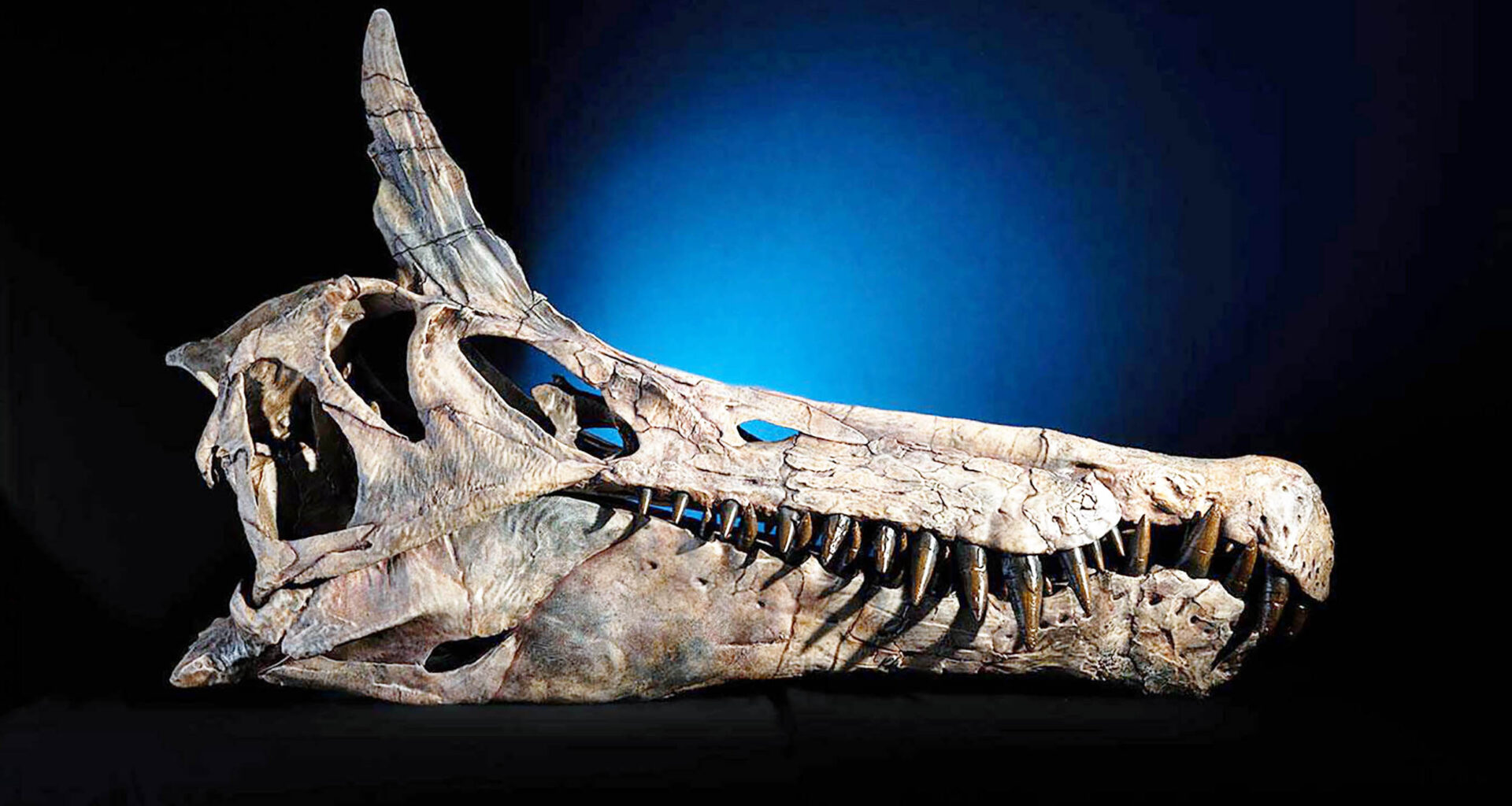
For years, Spinosaurus has been portrayed as a dinosaur built for open-water hunting – a giant predator chasing prey through ancient seas. But new fossils from the Sahara are shifting that story.
Researchers have identified the first new Spinosaurus species in more than a century. Named Spinosaurus mirabilis, it features a towering, scimitar-shaped skull crest and was discovered in sandstone formed by inland rivers – hundreds of miles from any ancient coastline.

The find suggests this massive predator was not an ocean swimmer, but a river hunter that stalked fish in shallow freshwater channels.
Spinosaurus mirabilis in the Sahara
At Jenguebi in Niger, jaw fragments and a blade-like crest emerged from sandstone laid down by ancient rivers.
By assembling those bones into a single skull, Paul Sereno of the University of Chicago demonstrated that the crest belonged to a previously unknown species within Spinosaurus.
Two additional crests uncovered at the same locality confirmed that the unusual anatomy was not an isolated deformity but a defining trait.
That concentration of evidence at one inland site anchors the species in a riverine setting and sets the stage for reexamining how these dinosaurs lived.
A skull built for show and fishing
One paper named the animal Spinosaurus mirabilis, the first new species of Spinosaurus since 1915, and focused on its towering crest.
At roughly 20 inches (about 50 centimeters) tall, the scimitar-shaped crest showed grooves and inner canals that pointed to keratin, the tough protein found in hair and nails. Bright color remains speculative, but such a tall midline signal could have helped individuals recognize rivals or mates quickly from a distance.
Because display structures rarely fossilize cleanly, the crest may ultimately reveal more about social behavior than day-to-day hunting.
Along the jaws, however, the evidence shifts from show to survival. Tooth rows met in interdigitating fashion, with upper and lower teeth locking between each other. When the dinosaur snapped at a fish, the outward-leaning lower teeth filled gaps in the upper row.
Spaced teeth and a long, narrow snout also left room for struggling prey, limiting the chance of escape. That dental setup suggests big fish were not an occasional meal, but a regular part of the diet.
Spinosaurus mirabilis in rivers
The fossils came from fluvial rocks formed by rivers and moving water, roughly 300 to 600 miles (about 480 to 965 kilometers) inland. Nearby, partial skeletons of long-necked giant plant-eaters lay in the same beds, pointing to a shared river plain environment.
Today the site is desert, but the rock record preserves signs of broad channels and wet ground beneath ancient trees. That inland setting makes it harder to picture Spinosaurus as an open-ocean pursuit hunter.
For years, debate centered on whether Spinosaurus swam after prey or waited in shallows with its feet planted. One earlier study argued that the tail of Spinosaurus aegyptiacus could propel the animal through water.
The new inland fossils add a second line of evidence. A full-time ocean swimmer would not depend on landlocked river systems. Wading still means wet hunting, but the picture now narrows to shorelines and shallow, waist-deep freshwater rather than open seas.
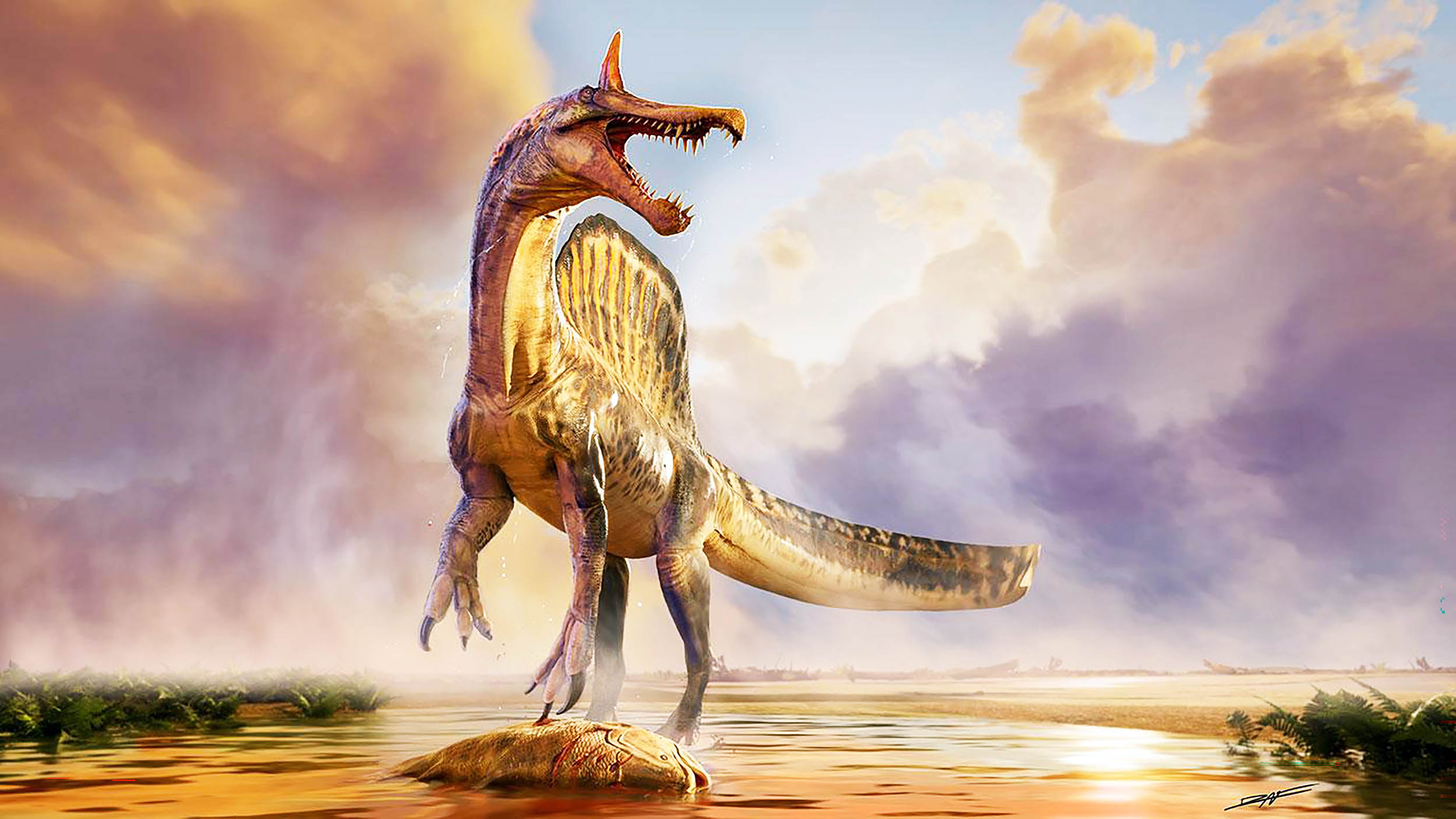 In an artist’s recreation, ‘Spinosaurus mirabilis,’ nicknamed the “Hell-heron.” stands along the river’s edge over its prey some 95 million years ago. A scimitar-shaped head crest and interlocking teeth characterize this wading giant, one of the last-surviving spinosaurid species. Credit: Dani Navarro. Click image to enlarge.Rise and fall of fish specialists
Across their family tree, spinosaurids – long-snouted dinosaurs adapted for eating fish – did not appear all at once. Early members developed narrow snouts and modest crests, while later branches evolved more distinct skull designs.
Over time, these predators spread across northern coastlines and river systems, often ranking among the top regional hunters. Near the end of their lineage, the branch that included Spinosaurus mirabilis grew enormous and highly specialized – a powerful strategy, but also a risky one.
Around 95 million years ago, sea levels rose rapidly enough to redraw waterways across northern Africa. Higher water and shifting climates likely squeezed the shallow river habitats these fish specialists relied on.
In the new paper, Sereno and colleagues linked that environmental upheaval to the decline of spinosaurid diversity. Specialization can be an advantage – until the landscape changes faster than a body plan can adapt.
Digital dinosaur detective work
Back in Chicago, the real detective work began. What looked like scattered desert fragments had to be turned into a single, readable skull – and that’s where modern imaging stepped in.
Instead of physically cutting or reshaping the fossils, researchers ran them through CT scans, an advanced X-ray technique that creates thin, slice-by-slice images of an object’s interior.
That process allowed the team to see inside each bone and map every fragment without damaging it.
At the University of Chicago, those scans revealed matches that weren’t obvious to the eye. Pieces that seemed unrelated suddenly locked together in the digital model, transforming a box of scraps into a reconstructed skull.
The 3D files also made collaboration easier. Researchers could share models, rotate fragments on screen, and test different fits remotely – bringing a 95-million-year-old predator back into focus, one virtual slice at a time.
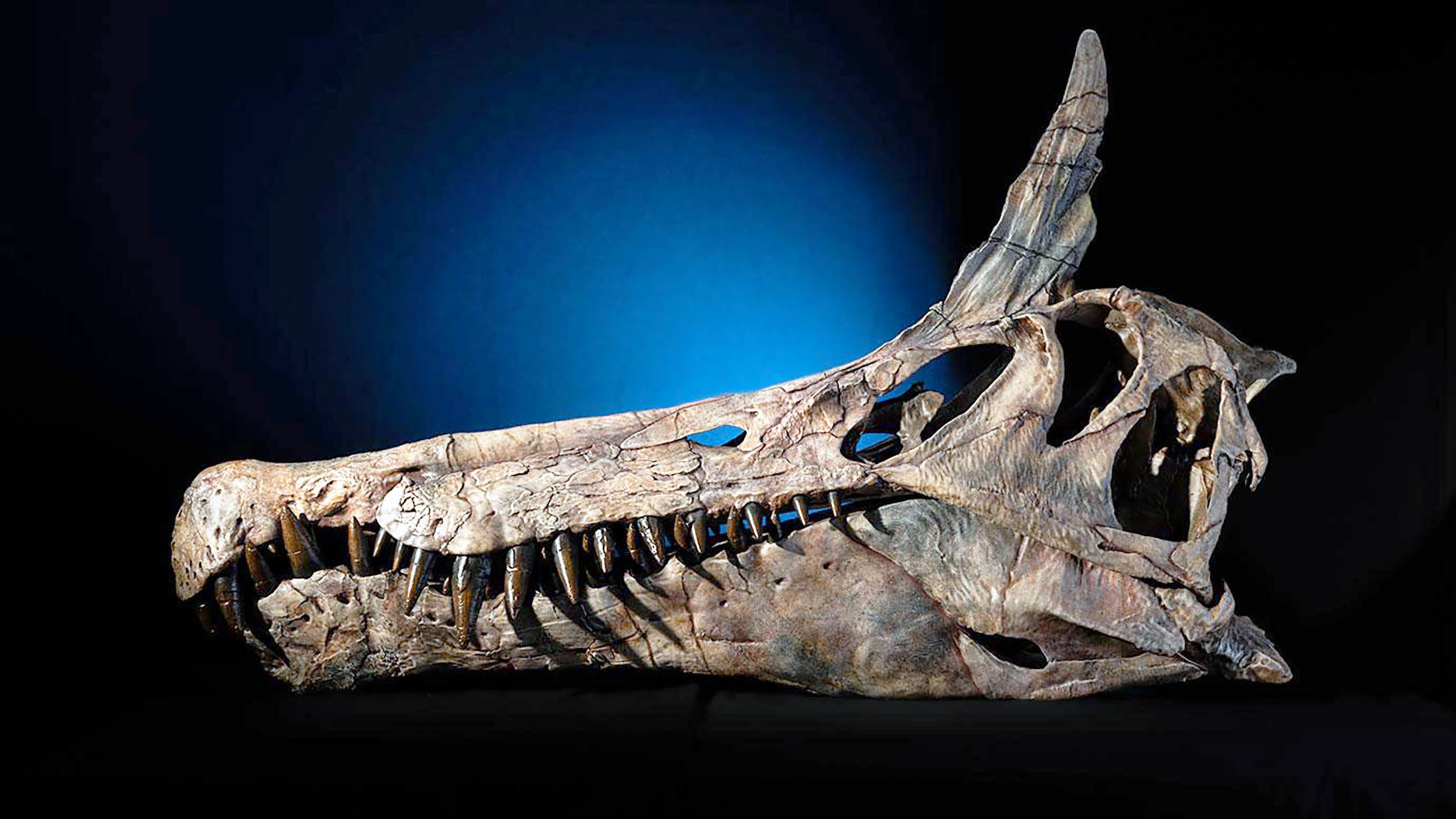 Skull cast of the new scimitar-crested spinosaurid “Spinosaurus mirabilis,” nicknamed the “Hell-heron.” Photo by Keith Ladzinski. Click image to enlarge.From lost tooth site to river hunter
A forgotten line in a 1950s monograph sent Paul Sereno back into Niger’s deep sand seas in search of a mystery that had lingered for more than seven decades. “No one had been back to that tooth site in over 70 years,” Sereno said.
Guided by a Tuareg scout on a motorbike, the team retraced the route to Jenguebi, where teeth and jawbones lay exposed in the desert. What began as a return trip to a long-abandoned location soon became something more.
Sereno later described the expedition as a grueling push across sweeping dunes that carried the group past the original site and into an even more remote fossil field – the place where the new species finally emerged.
The discovery did more than fill a historical gap. New evidence from a skull, a display crest, and inland river rocks now pulls Spinosaurus mirabilis back toward a wading ambush lifestyle rather than a fully open-water pursuit.
While more complete skeletons could still refine the picture, the Niger fossils give fresh weight to the idea that this giant predator hunted along rivers, stalking prey in shallow channels instead of roaming the sea.
The study is published in Science.
—–
Like what you read? Subscribe to our newsletter for engaging articles, exclusive content, and the latest updates.
Check us out on EarthSnap, a free app brought to you by Eric Ralls and Earth.com.
—–