
Staff reporter
Updated February 26, 2026 — 4:36pm,first published February 26, 2026 — 4:16am
Save
You have reached your maximum number of saved items.
Remove items from your saved list to add more.
Save this article for later
Add articles to your saved list and come back to them anytime.
Got it
AAA
The Australian sharemarket has continued its record-breaking run, extending its rally on Thursday after Nvidia, the US chipmaker at the heart of the artificial intelligence revolution, posted results that beat Wall Street expectations, soothing concerns about the AI boom.
The S&P/ASX 200 rose 47 points, or 0.5 per cent, to 9175.30, a new all-time high, with technology shares again driving the advance. The gains came after the ASX jumped 1.2 per cent on Wednesday. The Australian dollar was trading at US71.29¢ at 4.22pm AEDT.
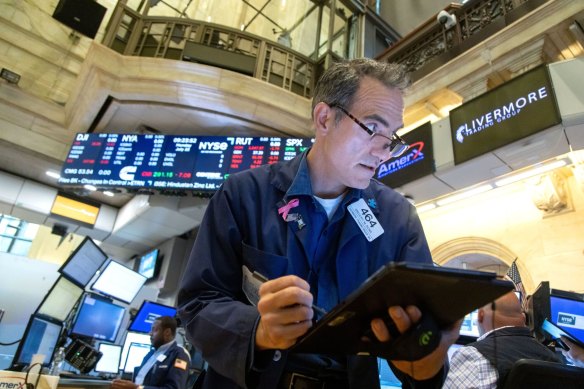 Markets were awaiting the latest results from Nvidia, which dropped after the closing bell in New York. Its profits didn’t disappoint.Bloomberg
Qantas shares climbed as much as 4.1 per cent in early trade, before plunging 9.2 per cent into the red. The airline reported record half-year earnings of $1.46 billion as less fuel-hungry Airbus planes are increasingly replacing its ageing domestic fleet. While the result came in slightly above analysts’ expectations, Josh Gilbert from eToro said the improvements were mostly thanks to the new aircraft, while travel demand, especially on flights to America, was starting to look a “little worrying”.
In other earnings news, fund manager Perpetual jumped 8.3 per cent after reporting a rebound in first-half net profit to $53.9 million, an increase of more than $40 million from the same half last year, when its profits were hit by significant items.
Super Retail shares rallied 8.4 per cent after the company posted a 4.2 per cent lift in half-year sales to $2.2 billion, even though statutory profits fell 19.8 per cent. Its Macpac stores saw the greatest growth of Super Retail’s four brands, lifting sales by 13.1 per cent, followed by Supercheap Auto, which grew 5.1 per cent. Rebel’s sales gained 4.8 per cent, while BCF lifted 0.3 per cent.
Related Article
Hospital operator Ramsay Health Care rallied 10.4 per cent after saying its underlying first-half net profit rose 9.1 per cent.
Mining stocks also advanced after iron ore prices climbed overnight. BHP set a fresh record yet again, climbing 2.2 per cent to $57.75. Rio Tinto gained 3.7 per cent. Lynas Rare Earths added 1.2 per cent after reporting a jump in production, sales and profit for the December half.
Lithium miners rose after Zimbabwe, one of the world’s top producers, suspended concentrate exports, fuelling fears that supplies of the battery ingredient will tighten. Lithium prices have nearly doubled since November. Local producers PLS Group and Mineral Resources gained 8.3 per cent and 4 per cent, respectively.
But it was tech shares that once again powered the rise on the local market. The sector soared 5.5 per cent, tracking gains in US tech stocks. Software maker WiseTech Global, which on Wednesday said it would slash about a third of its workforce as developers are being replaced by AI, rose 2.6 per cent. Accounting software makers Xero and TechnologyOne finished up 8.6 per cent and 6.4 per cent, respectively, and AI data centre operator NextDC added 2.4 per cent.
On the losing side, BlueScope Steel shares fell 2.3 per cent after its board knocked back this month’s sweetened $14.2 billion takeover bid by Kerry Stokes’ business conglomerate SGH and its US bidding partner Steel Dynamics as too low. The offered $32.35 cash price “does not adequately address our valuation concerns”, its chair Jane McAloon wrote in a letter to the bidders.
Yancoal slumped 8.4 per cent, pulling down the energy sector. The coal producer said on Wednesday its profit fell by more than half last year as prices for the fossil fuel declined.
Online luxury retailer Cettire plummeted 25.6 per cent after shocking investors with a $1.1 million loss in the December half as it was hit by softer demand for upmarket brands and uncertainty over Donald Trump’s trade tariffs. Its auditors Grant Thornton warned there was “material uncertainty that may cast significant doubt on the group’s ability to continue as a going concern”.
On Wall Street overnight, US stocks rose and erased their losses for the week so far, as bullish profit expectations for Nvidia boosted technology stocks. The AI chipmaker, which has become the US market’s largest stock by value, didn’t disappoint when it released its results after the closing bell – however, with expectations running sky high, it got a tepid investor reaction to its forecasts.
Nvidia’s fiscal fourth-quarter sales surged 73 per cent from the previous year to $US68.1 billion ($95.7 billion) while profit nearly doubled to about $US43 billion. It also flagged roughly $US78 billion in revenue this quarter, when analysts were seeing less than $US72.3 billion. Its shares, up 1.4 per cent during the session, edged up just another 0.2 per cent in after-hours trade.
The stock had helped push the S&P 500 up 0.8 per cent for a second straight gain after Monday’s rout, when shares dropped as investors tried to separate losers from winners in the AI boom. The Dow Jones Industrial Average rose 0.6 per cent, and the Nasdaq composite climbed 1.3 per cent.
Nvidia’s profit reports have become a bellwether for global markets, not only because it’s so big but also because of how influential the AI boom has broadly become over their moves. In past years, the AI frenzy helped stocks run to record after record amid hopes that it would revolutionise the economy and make it more productive.
More recently, though, concerns have climbed about whether companies like Alphabet and Amazon are spending so much on chips from Nvidia and other equipment that they’ll never be able to make back the investments through future gains in productivity. If that leads to a pullback in spending, it would hit Nvidia directly. The chipmaker’s latest report helped alleviate such near-term worries.
“Our customers are racing to invest in AI compute – the factories powering the AI industrial revolution and their future growth,” chief executive officer Jensen Huang said.
Related Article
Investors have also begun focusing on companies and industries that could get undercut by AI-powered competitors, selling off stocks seen as potentially under threat, and spasms have rolled through industries as seemingly disparate as software, trucking logistics and legal services.
That’s on top of other worries already weighing on the market, including new tariffs announced by US President Donald Trump to replace ones struck down by the Supreme Court.
“While those concerns are real, we believe investors would be wise to balance them out with offsetting trends that may be underappreciated in the current wall-of-worry headline cycle,” said Darrell Cronk, chief investment officer for Wealth & Investment Management at Wells Fargo.
Among them is the solid growth in profit that US companies have been reporting so far for the end of 2025. That has helped strengthen corners of the US sharemarket that had earlier been overshadowed by AI mania and Big Tech, including stocks of smaller companies.
Save
You have reached your maximum number of saved items.
Remove items from your saved list to add more.
From our partners