
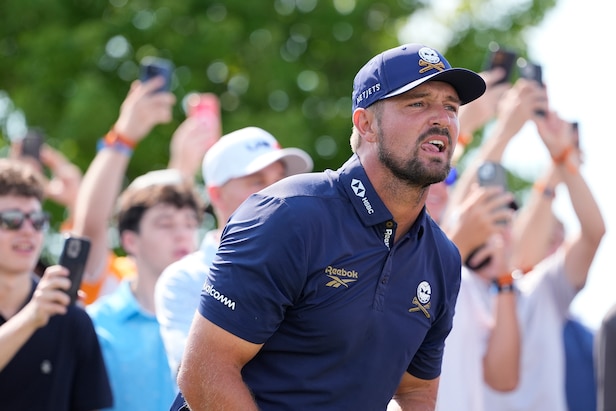
[Photo: Patrick McDermott]
When Bryson DeChambeau and LA Golf first announced their partnership in 2018, the message was clear: this wasn’t a typical tour player deal. LA Golf founder Reed Dickens described DeChambeau as “an ideal partner for our mission to bring the technically advanced shafts used by the pros directly to golfers”.
RELATED: Bryson DeChambeau posts cryptic message regarding his pro golf future
The company was attempting to align with a player whose analytical approach and engineering curiosity seemed uniquely suited to its ambitions.
That partnership was rooted in collaboration. DeChambeau helped LA Golf develop a custom putter shaft as one of the first projects under that umbrella, and the idea was to build more signature products together and extend that technology to everyday players.
Fast forward to today, and that relationship has come to an end.
According to a Golf.com report, DeChambeau – who owned a 2 percent minority stake in the company – sought to increase his equity to a controlling 51 percent. When Dickens declined, the two sides agreed to part ways. (DeChambeau was contacted for comment by Golf Digest but did not respond by the time of publication.)
“I think the guy doesn’t realise that he’s dealing with a redneck,” Dickens told Golf.com. “And I say, ‘There’s no path for that.’ They played chicken with me, and now we’re going to graciously part ways.”

On its surface, this sounds like a straightforward business disagreement. But it also reflects a deeper dynamic that has followed DeChambeau throughout his career: his equipment relationships are intense, highly technical and – at times – difficult to sustain.
Case in point: LA Golf’s Face ID driver was designed with specific feedback from DeChambeau – it should be noted he never used the driver in competition – on the face’s bulge (heel-to-toe radius) and roll (crown-to-sole radius) to match a player’s swing speed and ball flight.
That kind of engineering is expensive. It demands time, resources and repeated testing. Working at the extreme edge of speed and consistency can yield insights that benefit broader product lines – much like high-end automotive or aerospace research – but only if those learnings translate into products that golfers actually buy.
For LA Golf and Cobra, his previous equipment manufacturer, both found it difficult to create products for DeChambeau that had broad appeal in the marketplace, outside of a brief run for Cobra’s single-length irons.
DeChambeau’s previous split with Cobra Golf felt eerily similar to the split from LA Golf. After years of collaboration and highly publicised equipment development, the relationship ended following a very public critique of a driver. It highlighted the same tension between tour-level demands and a company’s broader product strategy.

The timing of the split is also notable for another very important reason. It comes as LA Golf is in the middle of a reported strategic shift – one that could re-shape the company’s identity as much as any ambassador departure.
Industry chatter in recent weeks has suggested LA Golf is moving aggressively toward a direct-to-consumer model and significantly reducing staff. Jeff Meyer, the company’s chief design officer, confirmed the pivot to a 100-percent DTC approach but pushed back on the notion of widespread layoffs.
“LA Golf has decided to sell our products 100 percent DTC,” Meyer told Golf Digest. “There will be new products launched soon, including new putters, irons and fairway woods to allow consumers to buy all 14 clubs from LA Golf. We have had a couple of employees resign due to the new direction, however no one has been let go.”
The shift represents a meaningful change. For years, LA Golf built its reputation primarily as a premium shaft manufacturer, supplying products that often found their way into other companies’ clubheads. Moving fully into assembled clubs – and selling exclusively direct – signals an effort to control everything from product development to the customer relationship.
The transition, however, raises a host of questions about what consumers can actually expect in the near term. At present, LA Golf’s official website directs visitors to a landing page featuring an AI-generated image of a bag drop alongside the tagline, “The last set of clubs you’ll ever have to buy.”
Beyond that, the page offers only an e-mail sign-up to track future product launches – there are no current offerings, not even the clubs that were sent for 2026 Hot List testing.
“It’s been Reed’s vision for years to own the relationship with a customer, and DTC is the only way to do that,” Meyer said. “Now that we are going to have a full bag of fully assembled golf clubs, it doesn’t make sense for us to sell shafts to support other brands’ heads.
“In spite of all the rumours and noise, we have some other big announcements coming later in the year, so stay tuned.”
If the strategy holds, LA Golf won’t just be competing in the high-end shaft space – it will be positioning itself as a full-bag equipment company selling directly to consumers. That’s a different business model, different margin structure and different competitive landscape.
Against that backdrop, the departure of DeChambeau lands at an inflection point. As the company narrows its focus and reshapes its go-to-market strategy, it’s also redefining how – and with whom – it builds the brand moving forward.