
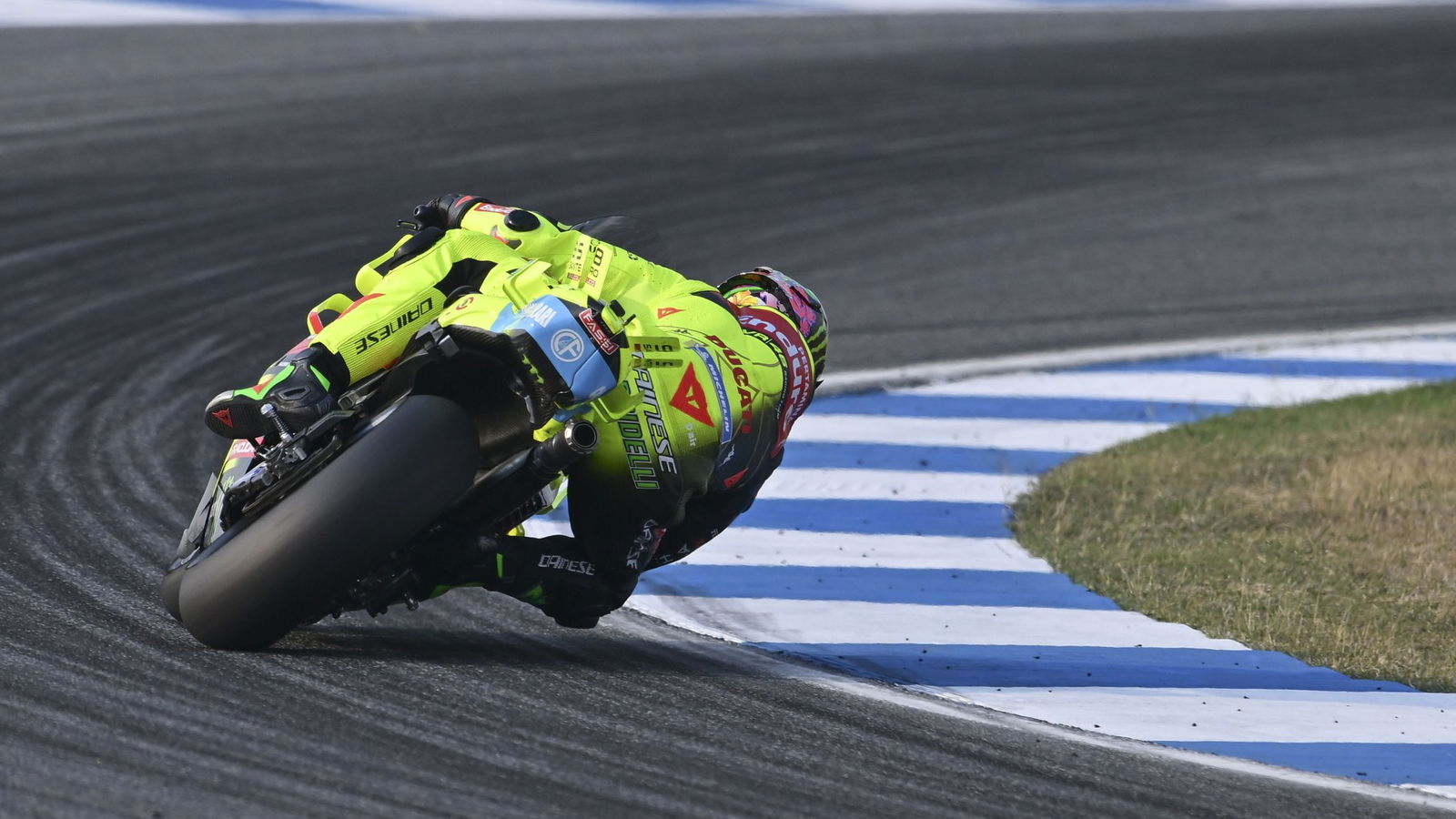
The FIM MotoGP stewards panel has released its penalty protocol for the 2026 season concerning how it judges various incidents.
The FIM MotoGP stewarding panel is once again being helmed by ex-racer and television pundit Simon Crafar, who took over the role last year.
For the most part, Crafar’s stewarding was met with praise from the riders for its balanced approach.
Ahead of the 2026 Thailand Grand Prix, the penalty protocol document for the season has been released.
Below is a full explanation from the document.
Article continues below ADVERTISEMENT
Article continues below ADVERTISEMENT
Slow riding on the racing line
“The stewards have a long-established protocol for slow-on-line incidents, which is regularly discussed with teams and the riders’ safety commission.
“The current protocol is that Q1 and Q2 incidents resulting in a clear disadvantage to a competitor almost always result in a penalty unless there are clear extenuating circumstances.
“The final 20 minutes of Practice (for MotoGP) and the final 10 minutes of Practice (for Moto2 and Moto3) are judged similarly regarding rider entry to Q2.
“Similar incidents in the earlier stages of FP1 and FP2 are assessed on a case-by-case basis.
Article continues below ADVERTISEMENT
Article continues below ADVERTISEMENT
“As a guideline for these instances, riders will initially receive warnings for first offences but penalties will be issued and then escalated for multiple offences during the season.
“This protocol is designed to punish serious offences that affect another rider, and to ensure that minor incidents with no safety or performance consequences do not take precedence for riders nor officials. Not every incident on track requires the stewards’ intervention, with focus always given to safety, fairness, consistency, and common sense.
“Any incidents causing safety issues are immediately and independently punished.
“The circumstances of incidents are almost never exactly the same. Therefore, as always, the Stewards reserve the right to adjust the above protocols where necessary to fit the circumstances in exceptional cases.”
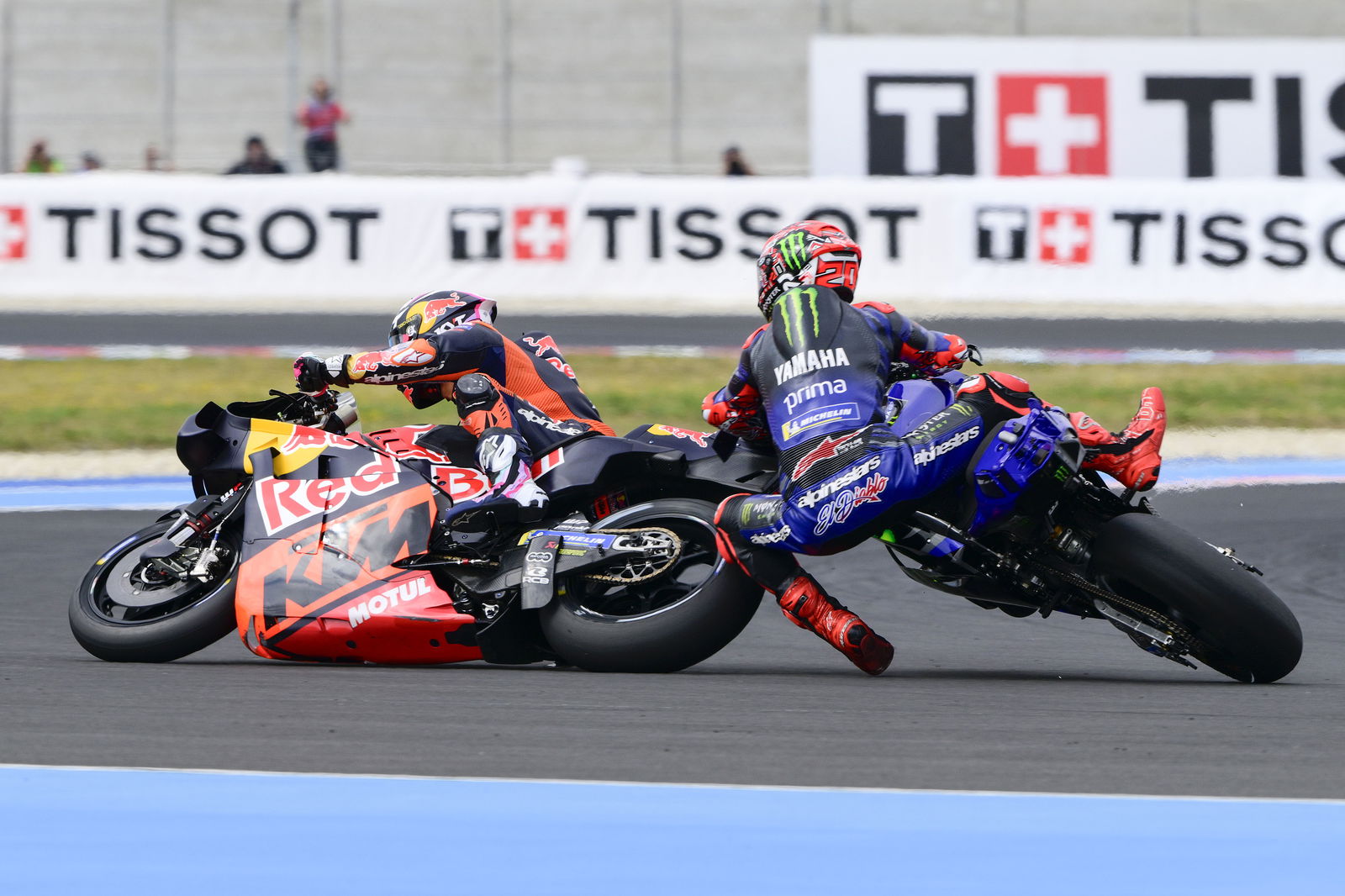
Fabio Quartararo, Enea Bastianini, 2025 Hungarian MotoGP
© Gold and Goose
Article continues below ADVERTISEMENT
Article continues below ADVERTISEMENT
On-track incidents
“The stewards have a long-established protocol for incidents between riders that result in contact or a crash, which is regularly discussed with riders and teams during briefings, hearings, and at the safety commission.
“If the Stewards consider that an overtake was not overly ambitious, then it will be deemed a racing incident and there will be no penalties. This applies to all classes.
“There are incidents which involve close racing and some contact between riders. There is always a line where some overtaking moves that include bumping or contact become too aggressive and positions can be unfairly gained. The stewards will review these incidents and depending on the severity, riders may receive position penalties or a long lap penalty.
“For instances where the stewards consider an incident that results in another rider being taken out of the race to be overly ambitious, and/or with little or no chance of making an overtake safely, riders will be penalised.
Article continues below ADVERTISEMENT
Article continues below ADVERTISEMENT
“Penalties may be escalated for riders who continue to repeat these offences during the season.
For instances where the Stewards deem an incident that results in another rider being taken out of the race to be an unfair or unsafe manoeuvre, creating a strong collision with no chance of making an overtake safely, riders will be more severely penalised.
“As a guideline, MotoGP and Moto2 riders will receive double long lap penalties, with Moto3 riders receiving a double long lap or Pitlane start.
“These penalties will be escalated for any repeat offences during the season.
“The stewards treat incidents at the race start and particularly the first turn and on the opening lap more severely. As a guideline all classes will receive double long lap penalties, and as always penalties may be escalated for repeat offences during the season.
Article continues below ADVERTISEMENT
Article continues below ADVERTISEMENT
“Yellow panels/flags are enforced, during practice riders must slow down and use caution, during the race overtaking is forbidden. Crashing under yellow signals is considered irresponsible and not using sufficient caution, and will be penalised, however consideration is given to circumstances, such as debris or oil on track.
“Practice starts must be made according to the published protocols and regulations, and unsafe practice starts may be penalised.
“As a guideline, the standard penalties for unsafe practice starts are grid penalties or long lap penalties.
“The circumstances of incidents are almost never exactly the same. Therefore, as always, the Stewards reserve the right to adjust the above protocols where necessary to fit the circumstances in exceptional cases.”
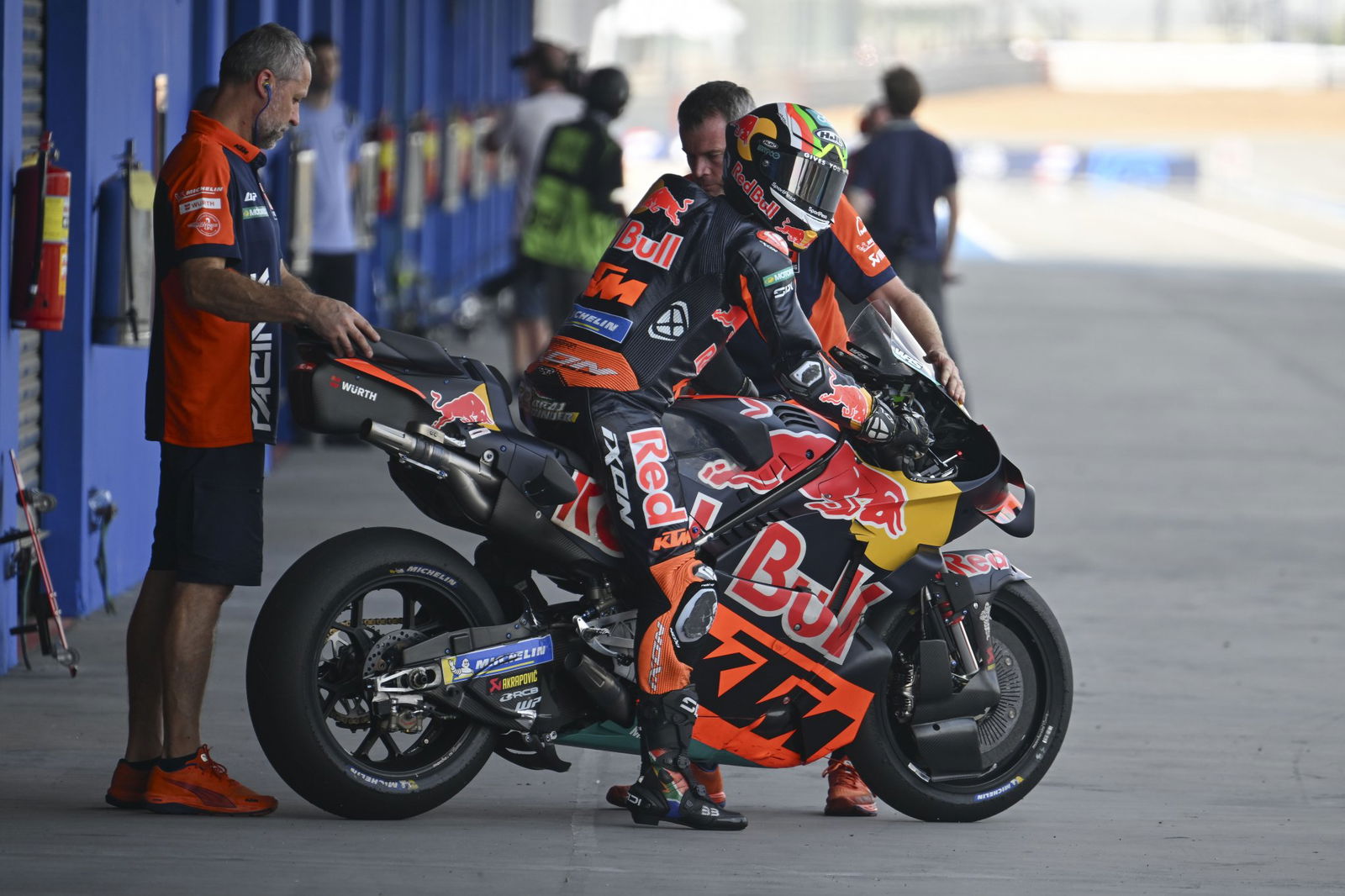
Brad Binder, KTM Factory Racing, 2026 Buriram test
© Gold and Goose
Article continues below ADVERTISEMENT
Article continues below ADVERTISEMENT
Serving a penalty
“The philosophy that the FIM MotoGP stewards follow for the application of a penalty is that penalties must be effective and that the rider must serve the penalty at the next event of the championship where the rider participates in, even if it’s at the next season of the championship.
“However, if the rider does not participate in or complete the next event due to a subsequent and unrelated injury or illness or other problem (not suffered during the penalised incident itself), then the penalty is deemed to have been served and does not get postponed to subsequent events. A cancelled race is not counted when determining the ‘next event’.
“If the rider does not participate in the applicable race (or sprint) at the next event for any reason specifically related to this penalised incident, the penalty shall be served at the next championship event in which the rider participates.
“Medical judgements are and must continue to be independent from disciplinary decisions. This exception for unrelated illness, injury or problem is for two reasons; the stewards deem that missing a race is a higher penalty than the penalty imposed (e.g. long lap), and to avoid the situation that happened in the past where riders have started a race whilst injured with the sole purpose of completing the penalty, thereby endangering themselves and others.”
Article continues below ADVERTISEMENT
Article continues below ADVERTISEMENT
Penalty severity between classes
“For similar infractions, the Moto3 class will receive more severe penalties for the same infractions as the MotoGP & Moto2 class. This is for two reasons.
“One, to set a precedent for young riders and ensure the, often higher, number of first-time competitors in the Grand Prix paddock are taught the riding standards expected and required of them.
“Two, due to the nature of Moto3 racing, some penalties do not impact a rider’s race as much as in the senior classes.
“Penalties are given out to impact a rider’s race and should act as a deterrent for incorrect behaviour. Moto3 riders will therefore receive more severe penalties in order to create the same impact on their race as other penalties do for the intermediate and premier classes.”
Article continues below ADVERTISEMENT
Article continues below ADVERTISEMENT
MotoGP sprints
“Following the principle that the grand prix on Sunday is the main MotoGP race, almost all disciplinary penalties are served in the GP race and not the sprint.
“However, the Stewards may impose penalties during a sprint for infractions during that same
race.
“Penalties for track limits, jump start and technical infringements will be served in the sprint, however, with some different criteria as detailed in FIM MotoGP regulations.”
Article continues below ADVERTISEMENT
Article continues below ADVERTISEMENT
Subscribe to our MotoGP Newsletter