
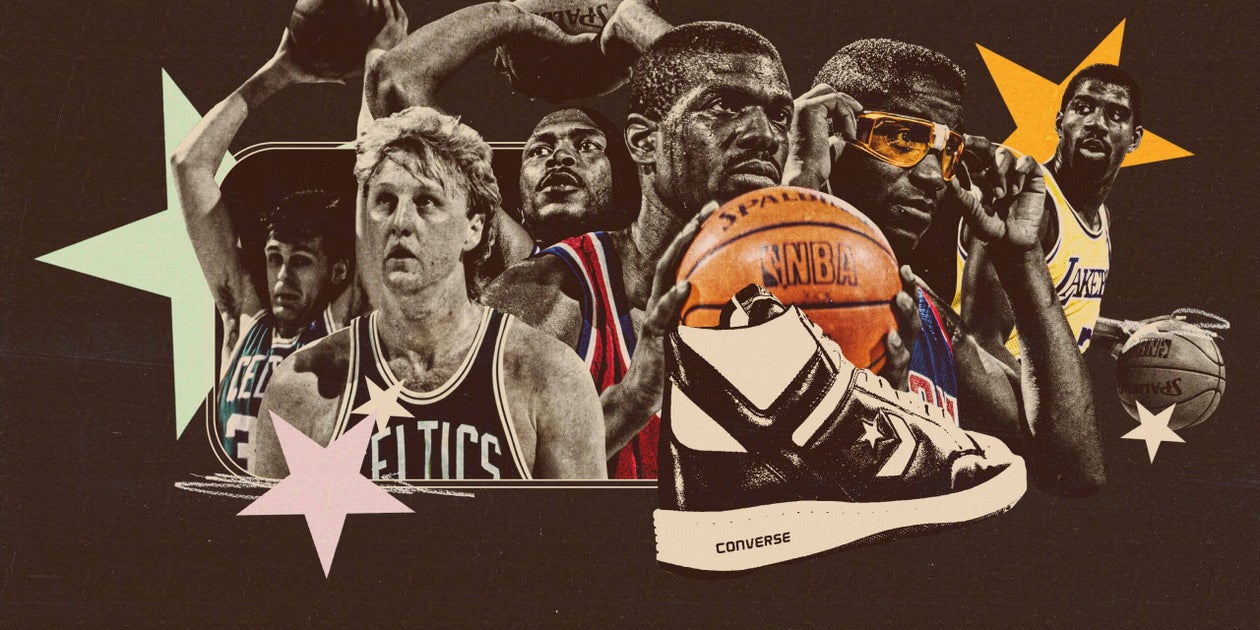
Rap was still a relatively new genre of music 40 years ago. So young that it was considered groundbreaking when Converse incorporated it into a commercial with some of the biggest stars in the NBA.
The “Choose Your Weapon” commercial — featuring six of the NBA’s biggest stars in Magic Johnson, Isiah Thomas, Kevin McHale, Mark Aguirre, Bernard King and then-reigning MVP Larry Bird — debuted the Converse Weapon basketball shoe in multiple colorways in 1986. Each player delivered two bars in a commercial then viewed as a bit … edgy?
Even if the content wasn’t explicit, the newness made some apprehensive, since rap music had only been around roughly 13 years.
“Rapping was so young,” said Aguirre, a three-time NBA All-Star with the Dallas Mavericks and a two-time league champion with the Detroit Pistons, one of the players in the commercial. “We didn’t know what we were doing. … We were just putting this together.”
The commercial also included Thomas, King, McHale, Johnson and Bird rapping about what the Weapon did for their respective games. It’s one of the first times a major brand incorporated the emerging hip-hop culture into basketball advertising.
“That was a big change for the sports world that they would choose rap in order to be a go point,” Aguirre said. “That was a big change, big change.”
There have since been several instances of basketball culture and hip-hop culture merging for advertising. Reebok paired rap star Jadakiss with Allen Iverson for a now-iconic Answer 5 shoe commercial in 2001 — and followed with a commercial for the Answer 6 the following year.
Nike has incorporated hip-hop elements in commercials for years. From pairing Kobe Bryant with Kanye West to having Tyler, The Creator and Doechii narrate commercials last year, Nike has leaned heavily into hip-hop at times for its marketing.
The rap-basketball crossover isn’t limited to sneakers. Such an example is the 1998 Sprite commercial that featured Bryant, Tim Duncan and rap legend Missy Elliott.
But infusing the rap game into ads wasn’t the norm 40 years ago. Run-DMC was a trailblazer by becoming the first rap group with a sneaker deal when they signed with Adidas in 1986. Now, sneaker brands collaborate with rappers routinely for commercials and their own shoes and apparel.
But the Converse Weapons commercial was different because it featured active players rapping. The commercial was an acknowledgement the new genre was more than a fad and was becoming ingrained in culture.
Converse hired Boston-based advertising agency Ingalls, Quinn & Johnson to produce the ad. The ad agency, acquired by Holland Mark in 1999, was shut down in 2001.
Converse was the preeminent basketball shoe brand at the time. The Weapon was the latest release from Converse, which had been a sponsor of the 1984 Olympics. At the end of the commercial, at the bottom of the screen, one might notice, “Converse is the official shoe of the NBA.”
That commercial debuted during All-Star Weekend in 1986 at a time when Nike was making a push in the sneaker industry with Michael Jordan and the Air Jordan. Converse featured its biggest stars for the commercial, with the idea of highlighting the talent on its roster.
“That was kind of like a player’s shoe,” said Chris Chase, co-founder of WearTesters, which reviews shoes. Chase has also researched several shoes, including the Weapon.
“Even at the end of the ad, it was really cool to see it be like, this is what professional players are choosing as their weapon, which was the whole purpose,” Chase said. “They were kind of, like, trying to stay away from that signature, but they were definitely making player team edition-like colorways.”
Bird and Johnson were arguably the game’s biggest stars at the time. Johnson was coming off his third NBA championship with the Los Angeles Lakers in 1985. Bird was on his way to winning a third consecutive MVP and his third championship with the Boston Celtics in ’86.
McHale was one of the league’s best post players and had won back-to-back Sixth Man of the Year awards (1984, ’85) and was on the verge of his third championship that season with Bird.
King was an elite scorer who led the NBA in 1984-85 with 32.9 points per game for the New York Knicks. Aguirre was the No. 1 pick in the 1981 draft who’d make three All-Star teams and would eventually join Thomas as part of the Bad Boy Pistons and win back-to-back championships. Thomas is perhaps the best small guard in league history and was emerging as a threat to the Celtics by 1986.
“I think they built it around the fact that all of us were Converse All-Star people,” Aguirre said. “Converse was being sold, so they wanted to get us under a contract before Converse got sold. That was the idea, so we were all good for it.”
Converse was sold to Interco in August 1986.
Aguirre said previous ads he’d been involved in were more straightforward. There was a product. He said who he was, a few words about what the product was, and that was it.
Aguirre mentioned he didn’t remember who wrote the lyrics, but he said it didn’t take long for the six NBA stars to catch on. Knowing about the music and being from an urban area where the music was thriving, Chicago, also helped, he said.
“It wasn’t constant (rehearsing) once they gave it to us,” Aguirre said. “Me and Isiah were from the hood, so we knew what rapping was all about.”
The commercial became a success and remains one of Converse’s most-memorable campaigns.
“It was a very fun experience,” Aguirre said. “We laughed about it afterwards. We were happy to do it.”
Converse would have other campaigns, like its popular run with Larry Johnson’s “Grandmama” character, but didn’t take off after the Weapons ads, even with some of the biggest stars in major markets.
“You got Larry at the end talking about that he got the MVP in them,” Chase said. “In today’s standards, it’s like, yeah, give this man a shoe. It’s so weird how they had everything in the palm of their hand — literally everyone, from the East Coast to the West Coast — and they just dropped it.”
Converse is now owned by Nike, the company it was trying to fend off with the Weapon 40 years ago. Converse didn’t build off the momentum of the popular commercial that was ahead of the competition in its use of hip-hop.
“This was like a blend of cultures almost, which is cool, specially before each culture kind of blew up,” Chase said.
The landscape has changed a lot for rap music and basketball. Hip-hop culture also doesn’t have to fight to be associated with basketball.
Slam magazine merged the two on the regular. Its first issue had an advertisement for Shaquille O’Neal’s debut album “Shaq Diesel.” Slam founder Dennis Page said what happened with the Weapon commercial made sense then as does hip-hop and hoops being aligned today.
“Basketball is Black culture,” Page said. “So, whoever’s playing is listening to the music of the day. In the ’60s, in the ’70s, it was soul music, Motown, whatever the case may be. And then as the young guys in the league were more into hip-hop, it came full-fledged in the ’90s.”
Slam had advertising success recognizing that connection and became a place for music labels to advertise, as well.
But even in the 1990s, as the likes of Allen Iverson brought hip-hop to the NBA, it wasn’t a connection without concerns. Page recalled Ruthless Records purchasing ad space for a female rap group, H.W.A. Ruthless was Eazy-E’s label and the home of N.W.A. The ad featured three women in bikinis and fur coats.
“I’m, like, ugh, this is a little much; I don’t know if I should even run this,” Page said. “You know, we’re a basketball magazine. Blah, blah, blah. I ran it. We got a lot of (heat) for it, some from the NBA. … So, I remember for many, many years being careful with what record ads we got.”
Careful, but never to separate themselves from hip-hop culture.
And more than 40 years later, it’s hard to sell basketball without hip-hop.