

You’ve read the headlines: AI is coming to take your job, my job and the tea lady’s job. But Thinkerbell behavioural scientist Maddy Ross has run an experiment (with the help of Adam Ferrier and a bachelor’s handbag) that might give you reason to hit the brakes on sweeping tech projections.
Artificial people are officially mainstream.
Brands are launching AI influencers, virtual founders and synthetic spokespeople at speed. Production is faster, talent costs disappear, and content can be endlessly iterated. On paper, the logic is compelling.
But there’s a critical question the industry hasn’t fully answered yet.
If you swap a real person with an AI one, does anyone actually buy more stuff?
Most academic research compares how people feel about human versus virtual influencers, measuring things like attitudes, engagement and purchase intentions. We know much less about what they do when money is involved.
So we ran a live behavioural test.
The Experiment
We created two near-identical ads selling The Bachelor’s Handbag, a real handbag intentionally disguised as a roast chicken bag
(Side note: It was born out of Thinkerbell’s Pot of Gold initiative in collaboration with Size 11, you can see it here).
Both ads used the same script, the same setting and the same call to action. We then ran them as a controlled A/B test on Meta, with identical targeting and equal spend. The only difference was the endorser. One version featured Adam, a real human. The other featured an AI-generated version of Adam delivering the exact same message.
Real Human Ad:
AI Ad:
For the experiment, we were not measuring sentiment or stated intention, we were measuring behaviour. Specifically, add-to-cart and cost per result.
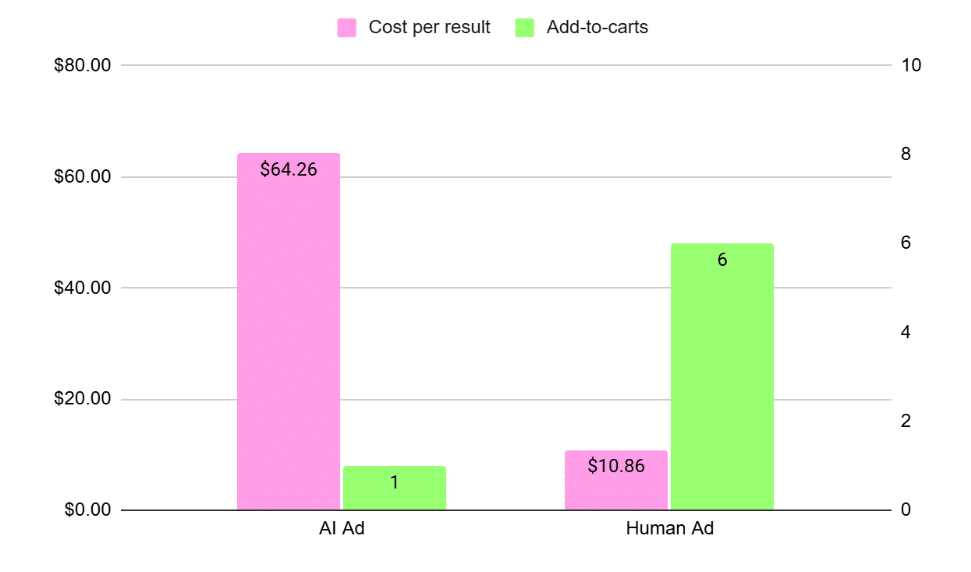
The AI ad generated one add-to-cart from just under 2,000 impressions, converting at 0.05%. The human ad generated six add-to-carts from just over 2,200 impressions, converting at 0.26%.
The real Adam converted at more than four times the rate of his AI twin.
Cost efficiency told the same story. The AI ad came in at $64.26 cost per result while the human version delivered $10.86.
Are we dealing with massive data sets here? No. Across both ads there were seven add-to-carts in total. This is a roast chicken handbag, not an iPhone launch.
But even in a small test, the difference was hard to ignore.
The demographic split made it more interesting. In the human version, 83% of the add-to-carts came from women, at a lower cost per result than men. The AI version’s single add-to-cart came from a man.
Adam is choosing to believe this proves he is objectively more handsome in real life. We suspect it has less to do with attractiveness and more to do with sensitivity to authenticity. When a product is socially expressive, small differences in how genuine someone feels can matter, and that effect may have been stronger among women in this audience.
Why Might This Be Happening?
Research suggests that both human and virtual influencers can impact consumer attitudes, but they tend to work through different psychological routes.
Human influencers typically drive persuasion through identification and authenticity, while virtual influencers are more likely to influence through perceived usefulness and technological objectivity (Belanche, Casaló, & Flavián, 2024).
That distinction matters for a product like this.
The Bachelor’s Handbag is not a utilitarian purchase. Nobody is evaluating it on performance metrics. The appeal lies in humour, cultural recognition and the sense that you are in on the joke. Research suggests that for hedonic or identity-driven products, perceived similarity and parasocial connection are stronger drivers of purchase intention, particularly when authenticity cues are present (Dondapati & Dehury, 2024)
There is also the question of realism. The uncanny valley effect suggests that when artificial characters look almost but not fully human, they can cause discomfort that reduces trust (Mori, 2012).
More recent research applying this idea to virtual influencers shows that characters in this middle ground of realism can see lower purchase intention as a result (Pan, Qin, & Zhang, 2024).
When something feels slightly off, people can hesitate and hesitation at checkout is expensive.
So What?
This experiment does not claim that humans always outperform AI, nor does it suggest that AI endorsers cannot sell.
It does suggest that when you are selling something deliberately ridiculous, like a handbag dressed up as a roast chicken bag, the person delivering the joke matters. Buying this product is not a rational decision and if the human version felt more believable, even slightly, that may have been enough.
As AI becomes more realistic and audiences grow more comfortable with it, the differences may fade.
This is not a rejection of AI. It is a reminder that in advertising, context matters.
Join more than 30,000 advertising industry experts
Get all the latest advertising and media news direct to your inbox from B&T.
Subscribe