
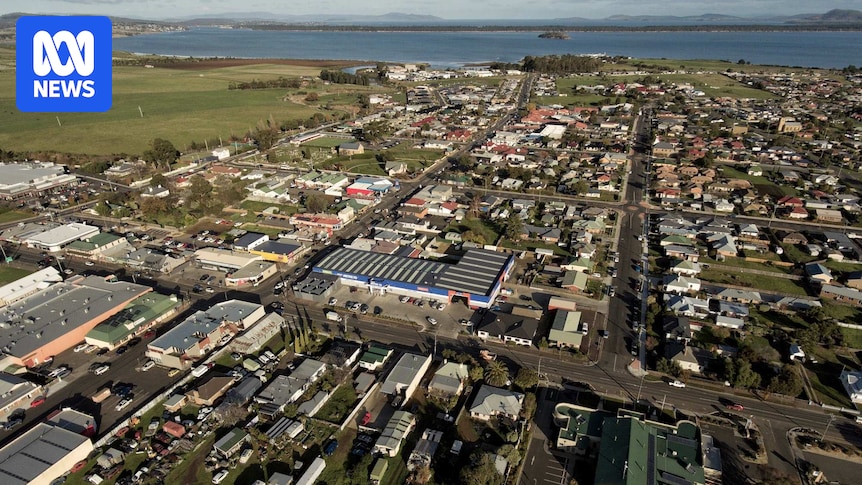
About a quarter of Tasmanians would change electorates under new federal voting boundaries put forward today by the Australian Electoral Commission (AEC).
Under the AEC’s proposal, the geographic area of Lyons would shrink, and Clark would become the southernmost electorate.
AEC Redistribution Committee chair Jeff Pope said the suggested new voting lines aimed to balance the distribution of enrolments across electorates, and “also to have electorates that reflect connected communities of interest and natural boundaries wherever possible”.
“Around 27 per cent of Tasmanians would change electorate with the vast majority coming from proposed changes to the electorates of Clark, Franklin and Lyons,” Mr Pope said.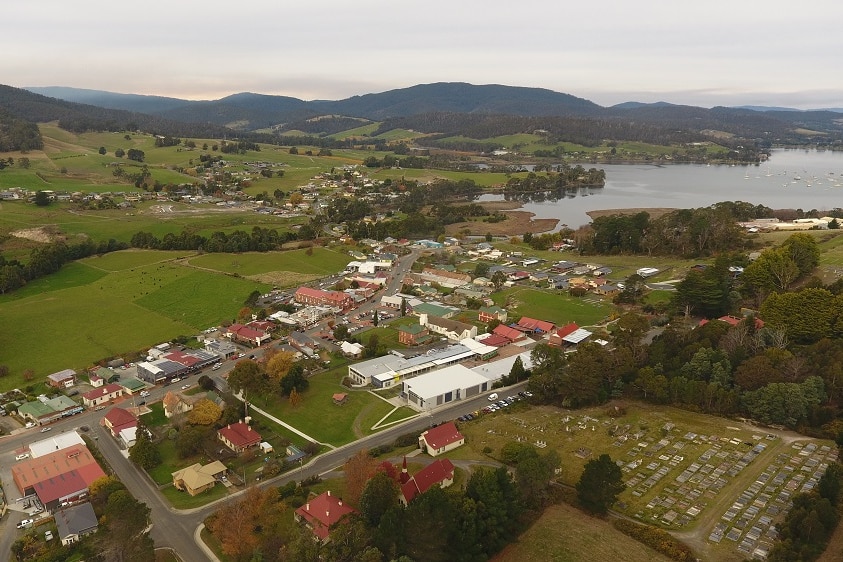
Under the proposal, the Huon Valley would move from Franklin to Clark. (ABC News: Peter Curtis)
The public is invited to submit ideas via the AEC website until March 27, with a final decision to be made later this year.
The proposed changes are:
Clark would encompass the Huon Valley and the parks of the Kingborough local government area that are currently part of Franklin.
Franklin would cover the south-east local council areas of Brighton, Glamorgan Spring Bay, Sorell, and Tasman.
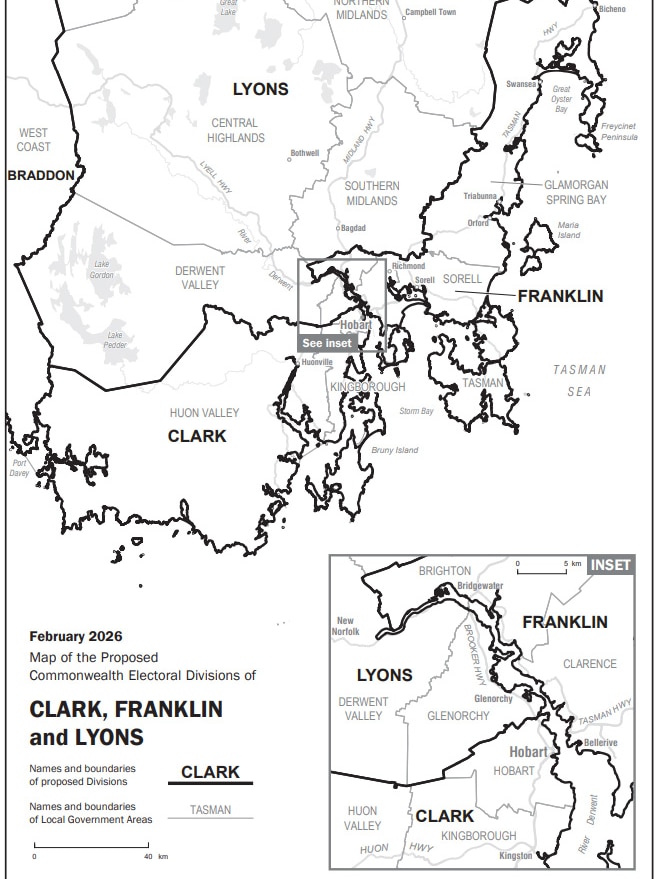
The proposed electoral boundaries for Clark, Franklin and Lyons would change. (Supplied: AEC)
Lyons would gain Glenorchy from Clark and lose most of its east coast local government areas to Franklin.
Bass would take in the Launceston suburbs of Blackstone Heights and Prospect Vale, which are currently part of Lyons.
There are no proposals to change the boundaries of the north-west electorate of Braddon.
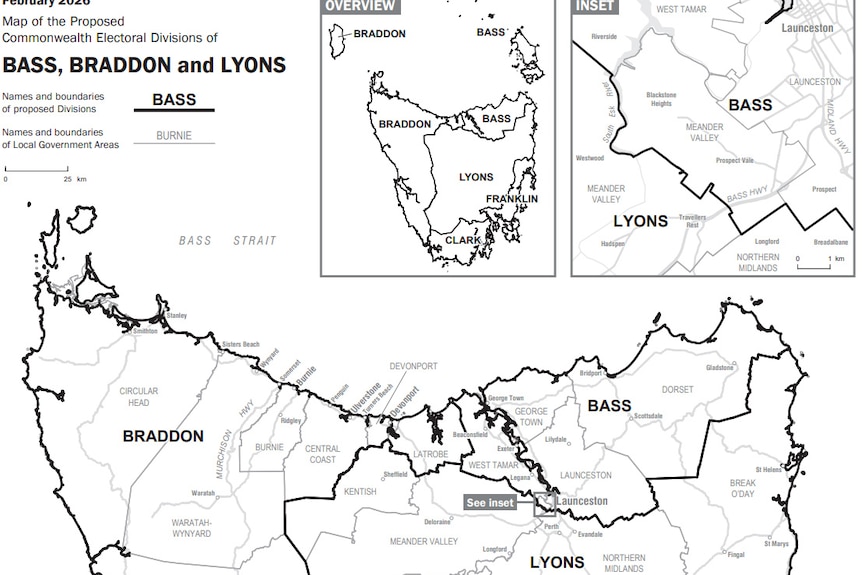
The proposed boundaries for Bass, Braddon and Lyons in the state’s north. (Supplied: AEC)
“Every electorate includes an urban or regional centre, strengthening access and representation,” the AEC said.
“Importantly, the proposed changes meet the numerical requirements of the redistribution quota and projected enrolment quota for Tasmania.”
Once new boundaries are determined, the AEC said Members of the House of Representatives elected at the 2025 federal election would continue representing their current electorates until the next federal election.
The new boundaries would also be applied to the electorates for the state House of Assembly after being assessed by the state parliament.
‘Radical’ change, analyst says
Political Analyst Kevin Bonham said the changing lines would leave politicians and candidates — particularly independent ones — with “interesting decisions” to make.

Kevin Bonham says the AEC’s proposal is “radical”. (ABC News: Ebony ten Broeke)
“Independent candidates often have their support base within a particular electorate that they’ve worked to build up over a while, and then they get a whole new chunk move into their electorate, that they’re not used to,” Dr Bonham said.
“Kristie Johnston at state level has support in Glenorchy and Hobart, so now does she run for Clark or does she run for Lyons?
“Another thing to mention is that Clark [under the proposal] is now even Greener than it was. That could be an interesting thing when [sitting member Andrew] Wilkie retires”.
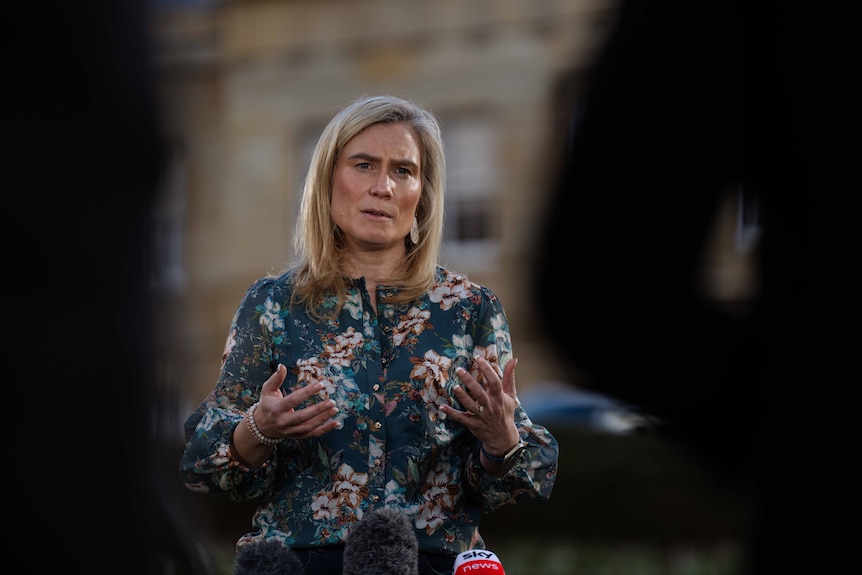
If the proposed boundaries are adopted, Kristie Johnston’s support base will be split across two electorates. (ABC News: Ebony ten Broeke)
Dr Bonham said state Liberal MP Eric Abetz would have a similar conundrum.
“Eric Abetz’s current base within the current Franklin [electorate] is Blackmans Bay [and] Kingston. Now that’s been moved into Clark. Does he move to Clark or does he stay in Franklin?”
He said the current make-up of Franklin — Hobart’s eastern shore, as well as the Huon Valley and parts of Kingborough — had been problematic.
“A lot of people have complained about that and said it’s difficult to do planning for an electorate when it falls into two halves.
“If this [AEC proposal] is adopted, we’ll see an end to that, and the boundaries will follow geographic boundaries more consistently,” he said.
Dr Bonham said the AEC had put forward for consultation the “most radical” of the options it had been considering.