
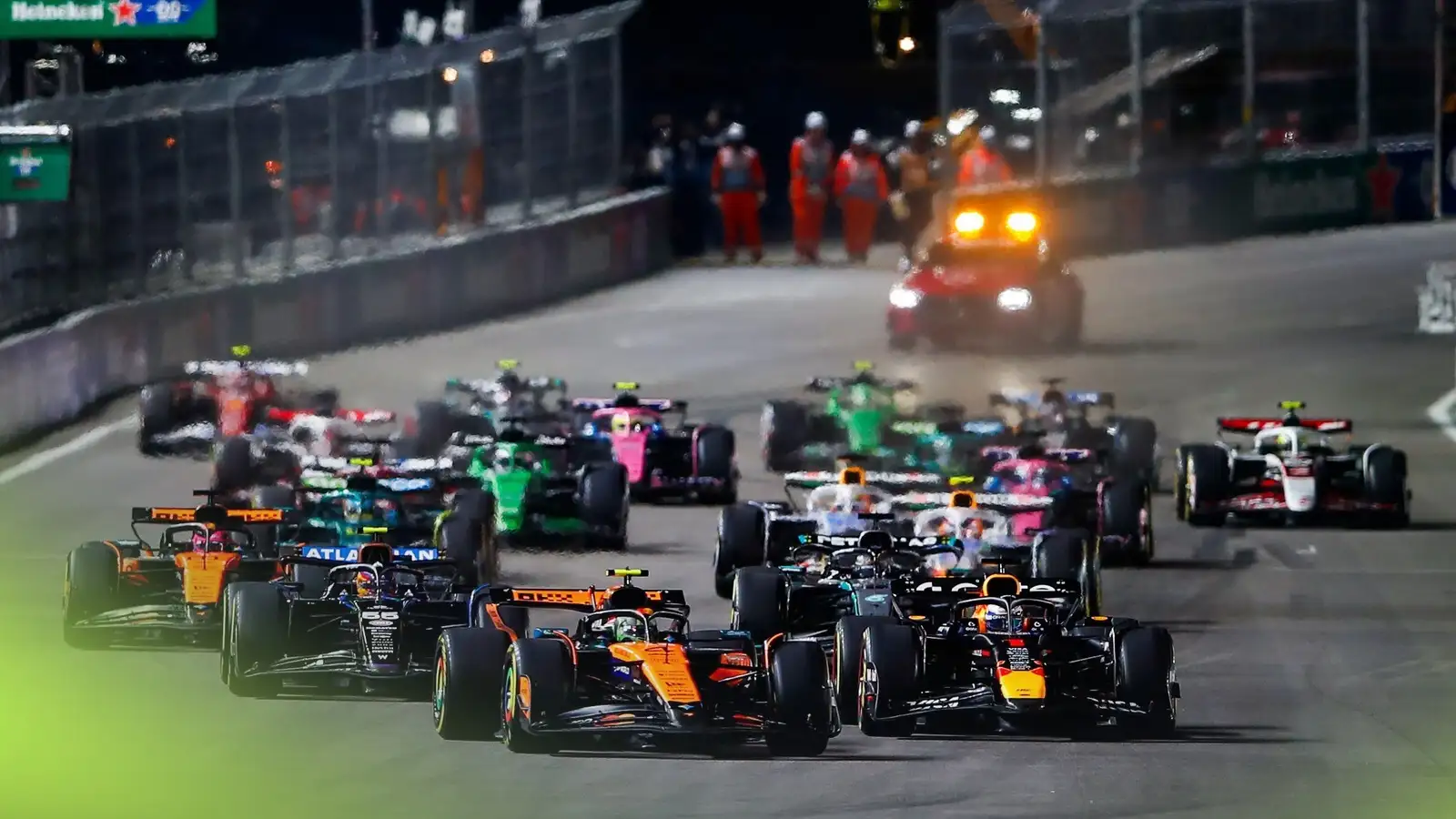
Formula 1 has smashed its revenue record, Liberty Media banking $3.87 billion in 2025 — but how exactly does the sport make its money?
Underpinning that $3.87 billion sits a commercial model built on a mixture of media rights, race fees and sponsorship. Here’s exactly how it breaks down.
F1 2025 revenue breakdown
Want more PlanetF1.com coverage? Add us as a preferred source on Google for news you can trust.
It’s a record high for the sport, a 14 percent increase on the previous year, contributing to an operating profit of $632 million for Liberty Media.
Liberty Media acquired F1’s commercial rights from CVC for $8 billion in early 2017.
Since then, it has more than doubled its revenues from the first year through consistent growth across the intervening years.
Of the $3.87 billion in income it enjoyed last year, approximately 45 percent goes towards team payments – though bonuses impact that final figure.
According to Liberty Media’s reports, it paid $1.4 billion to the 10 teams that competed in F1 2025.
Funding comes from three main sources of income for Liberty Media, namely media rights, race promotion fees, and sponsorship. There are other minor sources that, combined, contribute just over 20 percent of total F1 revenue.
Media rights – $1.21 billion
In 2025, the largest income driver was media rights, equating to $1.21 billion.
Media rights cover broadcast agreements and grew by $93.4 million over the $1.12 billion the stream generated in F1 2024.
There remains growth potential too as the sport’s popularity booms. Stefano Domenicali, CEO of Formula One Management, boasted that “global live TV viewership across all sessions was up 21 percent year over year,” when addressing analysts during the announcement of Liberty Media’s full year accounts.
In recent months, deals have been reached with Apple to take over as broadcast rights holder in the United States in an agreement understood to be worth upwards of $140 million annually, a sharp increase on the $85 million it received previously.
There has been an extension with ESPN through Latin America and the Caribbean, highlighting the continued appetite for F1 globally. Such deals hint towards prolonged growth in that segment in F1 2026 as those new deals fall into place alongside escalator clauses in existing contracts.
Race promotion fees – $1.03 billion
Following media rights, the next most significant income stream for FOM comes from race promoters.
Under the terms of the Concorde Agreement, the legal framework that binds the teams, the FIA and FOM together, there can be a maximum of 24 races.
aThat quota was filled in 2025 and will be again next year.
A total of $1.03 billion was derived from hosting fees across last season, generating just over a quarter of the sport’s revenue.
That figure is expected to increase incrementally as the calendar is at capacity, demonstrated by just $34.7 million in growth year-on-year in 2025.
It also highlights the desire to push for more Sprint events, which are understood to come with an increased asking price of $3 million per event. By adding a further six Sprint events to the calendar, as FOM is seeking to do, it could bolster its revenues by $18 million despite the calendar remaining at 24 races.
There are, however, two other growth strategies at play.
The simplest of these is an accelerator in each hosting contract which sees promoter contributions increase each year. Again, this is incremental but does add tens of millions of dollars.
The other means is through churning; replacing one event with another – ideally one that pays more handsomely for F1 – or rotating between two lower paying events such that the annual asking price can be increased.
That a maximum number of events exists helps create upwards pressure on those on the schedule, encouraging them to pay top dollar, while creating a scarcity of supply issue which affords FOM the ability to enter the market seeking a high initial price.
Zandvoort has been priced out of the game, with this year’s Dutch Grand Prix the last to be held as its contract expires. Belgium will also move to a rotating event alongside the Barcelona-Catalunya Grand Prix, which was gazumped by Madrid for rights to the Spanish GP.
Again, however, that churn only incrementally adds to the revenue with the biggest driver being the sheer number of events.
Sponsorship – $840.4 million
A total of $840.4 million in revenue was generated through sponsorship in F1 2025, equating to 21.7 percent of total F1 revenue.
It marked a sharp increase on the year prior, when $634.5 million came through the same channel.
According to Liberty Media’s report, that growth comes “from new sponsors, contractual increases from existing sponsors and growth in digital advertising revenue.”
FOM has worked hard to increase its roster of sponsors, and now boasts an array of partners of varying levels. The likes of Aramco, DHL, Heineken, and LVMH are global partners, with a total of 10 companies at that level.
There are 16 official partners, including PepsiCo, American Express, and Standard Chartered.
Beyond that are regional partners and official providers, making for a long list of sponsors – and a substantial sponsorship income.
It is also an area of key focus with Domenicali looking to continue to add names to the list though with a focus on quality now rather than quantity.
The calendar theoretically limits opportunities. However, F1 can still offer potential sponsors the value they seek through alternate means.
The continued rise in F1’s popularity affords opportunities to increase the asking price or open ‘creative’ new opportunities.
“We are quite creative in finding new opportunities,” Domenicali said. “You are going to see already this year some deal uplifted with new opportunity that we can offer, new quality, and new things that we want to offer.
“Of course, now that the quantity is really, in a way, great, we need to focus on the quality of what we are bringing in.
“Now, we are not only in the world of physical advertising, we have the digitalisation that will enable us to use in all the different channel possibility to put good advertising.
“We have different platforms. We have the podcast, we have YouTube, we have other social media opportunities we will monetise in the future even stronger.”
Other revenue streams – $786.2 million
While almost 80 percent of FOM’s revenue is derived from race promotion, media rights, and sponsorship, a diverse mix of smaller streams completes the picture.
Hospitality, freight and licensing all combine to deliver 20.3 percent of F1’s total income, or $786.2 million.
Corporate hospitality, and more specifically the Paddock Club, is a key factor in that, which saw 10 percent growth over F1 2025 as it served 65,000 race day guests.
With Paddock Club tickets averaging around $7,000, this alone generates over $450 million in revenue.
Alongside the Paddock Club is income from feeder categories, Formula 2, Formula 3, and F1 Academy, as well as freight earnings – the latter receiving special mention during the Q4 earnings call with analysts.
Combined, it makes for total revenues of $3.87 billion for the 2025 calendar year, a 14 percent increase from the previous year.
However, the costs associated with Liberty Media’s motorsport revenue came in at $2.581 billion, with other expenses totalling $346 million.
Once depreciation and amortisation are also accounted for, at $263 million, and a handful of other small costs, the operating income for Liberty Media in 2025 was $632 million.
Want to be the first to know exclusive information from the F1 paddock? Join our broadcast channel on WhatsApp to get the scoop on the latest developments from our team of accredited journalists.
You can also subscribe to the PlanetF1 YouTube channel for exclusive features, hear from our paddock journalists with stories from the heart of Formula 1 and much more!
Read Next: F1 2025 prize money payouts revealed: McLaren crowned champions as Ferrari steal the spoils