
The major foreign exchange rates have remained relatively stable overnight. For the week as a whole the US dollar is currently on track to weaken modestly against most other G10 currencies. The best performing G10 currency has again been the Australian dollar extending its year to date gains against the US dollar to around 6.8%. The Australian dollar continues to benefit from the hawkish repricing of RBA rate hike expectations which was reinforced by another upside inflation surprise in Australia at the start of this week. Furthermore, speculative demand for the Australian dollar has been encouraged by the continued upward momentum for the Chinese renminbi at the start of this year. USD/CNY has continued to fall sharply this week hitting a low of 6.8318 yesterday although it has risen back above the 6.8500-level overnight.
The stronger renminbi has been encouraged this week by the US Supreme Court’s decision last Friday to strike down President Trump’s IEEPA tariffs. The reduction in tariffs on China will help to further dampen downside risks to growth from trade. China’s record trade surplus last year already highlighted that it was proving more resilient than feared to disruption from US tariffs. The lower daily fixes for USD/CNY this week have added to views that Chinese policymakers are becoming more tolerant of currency strength The PBoC announced overnight that it will cut the reserve requirement on FX forwards to zero from 20%, effective from 2nd March, to lower transaction costs and encourage corporate demand for US dollars. According to Bloomberg, the reserve requirement served as a key defence against renminbi weakness since 2015, and it was last raised to 20% in September 2022 when USD/CNY rose above 7.0000. The PBoC stated that the move will “support companies’ management of foreign exchange risks”. The PBoC also pledged that going forward it will keep the renminbi exchange rate stable at reasonable, equilibrium levels and guide financial institutions to improve FX hedging services. The removal of charges for speculating against the renminbi have been viewed by market participants as a sign that Chinese policymakers are starting to become uneasy over the recent fast pace of appreciation.
The other main market focus over the last 24 hours has been the negotiations taking place between the US and Iran to avoid military conflict. It has been reported that US and Iranian officials ended the latest round of nuclear talks in Geneva by agreeing to reconvene as soon as next week in Vienna. It leaves the door open to further diplomacy before the end of President Trump’s self-imposed deadline of approximately 10-15 days to agree to a “meaningful” nuclear deal, or else face unspecified consequences. According to Bloomberg, the Americans were leaving Geneva disappointed with the progress of talks while officials from Iran and mediator Oman were more upbeat. The WSJ has reported that the US had tough demands for Iran including destroying the three main nuclear sites at Fordow, Natanz and Isfahan. The nuclear deal must also last forever and not have sunset clauses. The price of oil has been largely unmoved by the developments limiting any spill-overs into the FX market. The price of oil has already risen back above USD70/barrel to price in a higher geopolitical risk premium ahead of the talks. Among G10 currencies, the Norwegian krone has been the main beneficiary at the start of this year from the higher price of oil.
CATCH UP CURRENCY STRENGTH FOR CNY VS. USD
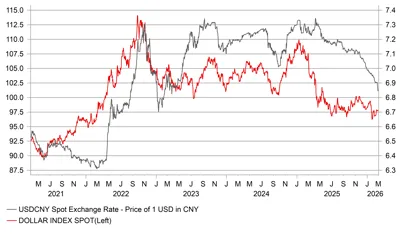
Source: Bloomberg, Macrobond & MUFG GMR