
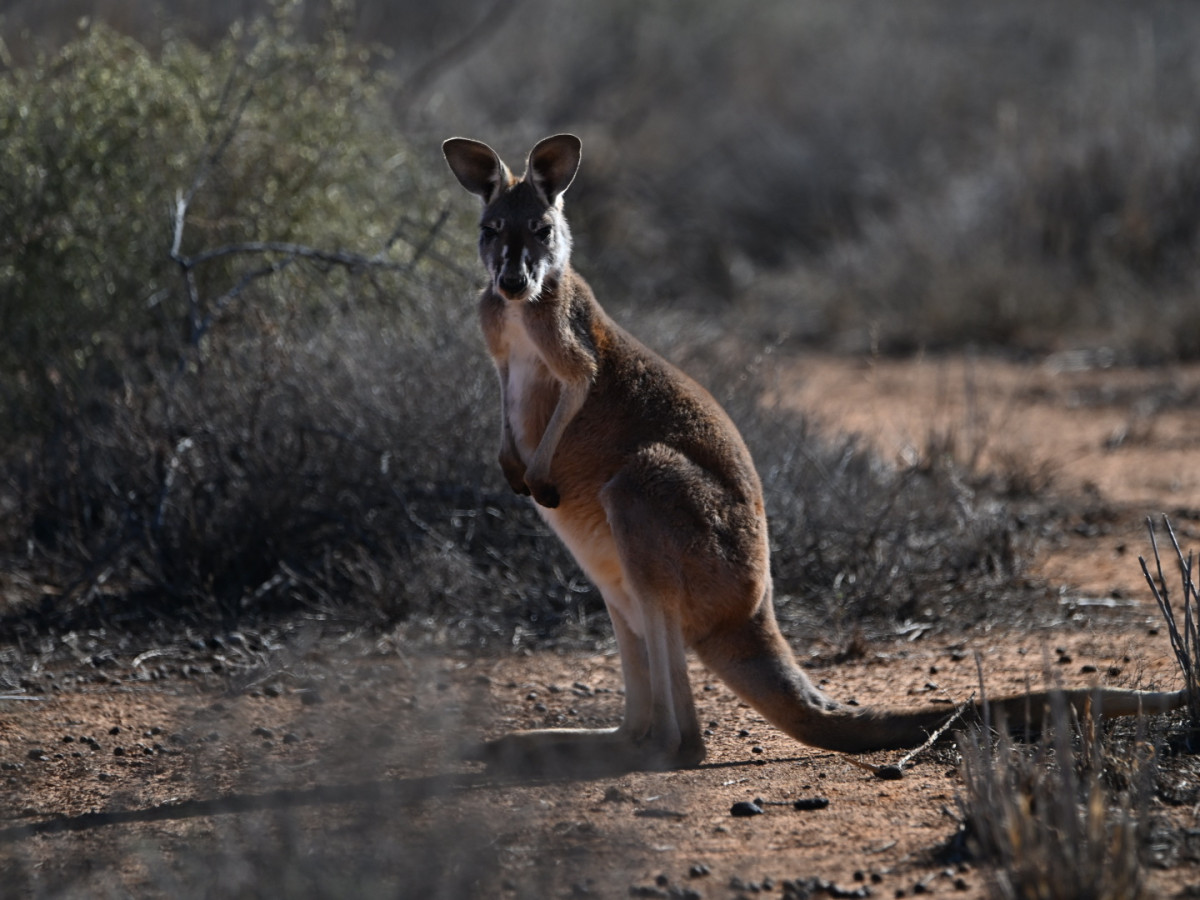
Kangaroos alter their posture as they hop faster to store more elastic energy in their Achilles tendons and improve the efficiency of their locomotion. In fact, as they speed up, they burn off no extra calories. If only our cars could work that way! Speaking with Chris Smith, Christofer Clemente, is at the University of the Sunshine Coast…
Christofer – Back in the 1970s and 80s, a group of scientists at Harvard University actually discovered this unique phenomenon that we see in kangaroos. They managed to get these kangaroos to hop on a treadmill while wearing a metabolic mask so they could measure how much energy that they were using. What they noticed was that as they hopped faster, the kangaroos didn’t use any more energy. Now, the reason that is so interesting is because if I was to run on the treadmill, and as I go faster, I would generally use more energy. It’s like, you know, when we’re driving a car, we put our foot on the accelerator, we use more petrol to go faster. That’s true of most animals, except for the kangaroos.
Chris – And what? We knew they were doing it, but we didn’t know how?
Christofer – That’s right. So what we wanted to try and figure out was what’s changing in kangaroos? What are they doing that allows them to decouple energy use from speed? So we actually used a little bit of sports science technology. So you might see sometimes when sports players are running along, and they have, you know, these segments and angles and high-speed cameras all used to figure out what their skeletons are doing. So we had little markers that we would put on these kangaroos, and we would get them to hop over force plates, and what that allowed us to do is build a computer model of their skeleton as they’re hopping along and measure the forces that they’re impacting the ground with.
Chris – And at different speeds, presumably.
Christofer – And at different speeds, yeah. And this was the fascinating thing. When we looked at their posture, we noticed something was changing. As these kangaroos are hopping faster, they’re starting to become more crouched. And this is our first clue as to what they’re doing.
Chris – When you say more crouched, which joints specifically are they crouching?
Christofer – Their foot design is a little bit different to us. They have a very long foot, and their ankle joint is the main joint that they use. And as they’re moving, they’re flexing this ankle joint, and they’re using that to push themselves forward.
Chris – So as they go faster, they what, flex towards the floor more, that ankle joint. How does that translate then into improved efficiency of movement around that joint, which is what this must be? If they’re not using more energy, they’re not getting a free lunch, because physics doesn’t do free lunches. So they must be being more efficient with what they’re using. So how are they doing that?
Christofer – That’s right. So the way we normally move a joint is we have muscles, right? And our muscles shorten, and as they contract, they pull on that joint, and that joint moves about the axis. Now, the muscle is not the only thing. Kangaroos have ridiculously long Achilles tendons, and it has rather interesting properties. So when we shorten a muscle, we use up energy to do so, but tendons are like an elastic band. If you stretch an elastic band, it takes energy to stretch it, but when you relax it, the elastic band pulls back together by itself. So it’s capable of storing energy, and when we let it go, it releases that energy back. So these two things are happening, and both of those are clues as to what’s actually going on in these kangaroos.
Chris – How does the postural change alter the behaviour of the tendon then?
Christofer – What we think is going on is, as these kangaroos are hopping along, say at slow speeds, most of the time, because they’re hopping relatively slow, that tendon is stretching a little bit, but not much, and so they have to contract their muscle in order to rotate their ankle joint. But as they hop faster and faster, they will want to try and do less and less muscle work, and the way they can do this is by stretching the tendon more and more. And the trick that they use to stretch this tendon more and more is by becoming more and more crouched, forcing the tendon to be stretched further with each hop. Now, when you’re stretching the tendon and not the muscle, that means you can tend to store a lot more energy in these tendons, and that meant that the leftover bit, the amount that the muscles needed to do to push them forward, actually doesn’t change as they go faster.
Chris – Why is it that just kangaroos have hit onto this ingenious solution? Why can’t I do this?
Christofer – Yeah, why can’t we do this? That’s a great question. Why wouldn’t all animals do this if it’s such a neat strategy? There is a cost, of course, to doing this. So when I say we’re stretching the tendon more and more, what that means is we’re putting it under more and more stress, but the more stress you put something under, the closer it is to its breaking point. So we imagine that these particularly large kangaroos, when they’re hopping very, very quick, are probably getting close to the limits of what that tendon can handle before it breaks. And so we think most animals are probably a little bit more safety-biased in that they don’t want to use this method because they don’t want to risk rupturing those tendons.
Chris – Does this, therefore, apply a size constraint? So it’s good for animals in a certain range of sizes because they can get away with really cooking things close to that safety margin. But once you add more body mass, biology just can’t cope with the load you would be asking that tendon to deliver.
Christofer – Yeah, exactly. So there’s going to be two real cons, I guess, with this approach. The first one is you probably can’t accelerate very fast, too, because if you try to apply too much load too quickly, you’re going to snap these tendons. And the second is exactly what you were saying. If we put too much weight onto these tendons, then we’re going to get to a point where that safety factor is too low, and we’re really going to rupture these tendons, and that kind of fits with what we see in nature. There are no giant horse-sized kangaroos. Instead, once animals get really big, they have to just switch from hopping to another type of gait, to something like walking. And so maybe what we see in kangaroos is something like the upper limit of locomotion, and these kangaroos are choosing a type of gait that maybe lets them be very efficient, but it’s at the cost of this ability to be very big or maybe very manoeuvrable.