
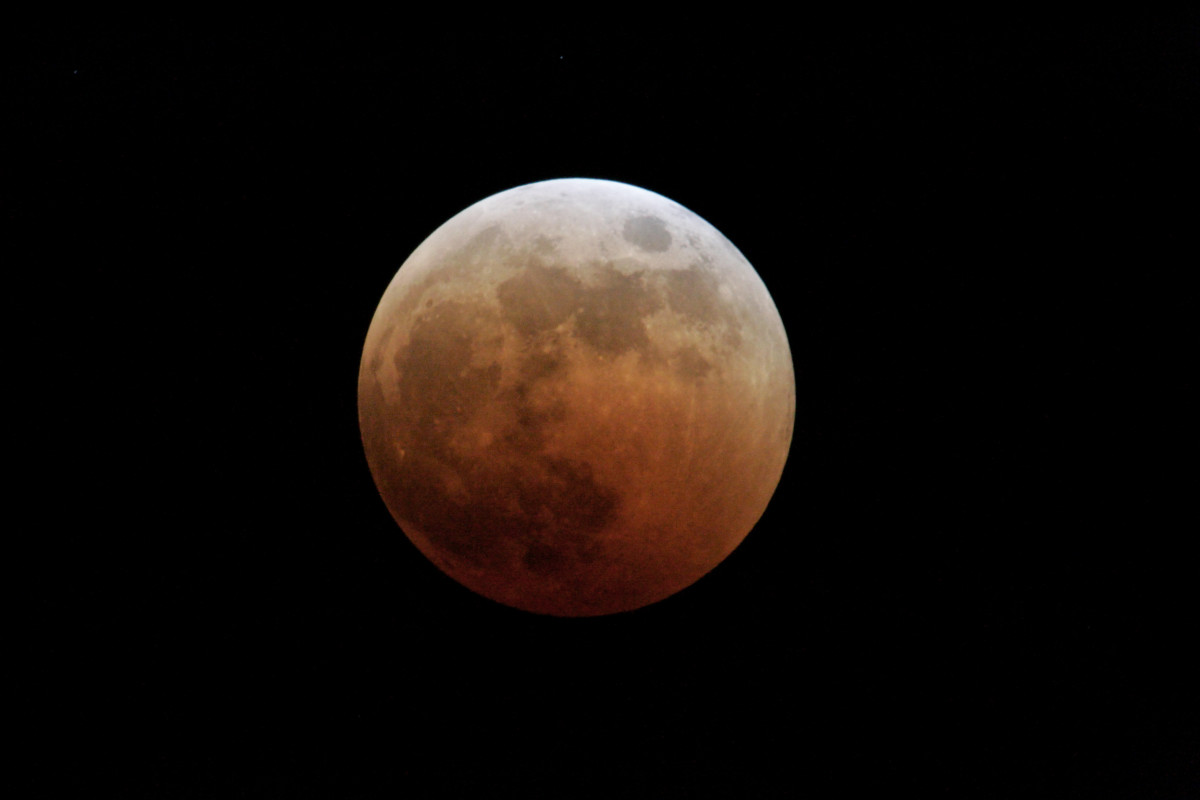
An “impossible” lunar event will touch the skies early next week as a total lunar eclipse takes place across several time zones in the United States. The rising sun and eclipsed moon will be visible in the sky at the same time, producing a rare selenelion effect.
The entire eclipse, from the start until the end of the penumbral phases is 5 hours 38 minutes 37 seconds long, while totality is 58 minutes 19 seconds in duration.
Seeing the ‘Impossible’ in the Sky Explained
The lunar event is seen as “impossible” due to the rare nature of events leading up to the blood moon.
For a lunar eclipse to occurs, the sun, Earth and moon are in a geometrically straight line, with Earth in the middle. If the sun is above the horizon, the moon must be below the horizon and vice versa, according to Space. This makes the incoming interaction between the sun, Earth and moon seem impossible with both the sun and moon visible in the sky.
Atmospheric refraction allows the selenelion event to exist as it causes astronomical objects to appear higher in the sky than they really are.
“Because of this atmospheric trick, for many localities, there will be an unusual chance to observe a selenelion firsthand with this impending shadowy event. There will be a short window of roughly 1-to-3 minutes (depending on your location) when you may be able to simultaneously spot the sun rising in the east-southeast and the eclipsed full moon in the west-northwest,” Space.com wrote.
Jack Dredd/Shutterstock
(Jack Dredd/Shutterstock)Where, When to See the Eclipse
The East Coast of the United States will have the best view at a total eclipse with major cities like Boston, New York and Washington D.C., seeing 100% of the moon’s diameter within the dark umbral shadow at the time of moonset.
Totality begins at 6:04 a.m. ET and NASA revealed what to expect: “The entire Moon is now in the Earth’s umbra. The Moon is tinted a coppery red. Try binoculars or a telescope for a better view. If you want to take a photo, use a camera on a tripod with exposures of at least several seconds.”
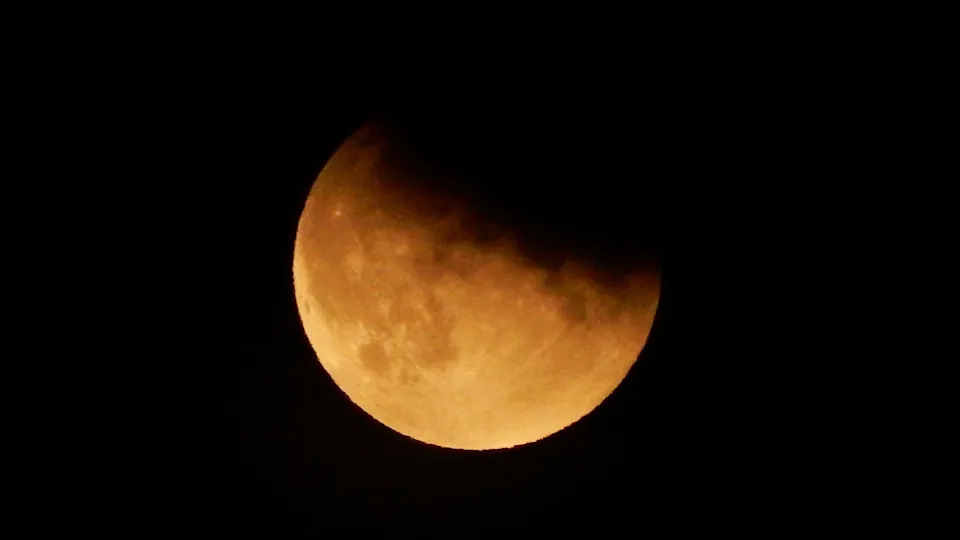
Less than an hour later, totality ends as the Moon exits Earth’s umbra and the red color fades. “It looks as if a bite is being taken out of the opposite side of the lunar disk from before,” NASA said.
By 9:23 a.m. ET the eclipse will be over.
A chart from NASA shows the full visibility of the eclipse around the globe, though it can’t be seen in throughout most of Europe and Africa.
What is a Total Lunar Eclipse?
A total lunar eclipse happens when the Moon moves into the inner part of Earth’s shadow, or the umbra, according to NASA.
“Some of the sunlight passing through Earth’s atmosphere reaches the Moon’s surface, lighting it dimly. Colors with shorter wavelengths ― the blues and violets ― scatter more easily than colors with longer wavelengths, like red and orange,” NASA wrote. “Because these longer wavelengths make it through Earth’s atmosphere, and the shorter wavelengths have scattered away, the Moon appears orangish or reddish during a lunar eclipse. The more dust or clouds in Earth’s atmosphere during the eclipse, the redder the Moon appears.”
Related: Netflix Quietly Cancels New Show After Just 1 Season
This story was originally published by Men’s Journal on Feb 28, 2026, where it first appeared in the News section. Add Men’s Journal as a Preferred Source by clicking here.