
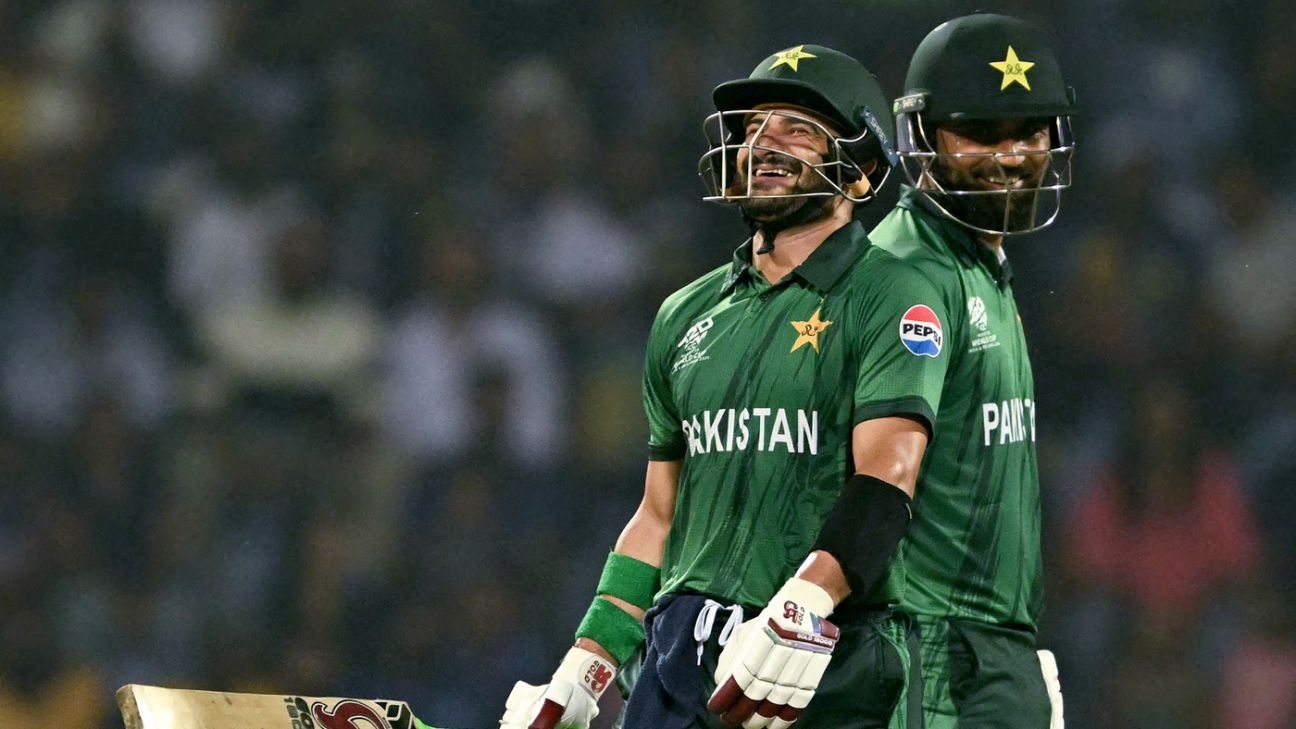
Pakistan captain Salman Agha conceded that his side “underperformed” in the “whole tournament”, after Pakistan were eliminated from the T20 World Cup following a narrow win over Sri Lanka in Colombo.
Pakistan required a 65-run win over Sri Lanka to pip New Zealand to a semi-final spot, needing to restrict the hosts to 147 runs or fewer after scoring 212. In the end, they didn’t come close, with Sri Lanka captain Dasun Shanaka‘s late onslaught nearly winning the game altogether before Pakistan clung on for a five-run win.
“If you look at the whole tournament and I had to sum it up, we underperformed,” Agha said at the post-match press conference. “Our middle order never performed, and we over-relied on Sahibzada [Farhan] for our runs.”
Editor’s Picks
2 Related
Pakistan’s batting problems in Saturday’s game were a microcosm of issues that have persisted through the tournament. A century from Sahibzada Farhan saw him break Virat Kohli’s record for the most runs at a single T20 World Cup, finishing with 383. However, no other batter has come close to offering the opener any support; Pakistan’s next highest scorer this tournament is Shadab Khan, with 118 runs in six innings.
In Pallekele on Saturday, where Pakistan had Fakhar Zaman open alongside Farhan despite benching him for the entirety of the group stage, Pakistan got 176 for the opening partnership, only to go on to lose eight wickets for 34 runs in the next four overs as their momentum petered out. No batter apart from the openers reached double figures. Agha, who scored a two-ball duck, said it was difficult for a new batter to come in and score quickly on that surface.
Team selection, both with bat and ball, has been a point of intense scrutiny, too, particularly the continued selection of an out-of-sorts Babar Azam in the middle order, which both head coach Mike Hesson and Agha have at times contradicted themselves defending. Meanwhile Abrar Ahmed, Pakistan’s best T20I spinner over the past year, was dropped after a poor showing against India. ESPNcricinfo understands there were concerns about his ability to hold his nerve under pressure, but he was the pick of the bowlers last night, with 3 for 23 in his four.
Fakhar Zaman and Sahibzada Farhan had a good time in the middle AFP/Getty Images
“We take responsibility,” Agha said. “We look at conditions and the situation required before selecting our playing XI as captain and coach together. I take responsibility, as does the coach. We will have to improve our decision-making under pressure. There will always be pressure in ICC events, because you are playing the world’s best teams. And every game is important because if you lose one, you feel on the brink of elimination.”
That responsibility, however, did not extend into a decision on his future, yet, with Agha, who just completed his 50th match as T20I captain, saying he would not rush into taking any “emotional” calls. But it has been a tournament to forget for him with the bat, managing just 60 runs in six innings, 38 of them in one match against Namibia. For much of the tournament, he experimented with batting at No. 3, a position he co-opted after a couple of strong showings in bilateral series against Sri Lanka and Australia.
“At No. 3, I played the Sri Lanka and Australia series very well. At this World Cup, I was unable to deliver in that same way. At the whole World Cup, the batting unit, Sahibzada aside, did not play very well,” he said. “Today, we had an idea that we’d need Fakhar to utilise the powerplay. Saim [Ayub] wasn’t in good form, so we felt we should use Fakhar there, and he batted outstandingly well.
“When we knew we needed to win by 65, we were playing with that intent. When we scored 200, we always knew what we’d need to defend. And we were thinking we could do that, but you’ve got to give credit to Dasun and [Pavan] Rathanayake as well. They batted brilliantly even though we put pressure on them.”
play
2:51
What are the lessons to be learnt for Pakistan and Sri Lanka?
Varun Aaron, Urooj Mumtaz and Farveez Maharoof on a memorable encounter
Pakistan paid the price for poor death overs with both bat and ball. They scored 35 in the final four overs, while conceding 100 in the final seven, including 40 in the last two as Sri Lanka came within one hit of victory.
“In the 20-over innings with the bat, we played 18 overs very well. The other team is allowed to play two overs well. The last three overs we bowled, our execution was not good,” Agha said. “We’re a better bowling unit than this, and we’ve been a better bowling unit in the past. Our execution with the ball was missing today.”
It has resulted in a fourth successive ICC men’s tournament for Pakistan that ended with an exit before the semi-final, with Agha calling for “improved decision-making” in key moments.
“When the pressure is on, how we improve our decision-making matters,” he said. “Whenever we are under pressure, our decision-making is not as good as it should be. And that’s why we get the results we get.”