
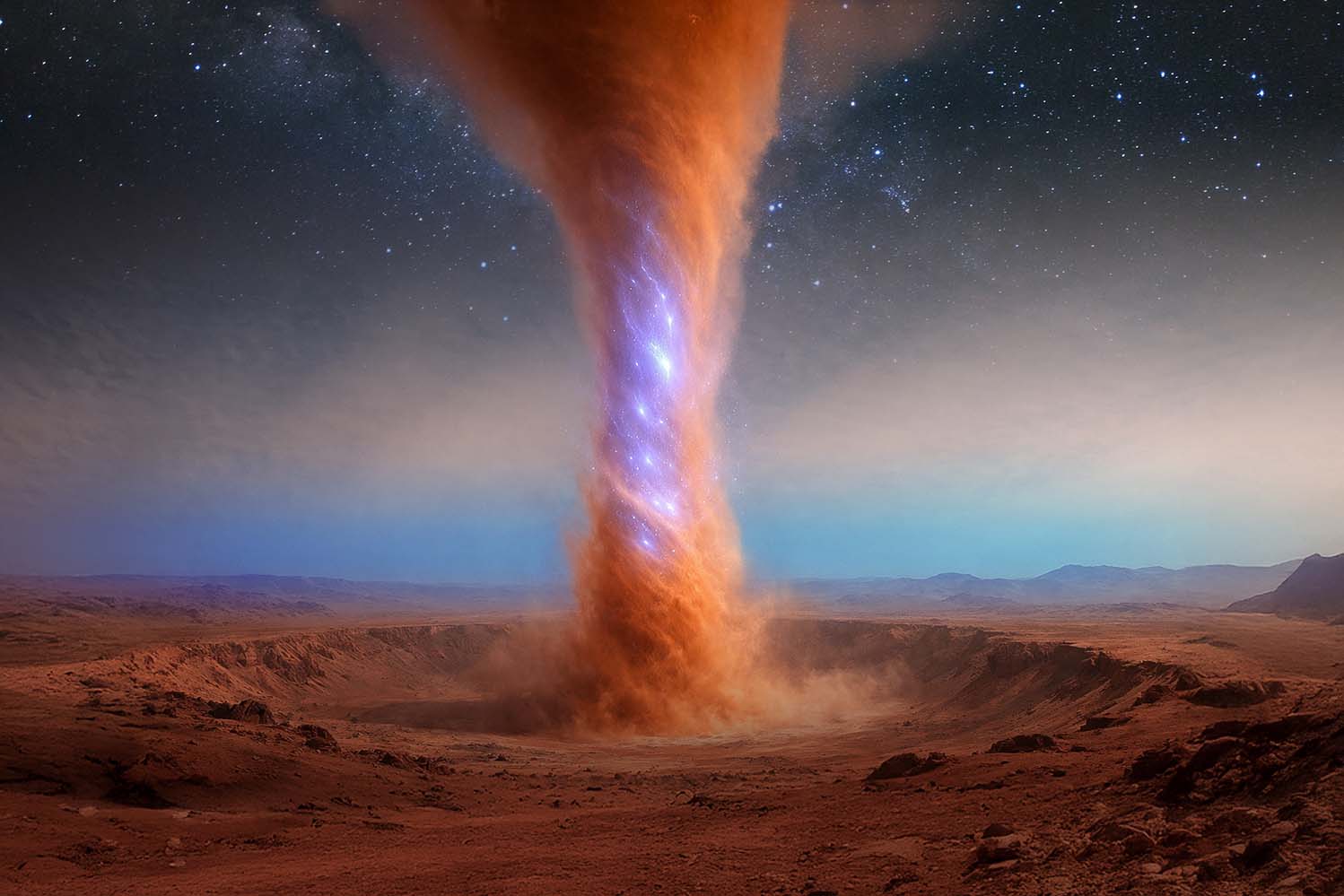
Researchers have identified powerful Martian electrical discharges, similar to lightning, and strong enough to be observed from orbit, in new research bringing this extraterrestrial phenomenon to light.
Mars and Earth feature very different environments—namely, the Red Planet lacks a global magnetic field and possesses only a thin atmosphere. As a result, lightning does not form in rain clouds as it does on Earth; instead, intense activity in dust storms and dust devils produces the electrical charge that generates Mars’ lightning-like electrical discharges.
MAVEN Observes Martian Lightning
NASA’s MAVEN orbiter made the crucial observation a decade ago, but only in December 2024 did the significance of the signals become clear. Recently, Czech researchers completed their analysis and revealed the findings in a new paper published in Science Advances.
“I went through data from the beginning of the mission, and after automatically filtering records measured outside areas of strong magnetic fields or at excessively high altitudes,” František Němec of Charles University said in a press release. “I found only a single electromagnetic lightning signal—a so-called whistler—among thousands of possible records.”
“Based on previous calculations, laboratory experiments, and observations of lightning in the dust plumes of terrestrial volcanoes, we all expected electrical discharges in the Martian atmosphere, but until that moment, no one had recorded them,” said Ondřej Santolík of the Czech Academy of Sciences and Charles University.
MAVEN—short for Mars Atmosphere and Volatile Evolution—was designed to study the Martian atmosphere and its evolution. Operating from 2014 until NASA lost contact in December 2025, the spacecraft examined interactions between the solar wind and the atmosphere. To support this mission, it carried instruments capable of measuring electromagnetic waves, which ultimately detected the lightning signal.
A Lucky Observation
Observing the lightning-like discharge required unusually precise circumstances. The MAVEN orbiter had to be at the correct altitude and position, and in the proper observation mode, at the moment the event occurred. Conditions on Mars also had to allow the signal to escape into space. Without a global magnetic field, lightning appears to form only in regions with localized fields, and for detection, those fields must be both strong and largely vertical. The signal also had to reach the ionosphere without losing strength.
Later observations by the Perseverance rover in 2021 and 2024 detected lightning-like discharges as well, though the researchers believe those represent a different phenomenon.
“In the thin atmosphere of Mars, the accumulation of large potential differences is limited by the onset of small, local glow discharges. Such discharges may be those detected by Perseverance,” Němec told The Debrief. “However, they are too weak and too localized to be detected by an orbiter.”
“A discharge detectable from orbit would have to be significantly stronger, involving a larger potential difference distributed over comparatively large spatial scales,” Němec added. “This most likely indicates that the mechanism responsible for generating the corresponding voltage must be different.”
The Lightning of Mars
Martian lightning discharges produce a cascading effect. A short, powerful current generates fluctuating magnetic and electric fields that propagate outward as electromagnetic waves. When part of the wave reaches the ionosphere, it slows, and different frequencies travel at different speeds, arriving at the orbiter separately. Higher frequencies travel faster and reach MAVEN first.
PhD student Kateřina Rosická developed a simulation to test this hypothesis, combining a model of Earth with the assumed composition of the Martian ionosphere. The simulation showed that lower-frequency waves would be delayed while higher-frequency waves would attenuate—exactly what MAVEN observed. The spacecraft’s failure to detect higher frequencies matched the prediction.
Whether the phenomenon strictly qualifies as “lightning” remains uncertain. For now, researchers describe it as a lightning-like electrical discharge.
“The common understanding is that the phenomenon of lightning encompasses various related effects, such as a visible flash,” Němec explained. “Of all these effects, the available measurements allow us to demonstrate only the sudden release of low-frequency electromagnetic radiation.”
“In other words, there is nothing yet that clearly separates this phenomenon from lightning, but the available instrumentation does not allow us to observe all the effects that the common understanding of lightning encompasses,” Němec added. “We therefore cannot confirm or exclude them, and it is possible that in the thin atmosphere of Mars some of these effects may differ significantly from those known on Earth.”
Keeping an Eye On Mars Lightning
For now, the researchers say the phenomenon poses little threat to future crewed missions.
“Based on observations on Earth, lightning is generally not particularly deadly or dangerous, at least when reasonable precautions are taken,” Němec said. “It could, for example, endanger surface antenna equipment by destroying its electronics; however, I would say it is not too significant a concern.”
Currently, the European Space Agency (ESA) is considering an unscrewed Mars mission called M-MATISSE for a possible 2037 launch, which the team says would provide vital new information on any Mars lightning-like electrical discharges.
“It will be better equipped to search for traces of lightning discharges than its predecessor, MAVEN,” said study co-author Ivana Kolmašová, who also serves as a member of the ESA Scientific Study Team for the M-MATISSE mission. ESA is expected to decide by the end of this year whether it will pursue the mission.
The paper, “Lightning-generated Waves Detected at Mars,” appeared in Science Advances on February 27, 2026.
Ryan Whalen covers science and technology for The Debrief. He holds an MA in History and a Master of Library and Information Science with a certificate in Data Science. He can be contacted at ryan@thedebrief.org, and follow him on Twitter @mdntwvlf.