
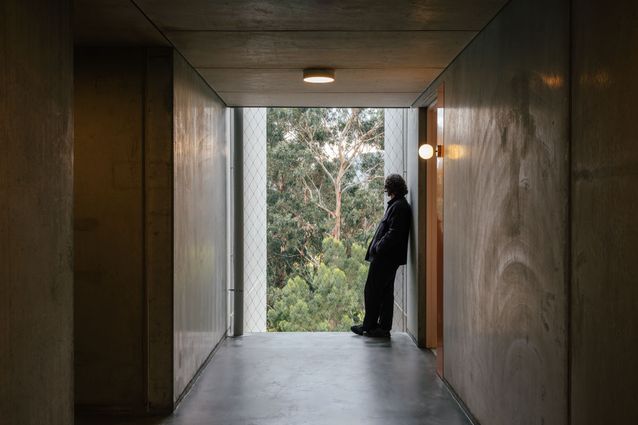
Along the northern approach into Hobart, the iconic Stainforth Court Housing Estate has long been admired by modern architecture enthusiasts. Designed by the architects’ division of the Housing Department of Tasmania in 1958 to fill a gap in the private rental market, the apartments provided both a unique housing model and an iconic gateway to the developing city. Although mid-rise development was more expensive to build than individual houses, the location, 10 minutes from the CBD, was envisaged to present other benefits, such as access to public transport and urban amenity.
View gallery
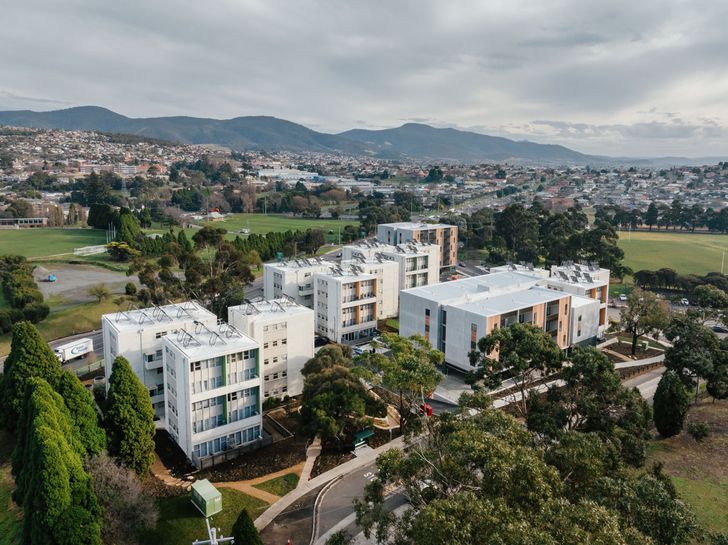
Four blocks containing 85 apartments were arranged in an open parkland setting. The checkerboard-like site arrangement provided expansive views in different directions and created open green spaces in between the buildings. Each five-storey block comprised a cluster of three smaller, hooded boxes with double-storey curtain walls facing outward and windows in walls on the less dominant edges. The site planning created a self-contained oasis, but as the surrounding infrastructure of highways and sporting fields developed, the complex became isolated from the residential neighbourhood. By the early 2000s, the estate had become synonymous with crime and had fallen into disrepair. Modest renovations in 2013 (Tim Penny Architecture and Interiors) and a change in tenancy began to address social issues, and a recent development, designed by Cumulus Studio, provides an optimistic future for the site.
The latest development, borne of a partnership between Housing Choices Australia and Homes Tasmania, expands the original estate, adding 38 one-bedroom and 27 two-bedroom apartments in two new blocks. The 149 dwellings in total provide long-term rental housing for residents on low to moderate incomes, housing a mixed demographic of younger and older people, singles and families.
View gallery
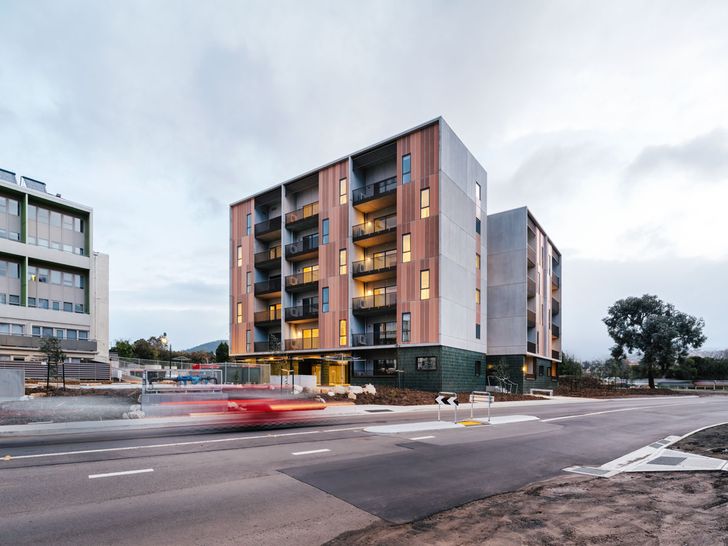
The renamed Queens Walk Housing presents a skilful response to a range of deceptively complex design constraints. Initiated during COVID-19 lockdowns, the scope of the project was framed by an initial feasibility study (Taylor and Hinds, and Partners Hill) that committed the project to a number of units. In approaching the project in August 2021, however, Cumulus Studio undertook a comprehensive reassessment of the site that took the design in a different direction in addressing additional practical constraints of budget, car parking, access, existing services, sewer lines and a substation, as well as site contamination from asbestos and heavy metals, flood risk from an adjacent rivulet, the impact of soft soil on the site, and the heritage significance of the estate.
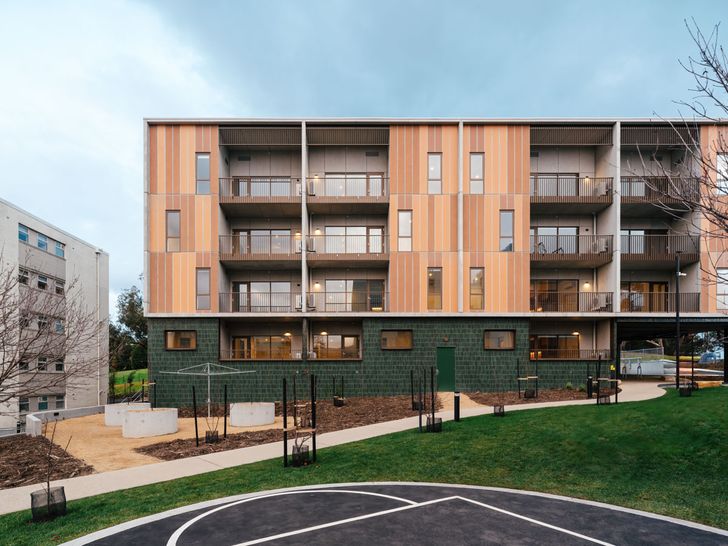
The siting of the new buildings was determined through analysis of sun, wind and views to minimise the impact on the existing dwellings, ensuring that sightlines from individual dwellings were maintained and that residents’ favourite sunny outdoor area was preserved. The location of the two new buildings maximises their amenity while complementing the rhythm of the original arrangement. Careful understanding of the level changes across the site allowed for a taller six-storey building on the lower ground to the north, increasing the scale of the complex from the highway. In contrast, the four-storey building on higher ground to the east provides a more pedestrian-friendly scale on approach from the park. Locating the new buildings at the periphery of the site also reduced the impact on the existing residents during construction.
View gallery
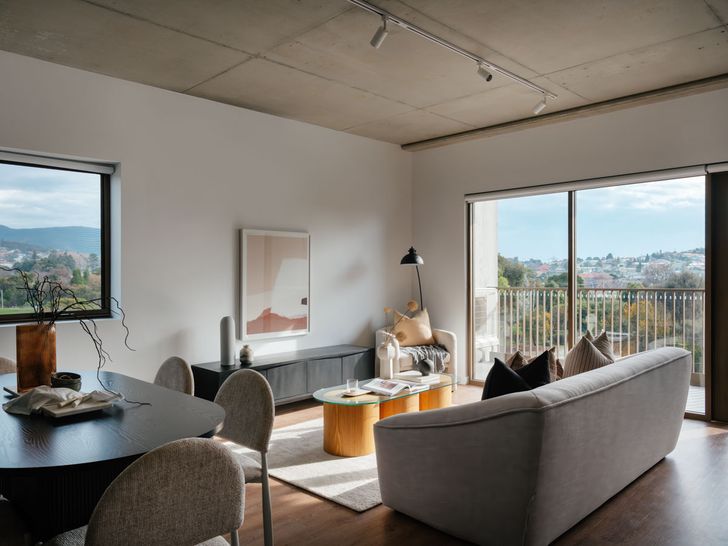
The one and two-bedroom apartments possess a bifurcated plan of bedrooms and bathrooms on one side and an open-plan kitchen, living and dining space to the other. Within this pattern, the location of the entry is shifted from one apartment to the next, providing the perception of different layouts that belies the simplicity of the arrangement.
Tectonically, the new buildings complement the form and detail of the original architecture, replicating the hooded box form with a light, articulated facade. The modulation of coloured concrete panels alongside a well-detailed metal balustrade provides a robust and low-maintenance solution. Rippled, green glazed tiles to the lower floor ground the building, creating a connection to the nascent garden spaces designed by Realm Studios, which will benefit from time to establish and supplementary planting down the track. As part of the landscape approach, the existing community garden has been retained and extended with a new communal barbeque area at the centre of the site, and site-wide wheelchair access has been achieved.
View gallery
Queens Walk Housing increases the site density, strengthening of the critical mass of occupation without a reduction in amenity, aligning with the City of Hobart strategy for inner city urban infill. The brief is skilfully executed, providing a level of amenity through good design that far exceeds the expectations of social housing.