
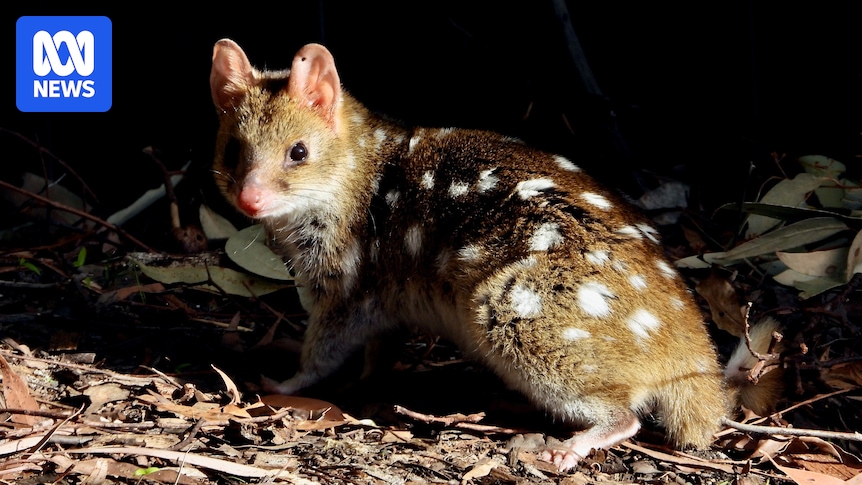
An endangered “native cat” is making a celebrated comeback, with a breeding population of eastern quolls making a new home for themselves in a small pocket of south-east mainland Australia.
Conservationists have trapped and re-released 27 eastern quolls in a protected pastoral property near Dunkeld in western Victoria.
Recent surveys have confirmed that the species has successfully bred.
The eastern quoll, once dubbed Australia’s “native cat”, was declared extinct on mainland Australia in 1963 after being wiped out by the introduction of the red fox in the late 19th century.
The species’s only original wild population remains in Tasmania.
Repopulation efforts in the Grampians/Gariwerd region are being led by the South-West Eastern Quoll Hub, a partnership between conservation group Nature Glenelg Trust and three local agricultural businesses.
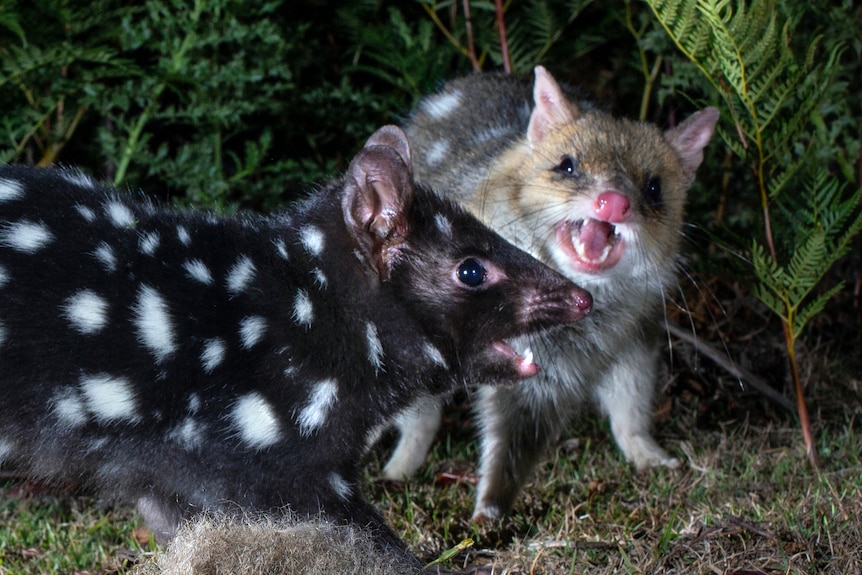
Eastern quolls come in black and fawn colour variants. (Supplied: Brett Vercoe, iNaturalist CC BY-NC 4.0)
Kai Dailey, who is a conservation manager with one of the businesses, said 12 male and seven female quolls captured during the most recent survey were born in the wild.
“It’s early stages, but it’s fair to say it’s a successful introduction, absolutely,” he said.
Mr Dailey said the survey showed the repopulation program was working “incredibly well”.
Three pregnant females were released into a fenced 95-hectare free-range enclosure at Dunkeld’s Mt Sturgeon two years ago, with two males added last May to increase biological diversity.
“We’ve maintained an almost 50-50 ratio between males and females,” Mr Dailey said.Predators abound
Previous efforts to reintroduce Tasmanian eastern quolls to the mainland were thwarted by foxes and other imported predators.
The South-West Eastern Quoll Hub project traces its roots back to 2013 and a program that revegetated pastoral land with native trees and protected existing river red gums.
Construction of a predator-proof fence began in 2022, coinciding with an intensive effort to eliminate foxes from the area.
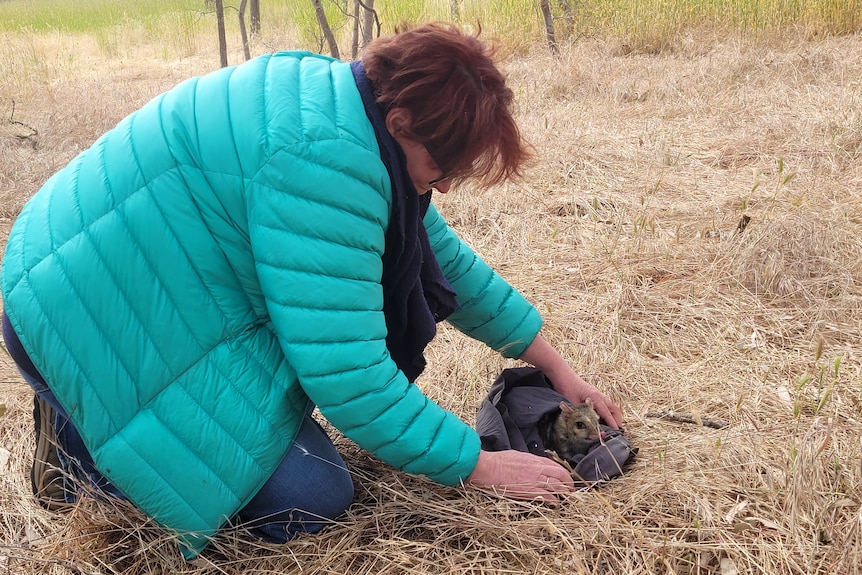
Melissa Herpich releases an eastern quoll during monitoring at a western Victorian site. (Supplied: Nature Glenelg Trust)
Nature Glenelg Trust managing director Mark Bachmann said the common fox was the key ingredient in the eastern quoll’s catastrophic population decline.
He said their removal was an essential step before the quolls could be released into an area.
“They’re in what we call the ‘critical weight range’ mammal group, which is a category of mammals bigger than rats, but smaller than the smallest wallabies that we’ve seen decimated in the last 100-150 years as a result of the introduction of foxes and cats onto mainland Australia,” he said.
“In Tasmania, where for one reason or another, foxes never got going despite attempts to establish them, quolls have continued to persist in the places where there are cats.”
Other predator-proof sanctuaries are planned along the edge of the Grampians National Park, Mr Bachmann said, including in the Cobboboonee National Park around Mount Vandyke.
He said there was potential for the program to grow beyond regional Victoria.
“We’re all working towards a common goal and it would be valuable for us to be able to get together, compare notes, and save reinventing the wheel,” Mr Bachmann said.
“Because none of our sites independently [are] big enough to do everything we might want to do for the species in terms of managing its genetics.
“We have the benefit that we can — once we’ve all got animals inside our enclosure — work together to make sure that we’re managing the viability of the genetics of those populations across our four sites.”
Disappearing act
Australian newspapers and journals were once filled with tales of the so-called “common variable native cat”, an aggressive carnivore disparaged by farmers as a menace to domestic poultry.
From the 1870s, the quoll began to disappear from public view, vanishing from the Australian mainland.
Within decades, the marsupial was wiped out by a far greater threat, the familiar fox.
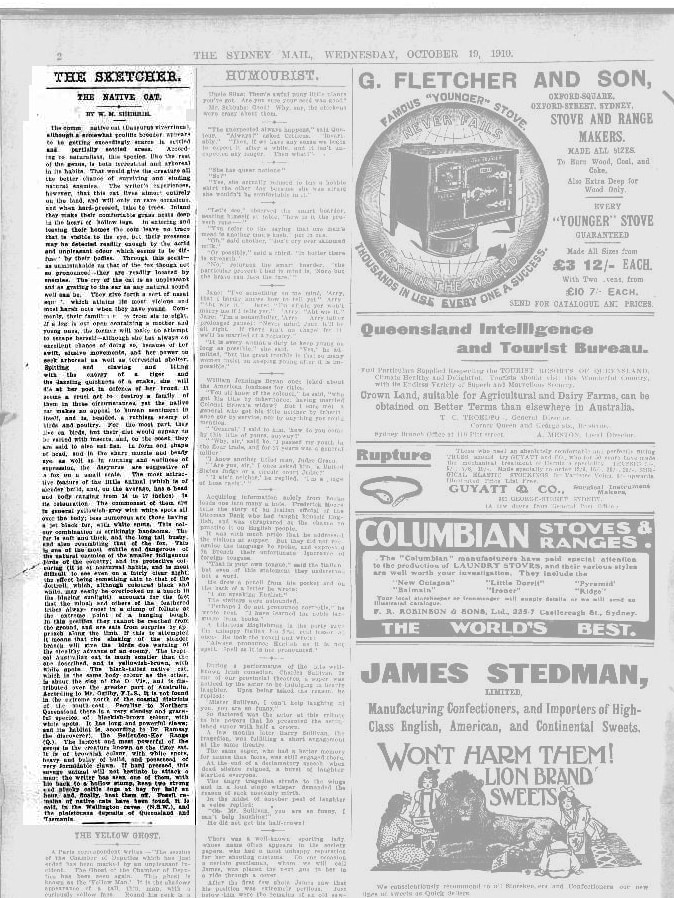
A 1910 article in The Sydney Mail describes the decline of the “common native cat”. (Supplied: Trove, NLA)
“Quolls have been almost lost from our collective memory on the mainland because they were lost so long ago,” Mr Bachmann said.
“The eastern quoll in particular is not a species that anyone will be that familiar with.”
Despite being commonly described as the eastern “native cat”, they bear only the tiniest resemblance to a domestic cat.
The quoll is a small to medium-sized marsupial, generally smaller than an actual cat.
In addition to their reintroduction in western Victoria, there are other breeding programs in the Australian Capital Territory and in New South Wales, with a view to further reintroductions on the mainland.
Quoll species
For those eager to learn more, there are six species of quoll: four occur in Australia, two in New Guinea.
They are all carnivorous marsupials with a diet that includes insects, reptiles, birds and other small animals, according to Mr Dailey.
Of the Australian varieties, the eastern quoll (Dasyurus viverrinus), northern quoll (Dasyurus hallucatus) and western quoll (Dasyurus geoffroii) each live in isolated pockets, although the significantly larger spotted-tailed quoll (Dasyurus maculatus) has a wider home range which overlaps that of the eastern quoll in Tasmania.
Eastern quoll (Dasyurus viverrinus)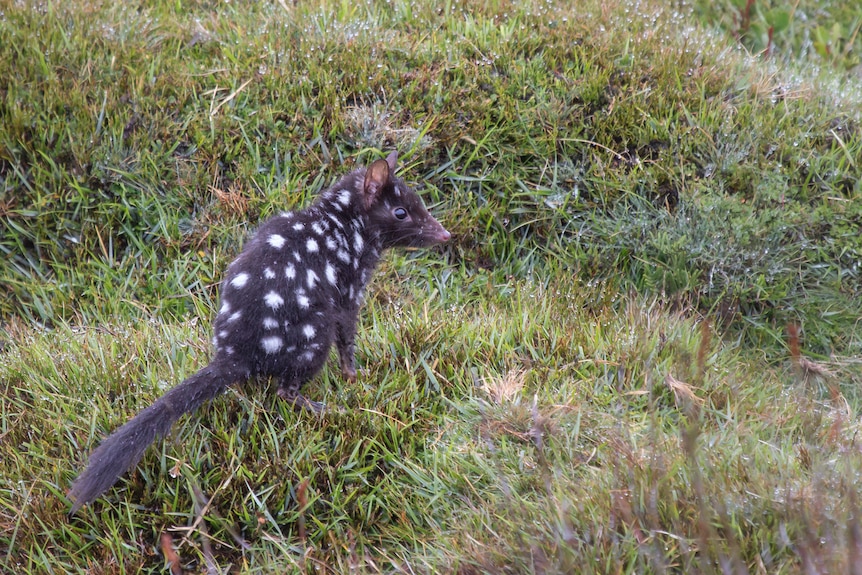
An eastern quoll (Dasyurus viverrinus) with a black morph. (Supplied: Ramit Singal, iNaturalist CC BY-NC 4.0)
Once one of Australia’s most abundant native predators, the eastern quoll’s home range is now limited to Tasmania and a few attempted reintroduction sites on the mainland. It is categorised as endangered.
Formerly known as the eastern native cat, there are two colour combinations (or morphs): fawn with white spots and black with white spots. Both combinations can occur in the same litter, although the fawn morph is dominant. Neither have spots on their tails.
These quolls grow up to 65cm in total length, with adult males weighing up to 1.3kg and females up to 0.9kg.
Western quoll (Dasyurus geoffroii)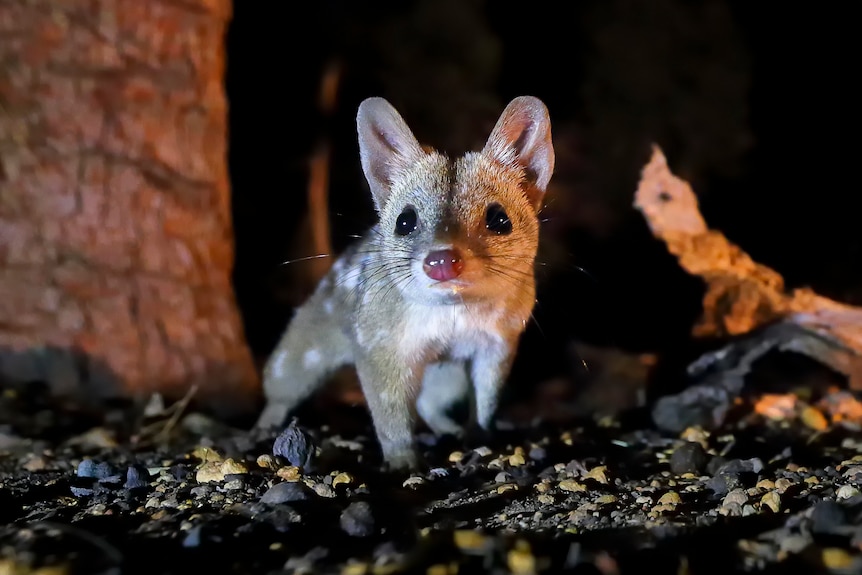
A western quoll (Dasyurus geoffroii). (Supplied: Georgina Steytler)
Reddish-brown in colour, the western quoll is similar in size to the eastern quoll. It occupies the south-west corner of Western Australia and is classified as vulnerable.
Northern quoll (Dasyurus hallucatus)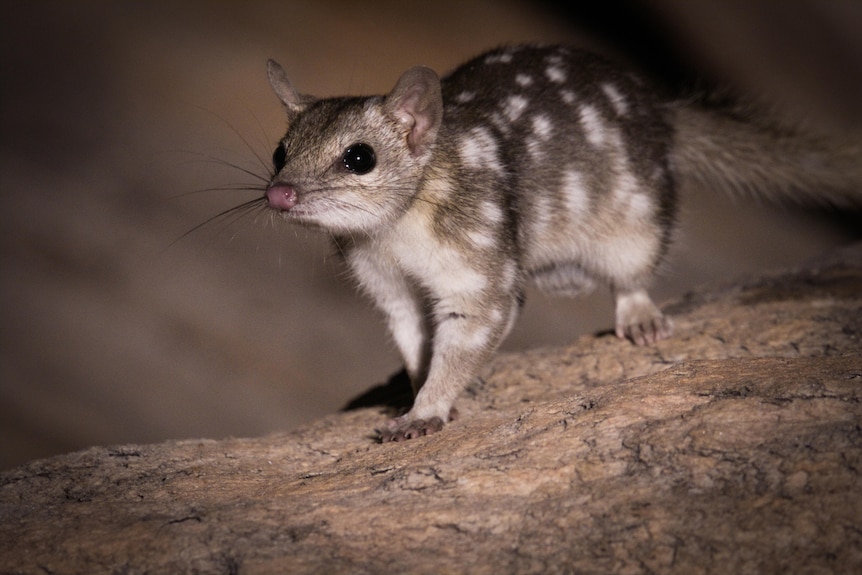
A northern quoll (Dasyurus hallucatus) sniffs the air. (Supplied: Wild Pacific Media)
The smallest of the four Australian quoll species, the northern quoll (previously known as the northern native cat) grows to about 65cm with adult males weighing up to 1.1kg and females up to 0.7kg.
It can be found in the Pilbara and Kimberley regions of Western Australia, as well as coastal Northern Territory and Queensland. It is classified as endangered.
Spotted-tailed quoll (Dasyurus maculatus)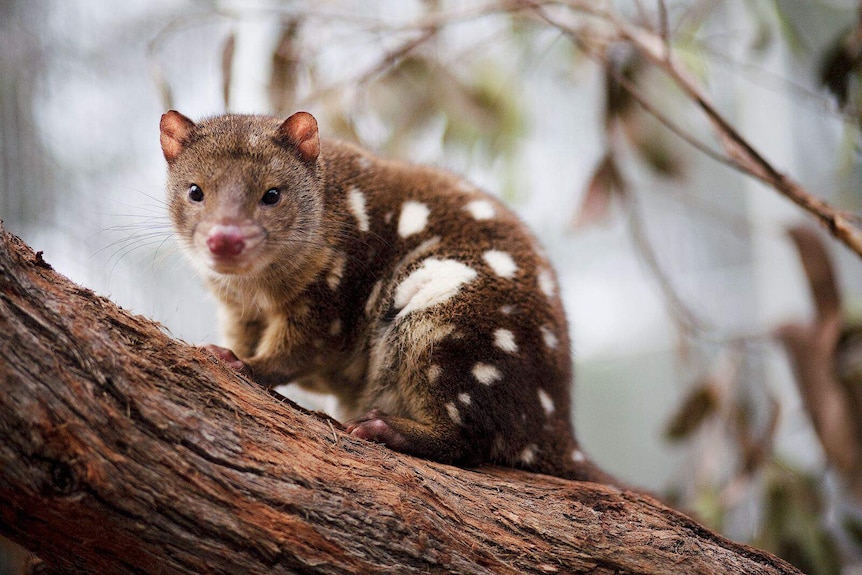
Spotted-tailed quolls (Dasyurus maculatus) are also known as tiger quolls. (Supplied: Lucia Griggi)
Also known as the tiger quoll, males weigh up to 3.5kg, with females weighing up to 1.8kg. The spotted-tailed quoll can be found along the Australian east coast and into Tasmania, and has a conservation status of near threatened.