
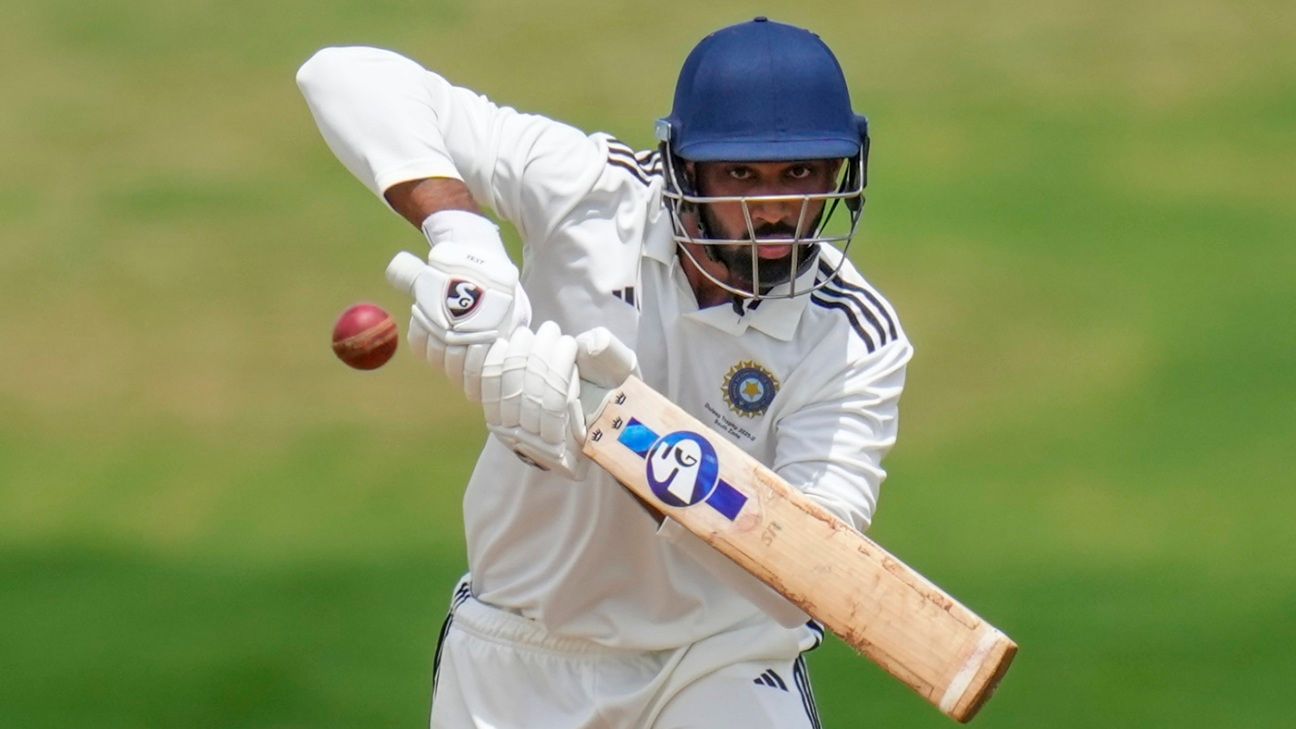
One of R Smaran‘s final acts at the 2025-26 Ranji Trophy was nicking Auqib Nabi, the season’s highest wicket-taker, behind for a first-ball duck. J&K’s celebration at his dismissal told a story. They had just dismissed the season’s highest run-getter.
Most batters mark 1000 runs in a single Ranji season as massive. Smaran finished with 950 runs in 14 innings at an average of 86.36, including four centuries. For a 22-year-old in only his second full season, it was another steep upward curve in a career that has moved quickly.
There is a phrase often used in cricket circles, for young batters especially: “second-season blues”. The dip that often follows a breakout year once bowlers have data, plans and footage. Smaran was warned about it early and was prepared.
Editor’s Picks
2 Related
“During preparation, I had a conversation with our coach [Yere Goud] regarding the second-season blues,” Smaran told ESPNcricinfo. “I didn’t go to him specifically, but he came and spoke to me, saying many cricketers face the problem of a second season.
“He told me not to change anything – not to think that the opposition would know my game and try to target my weaknesses. He just said, ‘keep batting the way you’ve been batting, put your head down and look to score runs’. So I didn’t think much about it when the season started. I’m glad I could keep piling on runs.”
The numbers suggest he did exactly that.
“The first goal was obviously to win it with Karnataka. It’s been 11 years, the last time we won was in 2014-15. That was the team’s goal,” he said. “Personally, I wanted to either finish with 1000-plus runs or stay at the top by the end of the campaign. I fell short by 50 runs, which was disappointing, but staying at the top is a very good feeling.”
Yet, a few hours after Karnataka’s defeat to J&K in the final, the disappointment of not being able to reclaim the crown they last won in 2014-15 overshadowed the satisfaction of the runs.
“It felt like instant karma,” Smaran said with a laugh, looking at the lighter side. “We batted long in the semi-final [against Uttarakhand], and J&K did the same to us. It can be a blessing and a curse. If you’re on the right side of it, it’s great. If not, you feel it completely.”
****
Within just two seasons, Smaran has established a presence within the Karnataka set-up. That he held his own in a side featuring KL Rahul (for the knockouts), Mayank Agarwal, Karun Nair and Devdutt Padikkal speaks volumes of his evolution as a batter.
There were a number of key knocks with Karnataka having their backs to the wall. Smaran exemplified solidity, and impressed many with his ability to play off the back foot on surfaces with bounce. It’s perhaps no surprise that he picked the knock against Mumbai in the quarter-final – not one of his four centuries – as his best.
“Probably the 83 in the second innings against Mumbai, I’d rate that as my best knock this season,” he said. “It was a quarter-final in Mumbai, a do-or-die situation. I’d made a duck in the first innings and we were chasing 325 to win.
“There’s always plenty riding on it when you play a side like Mumbai in Mumbai. I was nervous while going out to bat in the second innings. A conversation with Rahul helped. He told me to go after them and keep the energy in my batting. Within five-six overs, I hit four-five boundaries. He kept reminding me to show presence at the crease. That helped me ease my nerves and put pressure on them. That’s something I want to continue doing – maintaining energy every ball.”
That 83 against Mumbai revealed his temperament under pressure, but the season overall showed his growing appetite not just to score runs, but to dominate attacks and bat teams out of contests. He also had the hunger to not settle for just a century if he had the chance to go big.
“The appetite to score big hundreds was always on my mind,” he said. “Whenever I got a start or a hundred, I told myself to convert it into a double. That was the main focus. I could have done that in the semi-finals as well, but I got out in the 130s in both innings.
R Smaran likes to go big against spinners R Smaran/KSCA
“Conversations with Karun helped me a lot in the early stages of the season. We had many partnerships. After getting a hundred, it’s easy to go after the bowling, but he kept telling me it’s okay to bat long sessions and pile on runs. You don’t get many chances to turn a hundred into a double. That really helped, especially against Kerala and Chandigarh [when he made double-tons].”
It wasn’t just red-ball cricket where that hunger surfaced. In the Syed Mushtaq Ali Trophy, Smaran finished as Karnataka’s leading run-scorer, hitting 319 runs in seven innings at a strike rate of nearly 160.
If the Ranji season showcased his ability to bat long, the T20s underlined his expanding range. Yet, more than the runs, Smaran has gleanings.
“From a personal standpoint, yes, I’m satisfied,” he said. “But as a team, we haven’t qualified for the last three or four years. There were games I should have finished, like against Rajasthan, one ball and three runs needed. I couldn’t close it out. I believe if I’m there till the end, I should finish the game.”
Smaran’s improved range and ability to hit big against spin earned him a maiden IPL contract with Sunrisers Hyderabad in 2025. But a freak injury at training cut short his stint – he’d come in as a replacement for Adam Zampa. Building up to IPL 2026, Smaran is happy with his game but has no illusion that work remains to be done.
R Smaran celebrates a milestone R Smaran/KSCA
I still have a lot to develop in T20 cricket,” he said. “But being around guys like [Heinrich] Klaasen, Abhishek Sharma and Ishan Kishan gives you a lot of insight. They are among the most destructive batters in the format. Watching them and speaking to them helps. They have worked extremely hard to get where they are. I’ve not made my IPL debut yet, so I still have a long way to go.”
Can it be intimidating being around that batting group?
“Yes, you’re in awe, and you also learn,” he said. “You wonder when you’ll hit the ball like them. But they’ve put in hours of work. For me, there’s still a long way to go. I just want to keep improving and have conversations with them about how I can develop my T20 batting.
“As a middle-order batter, I get time to observe from the dressing room – how the pitch behaves, who is bowling well, which bowler to target. My preparation happens more during the game. In white-ball cricket, especially the IPL, there’s a lot of data. Sometimes I use it, especially if I don’t know a bowler well. But mostly, it’s my own visualisation and preparation.”
At 22, Smaran has already established consistency in red-ball cricket and has shown he can adjust to the demands of T20s. The evolution and the runs, he hopes – quietly, of course – will translate into an India A call-up. And that could come sooner than later.