
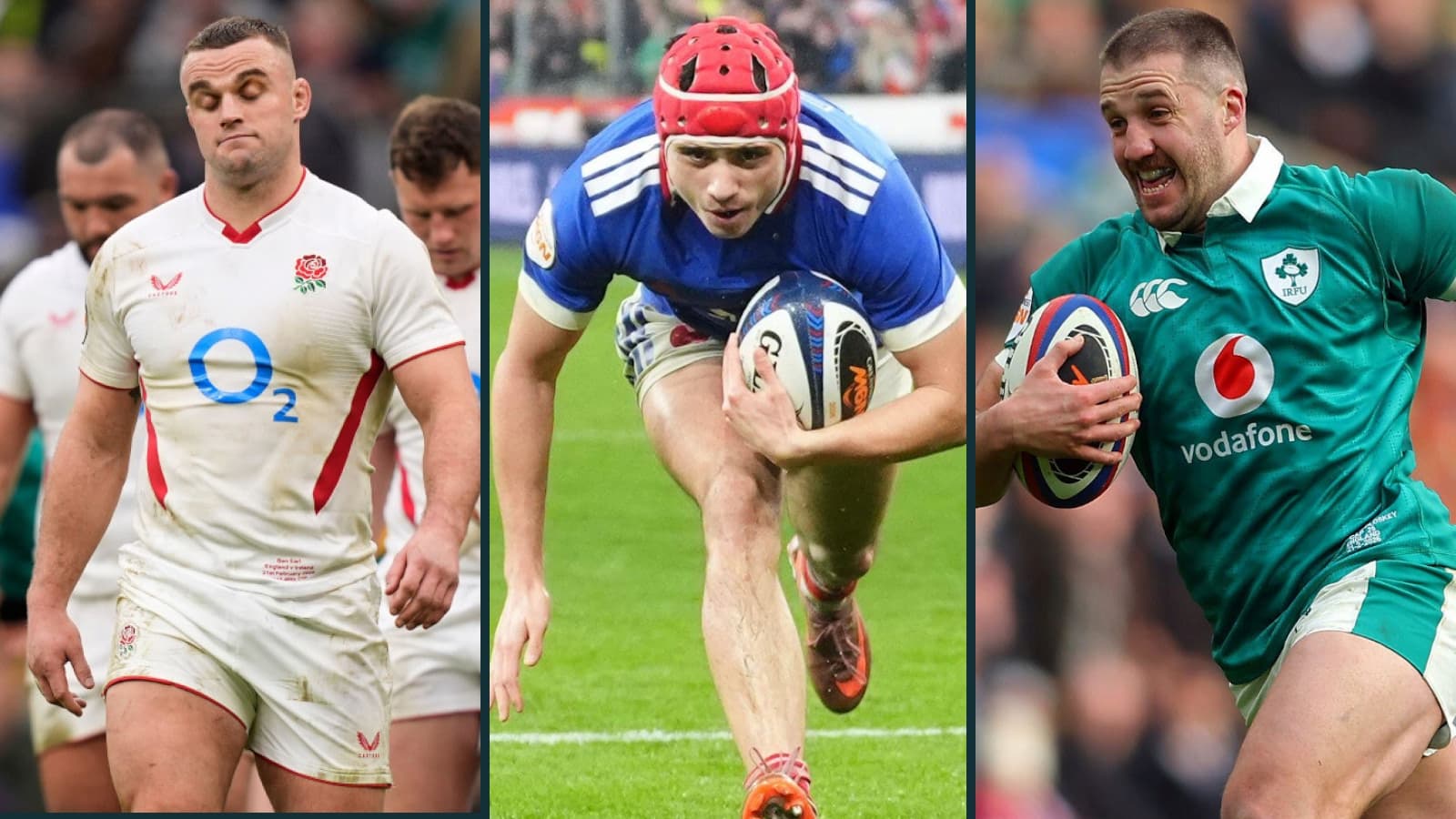
The 2026 Six Nations Championship has seen France continue its dominance of rugby’s greatest annual tournament, Italy emerge as a genuine force and England fall from a great height.
Scotland and Ireland have saved their best performances in a long time for Steve Borthwick’s team and Wales have continued to lose. With two rounds to go Fabien Galthie’s side are the only side unbeaten, yet lose at Murrayfield on Saturday and the Scots could go top.
We have been treated to another fascinating tournament in which established stars have shared the headlines with breakthrough talents. Here, Planet Rugby runs the rule over the first three rounds and picks out 10 performers worthy of praise.
Matthieu Jalibert (France)
France have been electric and there are numerous reasons for that, none bigger than the contribution of their Bordeaux ringmaster.
Scrum-halves, we all know, tend to dictate play in French rugby and Antoine Dupont is as good as they come. Yet his half-back partner has been sensational, squeezing every ounce of potential from France’s attacking game.
A question mark has long hung over Jalibert at this level. He has all the skills yet also a mind of his own. Famously, when omitted from the side to play New Zealand in November 2024 he asked to return to his club rather than warm the bench.
When Romain Ntamack was then red carded against Wales at the start of the 2025 Six Nations, boss Galthie and Jalibert buried the hatchet and the fly-half returned, only to have a horror show against England.
A combination of red-hot form for Bordeaux and injuries to Ntamack kept him in the picture post-Twickenham and a year on, UBB are not only European champions, Jalibert is eclipsing even Finn Russell with his playmaking.
France average over 40 points and six tries a game. Although Jalibert missed round three due to illness, he has more try involvements (6) than any other player, no-one has more offloads and only Thomas Ramos has more line-break assists. In short, he has been a joy to watch.
Finn Russell (Scotland)
A major narrative of this season has been the negative effect, in terms of performance, the British and Irish Lions tour has had on those who toured Australia last summer.
Every four years we see it. Players who bust a gut for a year to make the squad then live with the stress and expectation of delivering in the famous red jersey, pay the price on their return home.
Until they won at Twickenham observers pointed to Andy Farrell’s Lions-heavy Ireland as a case in point. Yet Russell started all three Tests for the Lions and has been superb for club and country pretty much all season.
Against England he had the ball on a string, picking apart Maro Itoje’s side with pin-point precision. At least one media outlet awarded him 10 out of 10. In Wales a week later he masterminded Scotland’s comeback; the speed of thought in his restart kick for Darcy Graham’s try quite outrageous.
The prospect of Russell and Jalibert pitting their wits against each other in Edinburgh this coming weekend is mouth-watering.
Stuart McCloskey (Ireland)
Nobody had McCloskey on their bingo card at the start of the tournament, when Ireland lacked any sort of punch in France and suffered their biggest Six Nations defeat under Andy Farrell.
The big Ulsterman had 24 caps to his name and been in and out of favour for a decade as Bundee Aki, Garry Ringrose and Robbie Henshaw dominated midfield selection in a team winning two Grand Slams, three championships and four Triple Crowns.
A week after Paris McCloskey got himself noticed with the neat offload for the try scored by Rob Baloucoune which beat Italy. He then went to Allianz Stadium and played a starring role in a record Irish win at Twickenham.
10 years since making his debut in the same fixture he announced his arrival as a major player on the international stage; taking the game to the opposition with his forceful carries and shaming England with a defensive effort to run down Marcus Smith that laid bare the difference between the two teams.
His 42 carries across the competition place him behind only Ben Earl, Aaron Wainwright and Theo Attissogbe. His metres-in-contact put him fourth in the Six Nations pecking order. Joe Schmidt might not have rated him, but Farrell certainly does.
Tommaso Menoncello (Italy)
If McCloskey put the fear of God into England, imagine how Borthwick’s men are feeling about coming up against this fella.
Menoncello is one half of the best midfield combination in the championship. The fact Juan Ignacio Brex has missed the last two rounds for personal reasons only makes the contribution of Toulouse-bound Tommy more impressive.
Playing for a team which has picked up eight Wooden Spoons in the 10 years the 23-year old is dynamite on both sides of the ball. In 2024 he was player of the championship.
This year, his try was the difference as Italy beat Scotland in round one. His brilliant break looked to have set the Azzurri up for victory in Dublin only for Louis Lynagh’s ‘try’ to be chalked off for a forward pass.
Only three players have made more line breaks, he ranks fourth in metres per carry and eighth in metres made. He has beaten 10 defenders and 75 per cent of his carries are dominant.
With Brex due back this week and England’s midfield thinking all over the place post-Ireland, opportunity knocks for Italy.
Ben Earl (England)
Since beating Wales in round one England‘s title challenge has disintegrated alarmingly; a team unbeaten in 12 dismantled first by Scotland then Ireland. There have been no redeeming factors. Well, perhaps one. His name is Ben Earl.
In a side which has lost its way, the Saracens back-row continues to go forward. Nobody in the championship has come close to Earl’s 59 carries, nor his 114 metres in contact.
No England player has made more dominant tackles. Only three players across the competition boast more metres ball in hand, only four have more line breaks.
Earl has worn different numbers in the last two games and, in the one before that, he put in a second half stint at 12. Few are a match for his versatility.
Against Italy he will win his 50th cap. It is incredible to think he had to wait three and a half years after his debut for his first start. His first 15 caps might have come off the bench but he has been England’s focal point ever since.
Jamison Gibson-Park (Ireland)
What Gibson-Park did to England at Twickenham on the third Saturday of February would have been remarkable even were he not 34 years old and been dropped to the bench the week before.
In the context of that and Ireland’s stuttering campaign through the autumn and first two rounds of this championship, the scrum-half’s virtuoso display stands as one of the performances of the year.
He bamboozled England with speed of thought and deed. He scored one try, had a second disallowed and made the assist for Baloucoune’s score which had the game won inside half an hour.
Ireland are an ageing team and it remains to be seen whether this group can make it through to a World Cup still 18 months away. Before that, they need to prove to themselves that they can back up against Wales and Scotland what they did against England.
Where there is little doubt is that Gibson-Park remains a key player for them and, with him in harness, they will fancy their chances of landing another Triple Crown.
Louis Bielle-Biarrey (France)
Where to start with this try-scoring phenomenon? In simple terms he is rewriting Six Nations history. Last year he set a single season tournament record with eight tries as France won the title, last week he became the first player to score a try in eight consecutive championship matches.
The Bordeaux flyer is untouchable at the moment. In the past 17 months he has played 50 times for club and country and scored 55 tries. He has won both Champions Cup and Six Nations, been voted player of the tournament in the latter and shortlisted for world player of the year.
His understanding with club mate Jalibert has paid rich dividends at Test level and, even when Jalibert cried off ill against Wales, the pocket rocket on the wide outside ploughed on regardless.
Louis Bielle-Biarrey: Records tumble around France star as Damian Penaud’s heels come into focus
In any other era Attissogbe, France’s other wing, would be getting all the attention. He has been brilliant. Damian Penaud, the nation’s record try scorer, would also still be in the starting line-up.
Yet Bielle-Biarrey has hogged the headlines from the moment he beat former European sprint champion Christophe Lemaitre in a foot race on the eve of the tournament.
It seems incredible now to think he went into the last World Cup as an unknown 20-year old, the youngest player in France’s squad. By the next one there will not be a person on earth who does not know of his lavish talents.
Lorenzo Cannone (Italy)
When Rassie Erasmus predicted Italy would finish second or third in this Six Nations the chances are he had two thoughts in mind. First, how good is that Italian midfield! Second, those Cannone boys are serious physical specimens.
Number eight Cannone has again been a revelation for the Azzurri. Through three rounds he has made 52 tackles, second only to Wales’ Dafydd Jenkins. In three matches he has racked up 10 dominant hits, almost twice as many as any other player in the tournament.
Italy’s forward pack did a demolition job on Ireland and yer man Lorenzo led the way in defence with 18 tackles in just 66 minutes, four dominant. The following week he took on France and put in a game-high 15.
He and lock forward brother Niccolò have experienced thin times with Italy but are now part of a pack arguably without equal in the Six Nations.
As England have found, perceptions can change fast in Europe’s showpiece tournament, but with England next at Stadio Olimpico and then a trip to Wales the potential is undoubtedly there for Italy to prove Erasmus right.
Mickael Guillard (France)
It is a toss up between Lyon’s young thruster and the great Charles Ollivon for France’s most effective second-row in this championship, but Guillard gets the nod by virtue of it being his breakout tournament.
He has been around the Test scene for a couple of years, since making his debut on tour to Argentina in 2024. A year later he caught the eye playing number eight for an understrength France team in New Zealand, dubbed ‘the best back-row on the pitch’ in the third Test.
Want more from Planet Rugby? Add us as a preferred source on Google to your favourites list for world-class coverage you can trust.
But it was his performance against Paris on opening night in this tournament which wrote his name up in lights. France obliterated champions Ireland with a statement performance.
Guillard, all 6’5″ and 19 stone of him, was named player of the match for 50 minutes’ work in which he won two turnovers and contributed a match-leading 16 carries.
Eddie James (Wales)
He has yet to win a Test match and plays for a country on course for a third consecutive Six Nations whitewash. Yet James has caught the eye and will be in the minds of Ireland’s analysts this week heads of Wales’ visit to Dublin.
Wales are not going to win any prizes now, that much is clear. It is the future they are investing in: short term pain for, they hope, measurable gain in the medium to long term.
On that front James is a key figure. The Scarlets centre is 23 and runs hard. Against France in round two he impressed rugby greats Martin Johnson and Sam Warburton. Against Scotland last weekend he improved again.
“He is growing with confidence,” said Welsh midfield great Jonathan Davies, hailing James’ “best” international outing yet. “We talk about running angry. It felt like he had an edge about him. Elbow first, looking to get over the gain line. I thought he was brilliant.”
James is a 12 by trade being deployed in the 13 slot. He is far from the finished article. But Warburton knows a gem when he sees one. “I am looking at somebody who can take over this midfield and I saw enough in Eddie today,” he told the BBC after Wales’ French test.
James against McCloskey this Friday under the Aviva lights promises to be an intriguing head-to-head. Not for the faint-hearted.