
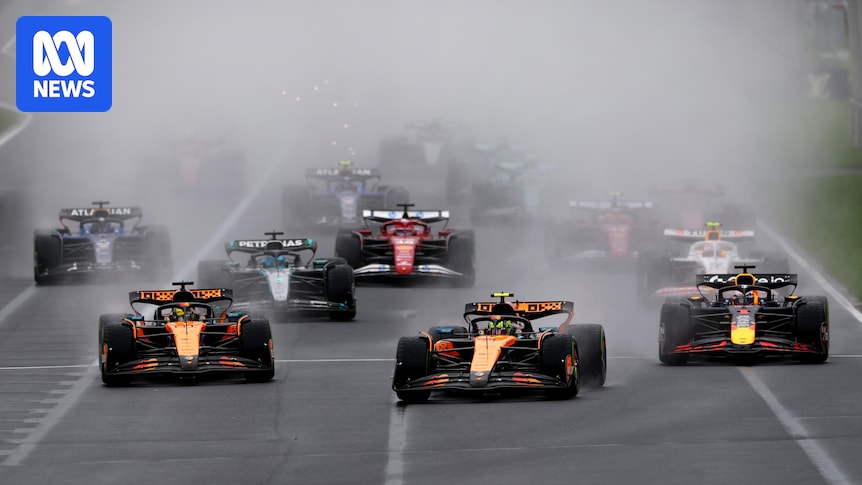
New cars, new drivers and one entirely new team descend on Melbourne as Formula 1 returns for the 2026 season.
The Australian Grand Prix will be held this weekend at Albert Park, ushering in a new era for the series.
With preseason now finished, here are some of the basics to know ahead of this weekend’s Australian Grand Prix.
When is the F1 Australian Grand Prix?
The Australian Grand Prix will be held on Sunday, March 8, at the Albert Park circuit in Melbourne.
The Australian Grand Prix will be the first race of the 2026 F1 championship.
Here is when the grand prix will begin in each Australian state and territory.
3pm AEDT: Victoria, NSW, ACT, Tasmania2:30pm ACDT: South Australia2pm: AEST: Queensland1.30pm ACST: Northern Territory12pm: AWST: Western AustraliaWhat is the Australian Grand Prix weekend schedule?
The Australian Grand Prix weekend will be held from Friday, March 6 to Sunday, March 8.
Practice sessions will be held on the Friday and Saturday, with qualifying held on Saturday afternoon.
The grand prix will be contested on the Sunday.
Free practice 1: 12:30pm-1:30pm, Friday, March 6Free practice 2: 4pm-5pm, Friday March 6Free practice 3: 12:30pm-1:30pm, Saturday, March 7Qualifying: 4pm-5pm, Saturday March 7Grand prix: 3pm, Sunday March 8
All times are in AEDT
How can I watch the Australian Grand Prix?
The F1 Australian Grand Prix can be watched on commercial and pay television, as well as streaming platforms.
Network 10 is the free-to-air broadcaster, with the race being shown on Channel 10 and streamed on 10 Play.
Pay television provider Foxtel will also broadcast the Australian Grand Prix on Fox Sports channel 507. You can also stream online via Foxtel Go or on Kayo.
ABC Sport will be publishing a live blog of the Australian Grand Prix on Sunday, March 8.
Who are the drivers and teams in the 2026 F1 season?
The 2026 F1 championship has 11 teams, each fielding two drivers.
Quick hits: F1 preseason testing
Audi enters the sport for the first time as a constructor, fully taking over from the team formerly known as Sauber.
Cadillac is the brand new team for 2026.
The American outfit makes its F1 debut in Melbourne, with plenty of buzz and excitement for the future.
There is one rookie on the grid to start the 2026 season.
Red Bull Academy driver Arvid Lindblad will make his F1 debut in Melbourne, driving for Racing Bulls.
This is the first season since 2016 that features more than 10 teams.
TeamDrivers (car number)AlpinePierre Gasly (10), Franco Colapinto (43)Aston MartinFernando Alonso (14), Lance Stroll (18)AudiGabriel Bortoleto (5), Nico Hülkenberg (27)CadillacSergio Perez (11), Valterri Bottas (77)FerrariCharles Leclerc (16), Lewis Hamilton (44)HaasEsteban Ocon (31), Oliver Bearman (87)McLarenLando Norris (1), Oscar Piastri (81)MercedesKimi Antonelli (12), George Russell (63)Racing BullsLiam Lawson (30), Arvid Lindblad (41)Red Bull RacingMax Verstappen (3), Isack Hadjar (6)WilliamsAlexander Albon (23), Carlos Sainz Jr (55)How many races are in the 2026 F1 season?
The 2026 F1 season will be contested over 24 rounds.
Each of the 24 rounds will have a grand prix, while six of the rounds will also hold a sprint race (one-third of a grand prix).
There is a brand new circuit on the calendar for 2026.
The Spanish Grand Prix (round 13) will be held in Madrid for the first time on a street circuit.
Previously, the Spanish Grand Prix has been held in Barcelona, which is still on the calendar as the Barcelona-Catalunya Grand Prix (round nine).
RoundGrand prixCountryCircuit, cityRace dateRound 1Australian Grand PrixAustralia Albert Park Circuit, MelbourneMarch 8Round 2Chinese Grand PrixChinaShanghai International Circuit, ShanghaiMarch 15 (sprint March 14)Round 3Japanese Grand PrixJapanSuzuka Circuit, SuzukaMarch 29Round 4Bahrain Grand PrixBahrainBahrain International Circuit, SakhirApril 12Round 5Saudi Arabian Grand PrixSaudi Arabia Jeddah Corniche Circuit, JeddahApril 19Round 6Miami Grand PrixUnited StatesMiami International Autodrome, Miami GardensMay 3 (sprint May 2)Round 7Canadian Grand PrixCanadaCircuit Gilles Villeneuve, MontrealMay 24 (sprint May 23)Round 8Monaco Grand PrixMonacoCircuit de Monaco, MonacoJune 7Round 9Barcelona-Catalunya Grand PrixSpainCircuit de Barcelona-Catalunya, MontmelóJune 14Round 10Austrian Grand PrixAustriaRed Bull Ring, SpielbergJune 28Round 11British Grand PrixEnglandSilverstone Circuit, SilverstoneJuly 5 (sprint July 4)Round 12Belgian Grand PrixBelgiumCircuit de Spa-Francorchamps, StavelotJuly 19Round 13Hungarian Grand PrixHungaryHungaroring, MogyoródJuly 26Round 14Dutch Grand PrixNetherlandsCircuit Zandvoort, ZandvoortAugust 23 (sprint August 22)Round 15Italian Grand PrixItalyAutodromo Nazionale Monza, MonzaSeptember 6Round 16Spanish Grand PrixSpainMadring, MadridSeptember 13Round 17Azerbaijan Grand PrixAzerbaijan Baku City Circuit, BakuSeptember 26Round 18Singapore Grand PrixSingaporeMarina Bay Street Circuit, SingaporeOctober 11 (sprint October 10)Round 19United States Grand PrixUnited StatesCircuit of the Americas, AustinOctober 25Round 20Mexico City Grand Prix MexicoAutódromo Hermanos Rodríguez, Mexico CityNovember 1Round 21São Paulo Grand PrixBrazilAutódromo José Carlos Pace (Interlagos), São PauloNovember 8Round 22Las Vegas Grand PrixUnited StatesLas Vegas Strip Circuit, Las VegasNovember 21Round 23Qatar Grand PrixQatarLusail International Circuit, LusailNovember 29Round 24Abu Dhabi Grand PrixUnited Arab EmiratesYas Marina Circuit, Abu DhabiDecember 6
*All dates reflect when the race will be held in the host city
What is new to F1 in 2026?
Formula 1 has gone through an overhaul for the 2026 season.
New chassis and engine regulations usher in a brand new era for F1, with the cars completely different to the ones used in 2025.
The front and rear wings on the cars will change throughout the lap, depending on whether the driver is going through corners, or speeding down the straight.
Loading Instagram content
When a driver is on a long straight, they will be able to open the rear wing of their car and flatten out the front wings to reduce drag.
The reduction in drag will allow the car to achieve higher speeds.
While most teams have gone for the conventional rear wing that opens like a mailbox, Ferrari has designed a rear wing that rotates upside down.
Meanwhile, the engine remains a 1.6 litre V6 turbo, but it will produce a lot more electrical power than before, potentially three times as much.
These new engines are expected to get roughly 50 per cent of their power from the electrical system, compared to the previous engines, where around 20 per cent of power was electrical.
You can read more about what is new in F1 for the 2026 season by tapping this link.