
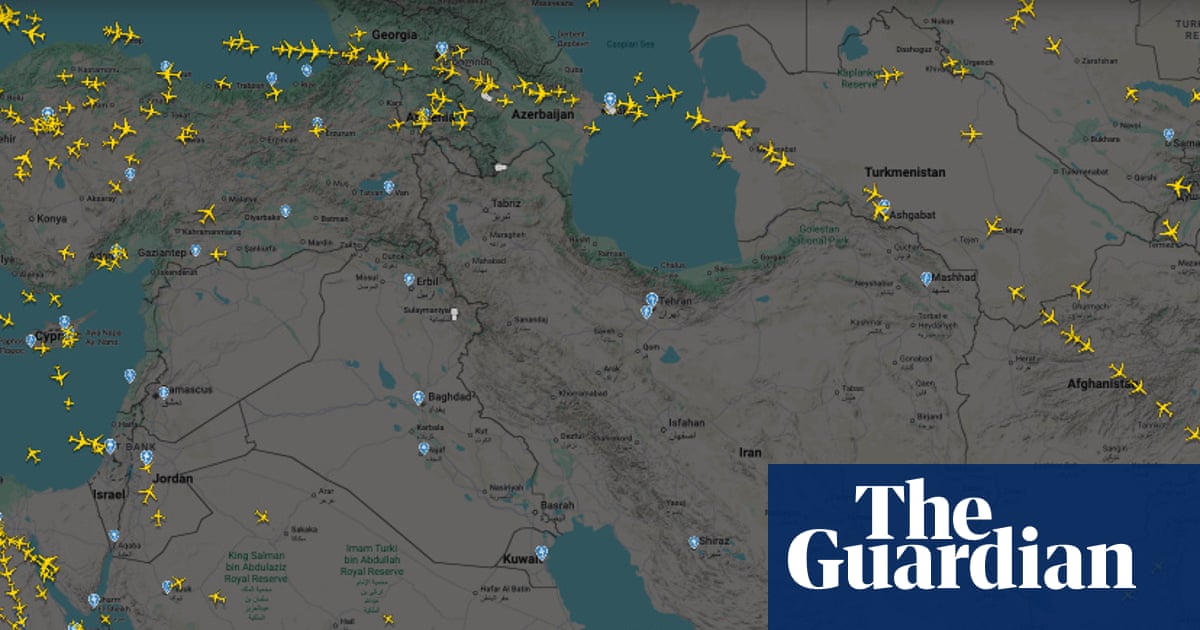
The Australian government says travellers should be prepared for “serious” disruptions in coming days amid the turmoil in the Middle East, saying there are limits to what the government can do to help those stranded in the region.
The foreign affairs minister, Penny Wong, said many Australians would be affected as countries shuttered their airspace amid the US and Israel’s attacks on Iran. Three major airports that connect Europe and Africa to Asia, in Qatar, Dubai and Abu Dhabi, halted operations as the latter two suffered damage during the conflict.
Sign up: AU Breaking News email
“We understand this will be a challenging time for many people, particularly those with family in the region or travel plans,” Wong said on Monday morning. “The Albanese government’s priority is the safety and security of Australians.
“We will continue to support Australians to navigate the disruption ahead, providing regular travel advice updates and consular assistance where we can, noting there are limits to what any government can do in a fast-moving and uncertain environment.”
Smartraveller recently updated its list of countries with “do not travel” advice to include many in the Middle East, including Bahrain, Iran, Iraq, Israel, Kuwait, Lebanon, Palestine, Qatar, Syria, the United Arab Emirates and Yemen.
Australians are encouraged to reconsider the need to travel to Jordan, Oman and Saudi Arabia.
Major airlines, including Emirates, Etihad and Qatar Airways, transit through those nations. All three airlines suspended operations, offering those on flights in the coming days options to rebook or request a refund.
Monday morning flight data on flightradar24 showed no commercial aircraft in the airspace over the United Arab Emirates or Qatar.
Virgin Australia, which has a partnership with Qatar Airways, urged passengers on upcoming flights to “closely monitor their flight information and visit the Smartraveller website for the latest travel advice”, adding “the safety of our guests and crew is always our top priority”.
Qantas flights remained unaffected by the turmoil on Monday morning as the flag carrier does not operate any aircraft into Middle Eastern airports. The airline has a number of flight path options into Europe to avoid airspace if needed.
Wong said on Monday morning that there were about 115,000 Australians in the region, with about 11,000 travelling regularly in and out of Australia on Etihad, Emirates and Qatar Airways.
“It’s very difficult at the moment for government to provide a great deal of assistance in circumstances where flights are being cancelled, disrupted and their space is closed,” she told ABC News Breakfast. “First we need to see if commercial flights will restart.”
She would not yet commit to repatriation flights, saying the government believed the fastest way to see people return home would be the resumption of commercial options.
“There’s conflict in the region, we’ve seen loss of life across the region, and airspace is not open,” she told reporters in Canberra on Monday morning. “So whether or not it is an Australian flight or a commercial flight, the flights are not able to occur.”
ABC producer Lisa Needham told Radio National on Monday morning that she was stuck in Dubai while en route from Melbourne to the UK for a funeral.
After passing through Dubai as the conflict broke out, she said she had now been in the UAE for nearly 30 hours, adding that she was bused to a hotel but had trouble getting any information from her airline, Emirates, or hotel staff.
“It’s just really a case of sitting and waiting,” she said.
She, and hundreds of other stranded travellers, were told everything had been cancelled.
“We’ve definitely had quite a lot of, we believe, missiles being intercepted in the sky above us. You can hear it,” she said. “People become very uneasy, then they settle again.
“A lot of people are feeling pretty resigned, I think … that we’re not going to go anywhere anytime soon.”
Social media accounts for the UAE’s Australian embassy indicated many similar experiences, with citizens reporting difficulties getting through to consular staff. The embassy continued to urge any Australians there to shelter in place and follow instructions from local authorities.