
Lightning is the most dramatic electrical force in a thunderstorm – but it may not be the only one touching the forest canopy.
For the first time, scientists have observed tree leaves producing faint electrical sparks during active storms, revealing that entire canopies can leak tiny currents into the air.

Rather than a single lightning strike, forests may experience thousands of subtle electrical flickers – nearly invisible discharges that can alter leaf surfaces and nudge local air chemistry.
Using a van-mounted ultraviolet telescope, researchers tracked bursts of corona discharge hopping across leaf tips as storms passed overhead.
Meteorologist Patrick McFarland at Penn State recorded repeated flashes across multiple storms and tree species, suggesting this quiet exchange between sky and canopy may be more common than once thought.
Where the electrical spark appears
One summer thunderstorm offered the clearest window yet. For 90 minutes, the ultraviolet camera remained fixed on three branches of a sweetgum tree as dark clouds rolled overhead.
During that stretch alone, researchers recorded 41 separate – faint electrical leaks that flared from sharp leaf tips.
Some flashes lasted up to three seconds, and the glow frequently hopped from one leaf edge to another as the storm’s charge shifted above.
“These things actually happen. We’ve seen them. We know they exist now,” said McFarland.
Charging the forest canopy
High in a storm cloud, positive and negative charges drift apart, and the ground below begins building the opposite charge.
That built-up charge moves through the tree roots and trunk toward the highest points, then concentrates at leaf tips, where the air begins to conduct electricity.
When charge leaks off sharp edges, it forms a corona – short for corona discharge – and releases a faint glow far weaker than lightning.
Even though the discharge stays cool and localized and does not shatter wood, it can still change leaf surfaces.
Ultraviolet reveals hidden currents
In open air, the visible glow from corona is far too dim to stand out beneath storm clouds. So researchers tuned their camera to ultraviolet light – a band invisible to human eyes – allowing them to capture flashes that would otherwise go unnoticed.
Lab calibrations then translated that ultraviolet brightness into electrical current, measuring about a millionth of an amp flowing from a single tree branch.
That step was crucial because it is the current, not the glow itself, that determines how much energy reaches the leaf.
At the sharp tips of leaves, that energy concentrates. In laboratory tests, corona discharges scorched tissue and appeared to damage the cuticle – the waxy coating that helps leaves retain water.
A single burst may leave only a tiny mark, but repeated storms could gradually expand that injury across many leaves.
What remains unclear is how trees respond over time. Without careful field checks after storms, scientists still do not know which species recover quickly and which may lose photosynthetic capacity over weeks or even seasons.
Electrical sparks reshape the air
Beyond scorching leaf tips, corona may also reshape the air forests breathe during storms.
As electrical charge leaks from sharp edges on trees, it can spark the formation of reactive chemicals. A 2022 study found that corona discharges can boost levels of the hydroxyl radical – a short-lived but powerful molecule that helps scrub pollutants from the atmosphere.
When those chemical reactions surge, they can rapidly break down natural gases released by leaves and nudge local ozone and particle levels upward.
The effect likely stays concentrated near the treetops, since fast-moving storms and rainfall quickly dilute and wash out the burst.
Even so, each flicker represents a small pulse of atmospheric chemistry – repeated again and again as thunderclouds pass overhead.
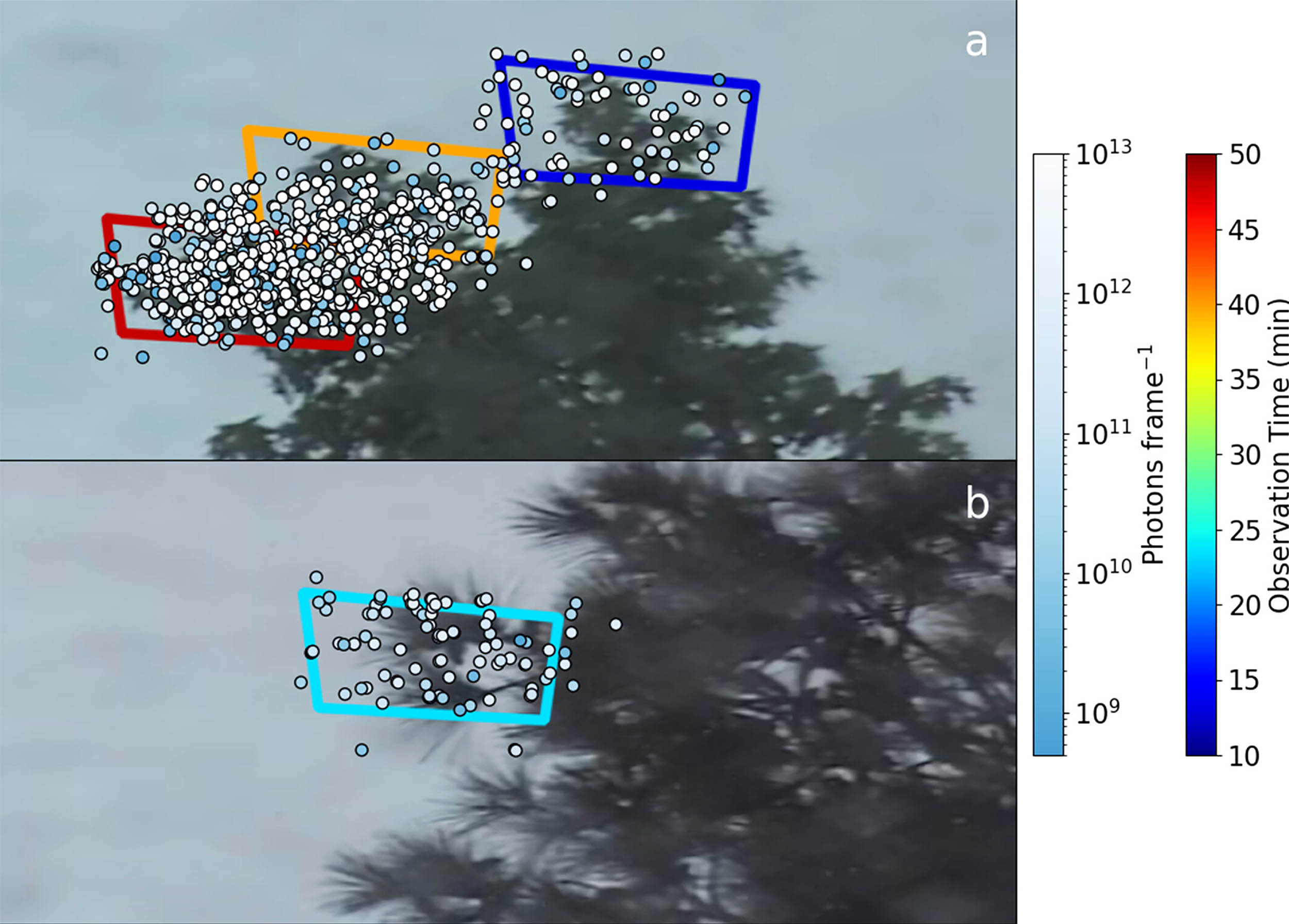 Corona UV signals observed under a thunderstorm on June 27, 2024. Approximate location of all 859 corona UV signals observed during the ∼1.5-hr observation period on a sweetgum tree. Credit: Geophysical Research Letters. Click image to enlarge.Tree electrical spark is hard to measure
Storm winds keep leaves in constant motion, twisting and tilting their tips toward or away from the sky. Corona tends to flare where a leaf points most directly upward, and even small shifts in angle can change how strongly electrical charge concentrates.
Wet surfaces can also redirect current to new edges, causing the glow to hop unpredictably from tip to tip. Pine needles, with their naturally sharp points, showed similar flickering alongside broadleaf species like sweetgum.
That motion makes the phenomenon difficult to capture. The ultraviolet telescope could frame only a small slice of canopy at a time, and overlapping leaves sometimes blocked one another.
Faint discharges likely slipped below the camera’s detection threshold, making undercounts almost inevitable when estimating activity across entire forests.
Even so, similar signals appeared during four additional storm chases from Florida to Pennsylvania, spanning multiple tree species.
“It’d probably look like a pretty cool light show, as if thousands of UV-flashing fireflies descended on the treetops,” McFarland said.
Mapping sparks across forests
With field confirmation in hand, scientists can now move beyond proof of concept and begin tracking how often corona appears across different forests and how leaves respond in the days that follow.
By teaming up with ecologists, McFarland hopes to pair ultraviolet footage with detailed leaf surveys that monitor surface damage and dehydration after storms.
Adding air sensors near treetops could reveal how strong each chemical burst becomes, while storm data may help link corona events to specific cloud setups.
Until researchers map the glow across entire stands of trees and repeat those measurements through many storms, estimates of forest-wide impact will remain rough.
Still, the work changes how scientists think about storm-forest interactions, showing that trees and weather connect through more than lightning – and that a once-hidden electrical process can now be measured directly to improve tree-health studies and local air models.
The study is published in Geophysical Research Letters.
—–
Like what you read? Subscribe to our newsletter for engaging articles, exclusive content, and the latest updates.
Check us out on EarthSnap, a free app brought to you by Eric Ralls and Earth.com.
—–