
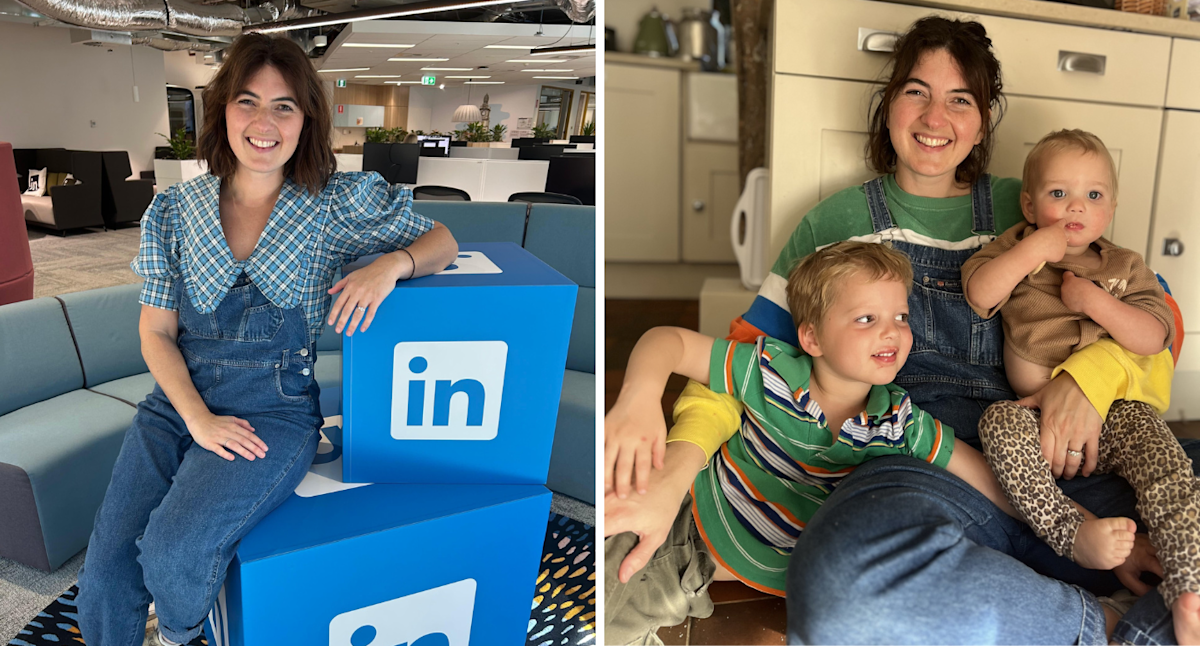
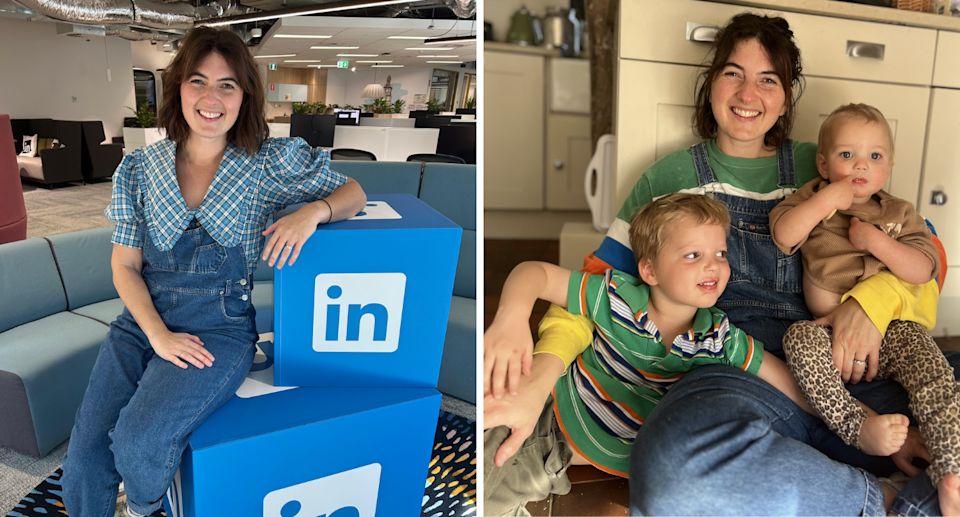
 Natalie MacDonald was made redundant from her job at LinkedIn in May last year. (Source: Supplied)
Natalie MacDonald remembers feeling like the “world fell out from underneath” her when she found out her role had been made redundant. Her job loss was part of what has now been dubbed “the AI transformation”, with some of Australia’s biggest companies announcing mass lay-offs in recent days.
After seven years at LinkedIn, MacDonald found out her role as senior news editor had been eliminated at 1.00am in the morning. The Sydney mum-of-two had returned from maternity leave just six weeks prior and had been up late with her baby, doing the classic “working parent juggle”.
“LinkedIn, like many tech companies globally as a US-centred organisation, we kind of thought that something was coming,” she told Yahoo Finance.
“So when the big company-wide email came that there was going to be restructures, it wasn’t really such a surprise.”
RELATED
MacDonald’s redundancy was part of wider layoffs at Microsoft, who owns LinkedIn, last year. Three roles in Australia’s editorial team were eliminated. Microsoft shed thousands of jobs globally last year as part of a broader restructuring effort as it invests in AI.
MacDonald said she had ironically decided to come back to work full-time, rather than part-time, partly because she was worried she was at risk of redundancy and didn’t want a reduction in her hours to impact any payout.
She later received a calendar invite for a meeting to confirm that her role was among the unlucky ones that had been impacted.
Do you have a story to share? Contact tamika.seeto@yahooinc.com
 MacDonald used her redundancy payout to pause and pivot, starting a consultancy company a few months later. (Source: Supplied)
In the last week, some of Australia’s biggest companies have announced mass layoffs related to AI.
WiseTech Global, an Australian logistics software business, announced it would be cutting 2,000 jobs over the next 18 months as part of an AI transformation. The redundancies will impact about 29 per cent of staff across 40 countries.
Afterpay and Square owner Block confirmed on Friday it would slash 4,000 jobs, or about 40 per cent of its workforce. Co-founder Jack Dorsey pointed to AI tools as the main reason behind the move, saying they had “changed what it means to build and run a company”.
Commonwealth Bank also recently confirmed 300 job cuts at the same time as it introduced a $90 million ‘Future Workforce Program’ to adapt AI into its workforce. In August last year, the bank notably announced and then reversed 45 job cuts after introducing an AI voice-bot.
Telstra, meanwhile, is expected to cut more than 200 jobs as it rolls out AI capabilities and sends some roles offshore.
New data from Randstad found 32 per cent of Aussies were worried about AI-driven job losses.
One in three believed their job would “disappear” due to AI in the next five years, with the same proportion believing their job prospects had worsened compared to a year ago due to the rapidly emerging technology.
Millennials (37 per cent) and Gen X (33 per cent) were the most worried about their jobs disappearing, while Gen Z (28 per cent) and Baby Boomers (22 per cent) were less concerned.
The survey revealed an apparent training gap, with less than half of workers saying they had received training on AI tools. But that was compared to 56 per cent of employers who claimed their workforce had been trained to manage the impending AI shift.
Randstad’s director of public sector and business support Amelia O’Carrigan said we may be heading towards an “AI skills cliff” where employers are moving quickly to adopt AI, but workers haven’t had the training to keep up.
Randstad’s Amelia O’Carrigan said we could be heading for an AI skills cliff for Aussie workers. (Source: Randstad)
“Without proper training, AI doesn’t boost productivity, it unfortunately erodes confidence. Companies need to focus on narrowing this gap otherwise we’ll begin to see job insecurity take hold,” she said.
“This is a problem that businesses can’t afford to ignore. Once AI becomes embedded in everyday roles, workers who haven’t been upskilled don’t gradually fall behind, unfortunately they fall off a cliff.”
SEEK found demand for AI-related skills had increased 80 per cent since early 2024. The most in-demand skills include machine learning, generative AI and LLMs, agentic AI, AI governance and ethics, and machine learning operations.
Now nearly one year on, MacDonald said redundancy was “still a journey” and, like many people, the experience raised questions around her professional and personal identity.
The redundancy also came at the “most expensive time” in her and her husband’s lives, with their two young kids aged 4 and 1 at the time.
But MacDonald said she was grateful for the job and how “life-changing” it was, with the mum gaining a 43 per cent pay rise when she initially joined the tech company.
“I did a lot of work that I’m really, really, really proud of, and I’m quite comfortable in the fact that, yes, while my role was eliminated, it was my role that was eliminated. It wasn’t a judgment on myself,” she said.
MacDonald said the “sad fact” was that we were already seeing broad and deep cuts related to AI, and more would be coming.
MacDonald believes organisations will have to reconcile their internal, client and product experience if they continue to cut human capacity at the same speed and pace.
“AI can only go so far. There is a ceiling. It can take a mediocre idea from mediocre to good, but that is about it,” she said.
MacDonald expects human skills, such as strategic thinking, critical analysis and storytelling, will become key.
“I think that there will be some organisations that do realise that that’s what they’re missing, or that is what they are losing through what is currently fairly frenzied job cuts,” she said.
MacDonald said her redundancy ultimately forced her to “pause” and “pivot”.
She used her redundancy payout to start her own consultancy firm, Working @ It, a few months later, where she uses her skills to help others in uncertain positions, or organisations and professionals to future-proof themselves.
Get the latest Yahoo Finance news – follow us on Facebook, LinkedIn and Instagram.