
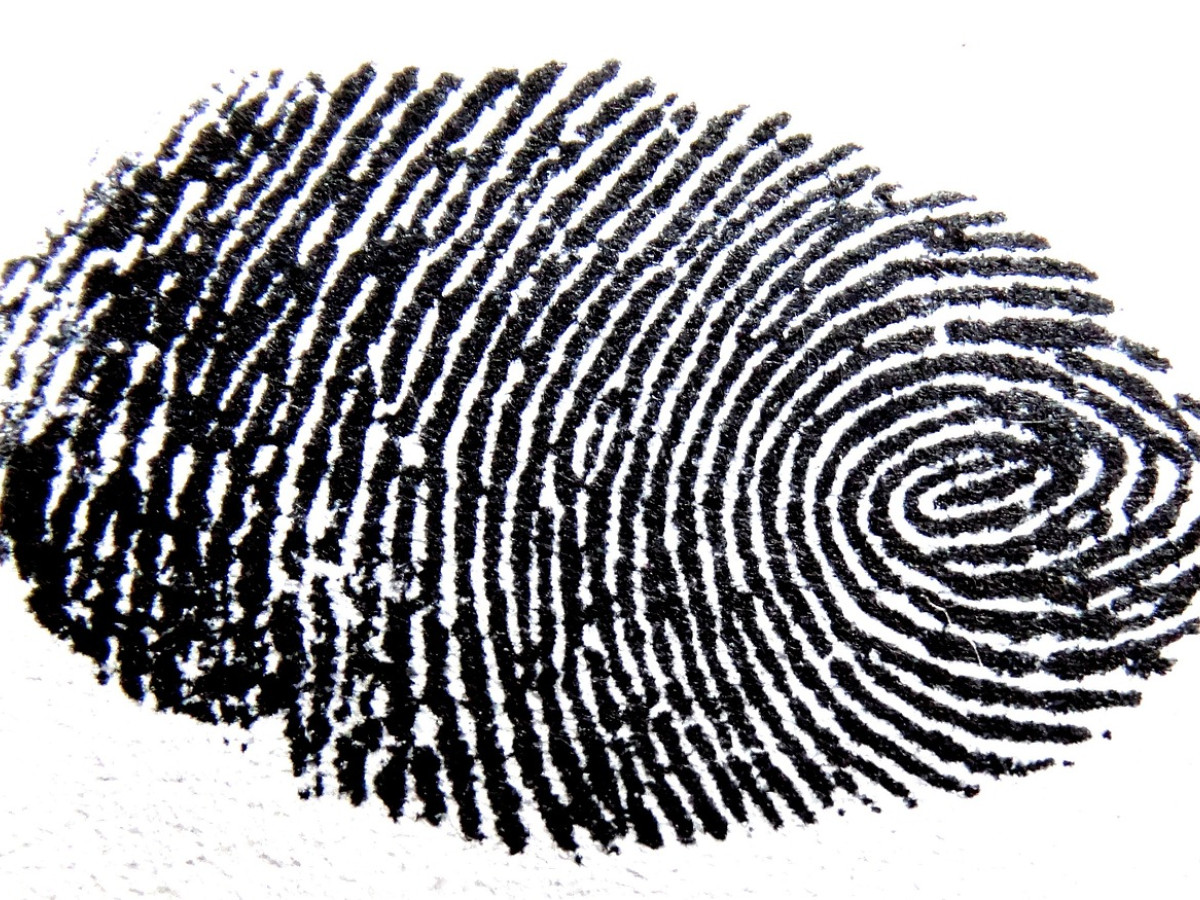
Humans, and just a handful of other species have fingerprints; but what purpose do these whorls and circles serve? Historically, scientists have speculated that they may improve grip in wet conditions, and the systems of ridges almost certainly assist our sense of touch, although no one could actually prove that, in vivo. At least, until now. Because, as she explains to Chris Smith, Giulia Corniani, at Harvard, has been using a technique called OCT – optical coherence tomography – to see inside the skin – in real time – as a fingertip slides across a transparent plastic surface. She has been able to document how the forces are conveyed into the skin and deform nerve endings to produce the sensations that they do when we reach out and touch a surface, or delve into a pocket for a key or a coin…
Giulia – At a basic level, we wanted to answer a question, what physically happens inside your fingerprint when you touch something? We want to understand how our skin deforms and how this mechanical stimulation has an impact on the subsequent information encoding that is happening in the nervous system.
Chris – So, how did you actually approach getting underneath this?
Giulia – It’s difficult to look at what’s below the skin surface in vivo conditions. And so, most of the studies existing in the literature just look at what’s happening on the skin surface, or they do a biopsy of small skin pieces and look at them with microscopes. We wanted to see what’s happening during a real tactile interaction because the skin elasticity and the skin properties really change when we just took a piece of skin out of the hand. And so, we found this imaging technique that allowed us to look into what’s happening below the skin surfaces. And we built this experimental setup to take images in vivo during a real tactile interaction.
Chris – What is that approach then? And how does the experiment work? Talk us through it.
Giulia – So basically, we use this imaging technique, which is called optical coherence tomography, which is something like ultrasound, but that uses lights. And we had some plastic transparent surfaces that we were sliding over the skin surface. And we were using this optical coherence tomography to image what was happening below the skin surface during the interaction between these plastic surfaces and the tip of the fingerprint.
Chris – How deeply into the skin can you image with this?
Giulia – So with these images, we can see for about half a millimetre inside the skin. But in this tiny depth, there is a lot of things happening. So basically, the skin has a layered structure and there are different layers that have different physical properties. And the first layer is called stratum corneum, which is basically the protection of our skin. And below the stratum corneum, there is the viable epidermis. And just below the viable epidermis is where the tactile receptor sits. And so, we were really interested to see how the mechanical deformation happening at the skin surface propagate to the viable epidermis to how the tactile receptors are receiving the tactile deformation that is happening at the surface.
Chris – Those are basically the nerve endings, aren’t they, that have got specialised endings that can pick up things like being squeezed, stretched, vibrated?
Giulia – Yeah, correct. So the fingertip contains thousands of these specialised nerve endings that respond to different aspects of any tactile interaction. There are some that respond more to stretch, others that respond to vibration. And overall, this small structure can encode any kind of stimulus happening on the skin surface with a very, very high resolution. So basically, we can perceive tactile stimulus that are like very small, very tiny, with a lot of precision.
Chris – Can you actually see those nerve endings being stimulated? So can you see them deforming or stretching or effectively receiving the signals? Because obviously, it’s one thing to watch as the finger slides across the surface and these changes happening, but do you actually know that those particular nerve endings are responding to the stimuli you can see going in there?
Giulia – So with our imaging technique, we cannot see those nerve endings responding, but we know from other studies in the literature that are collected with different techniques that the nerve endings respond to the sliding interaction. And we also know where these nerve endings sit because they sit precisely at the interface between the viable epidermis and the lower layer. And so we can infer from this that the mechanical stimulation we can image with our technique corresponds to some precise nerve encoding.
Chris – And what does this reveal? When you do this, as you slide the digit across the surface and you see these changes effectively in real time, what’s actually happening inside the fingertip?
Giulia – The fingerprint ridges don’t behave just like rigid bumps that just bend sideways. Instead, what we saw is that the fingerprint ridges flatten and they shear internally. And this means that different parts of the ridge that form like the fingerprint ridge slide and like they move relative to each other. And so under vertical pressure, the ridge structure compresses. And during sliding, there is like this shear that propagates to the internal layer of the skin.
Chris – Does it make a difference though? Because if you look at a fingerprint pattern, how those ridges are organised, they’re in sort of whirls or circles. So does that mean that certain directions of movement of the digit at certain positions are going to be interpreted differently? How does the nervous system overcome that?
Giulia – Yeah, what was interesting to observe is that the deformations propagate through the internal layers of the skin. And there are like some kind of deformation that are enhanced by the skin layers. For example, we saw a high response during the stick to slip transition. This means that when we start sliding something over the fingerprint, first there is a phase where there is no relative movement between the surface and the fingertip. And this phase is called stick. And then at some point, the fingertips start sliding over the surface. And when there is this transition between stick and slip, there is the higher deformation into the skin layers. And this is our nervous system is particularly interested in the transition between two different events. And this is what signals, for example, when an object is sliding from our hands, and we can respond promptly to the sliding of an object.