
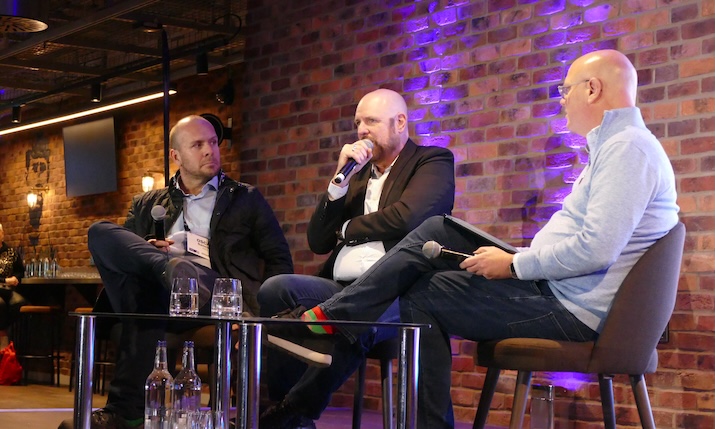
With the FIFA World Cup 2026 just a few months away, Oscar Sanchez, head of host broadcast production, FIFA, and Paul King, HBS, senior producer, FIFA World Cup 2026, took to the Football Summit stage to share production plans with SVG’s Ken Kerschbaumer last week
The creation of 16 discrete production teams is one of the biggest changes for this year’s tournament, helping to reduce the need for people to travel between the 16 venues across the USA, Canada and Mexico while also having a positive impact on budgets.
“The main difference here is that we need more crews, because we need to minimise the risk of people travelling across big countries like the US, Canada or Mexico,” said Sanchez. “We’ve been working with HBS for the last four or five years to identify the people that we are going to use and the best production model. It’s not about just finding people, it’s about the best production model to deliver a high-quality product and minimise risks.”
The teams will also have more of a global feel than previous tournaments. “Historically the teams have been very European focused because it’s a super-high-level crew of professionals,”” he added. “But this time we wanted to open the options more to people who live, breathe and enjoy football, and know the story of football as well as they do in Europe. I mean, nobody can say that the country that is the World Cup champions like Argentina don’t live and breathe football.”
The process of finding those directors is extensive to say the least, as Sanchez explained. “We do a follow up with all of the tentative candidates on a monthly basis. I’m constantly getting information about what games they’re directing so I can check on those games. We look at other tournaments to see how they perform and we get tapes of matches and look back at them. We do retrospective QC on some games to see how directors perform. The Club World Cup really gave us a chance to put some of those people in an actual situation of doing the matches. We used directors from Argentina, Mexico, the USA, Australia, and we saw how enthusiastic they were, how much they had a real passion and understanding of the game, and how much research the directors would do into teams and players that weren’t particularly well known, and all of those things are really important.”
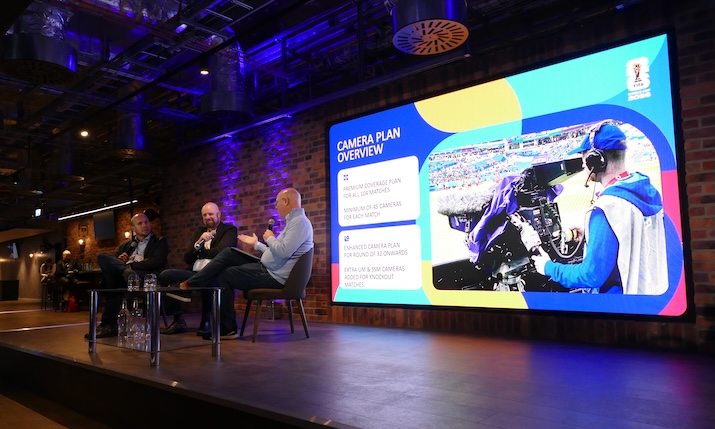
In terms of the camera plan for the tournament, there’s premium coverage for all 104 matches, with 45 cameras per match. This includes Polecams, cablecams and RefCams along with cine style and 360 cameras and digital-first devices.
“When we’re looking at those camera plans now, we don’t just put the broadcast cameras in, we put all of the ones that are going to be creating content, because content comes in so many different ways,” said King.
Things will be stepped up for the Round of 32 with additional Ultra Motion and super-slow motion cameras. Player cameras will also be reintroduced. “The group stage camera plan is pretty comprehensive to start with, so it’s not like we need to add half the number of cameras on again,” added King.
Following a successful debut on last year’s Club World Cup, RefCam will be used on every match during the tournament. However, it’s not a host broadcast camera, as Sanchez was keen to clarify.
“It’s a camera that was developed by our football technology and innovation team, along with our refereeing team, and then throughout the process, they made it available for us to use as part of the host feed. It has specific guidelines. It is not part of the ISO feeds available for the media partners. It is a camera that created a lot of impact, and now it is everywhere. I think the challenge on our side is to keep consistency across the 104 games. We’re working with Lenovo technology behind it to enhance it even more, and we’re excited because this is a great resource. Fans love it, so we’re excited for what could come up.”
“It’s not about just finding people, it’s about the best production model to deliver a high-quality product and minimise risks”
With the first crews due to arrive onsite in mid-May, the IBC in Dallas is also taking shape. As well as housing operations for the host broadcast and rights holders, this will also welcome the centralised VAR, plus all the content seen on the in-stadium big screens will be generated here.
The broadcast contribution network is through Verizon. “All cameras come to the IBC,” explained Sanchez. “We are doing centralised replays from there as well. From there, we generate the feeds that we distribute to our media partners, everything from SRT to satellite. For the first time in a World Cup, our partners will be able to access the same router that media partners have when they are inside at the IBC, even if they are outside. We have our post production and editing hub in London, replicating something that we did in Australia and New Zealand back in 2023 and it worked very well. We found a lot of talent in the UK, so we want to take advantage of that talent, and for us, from the budget perspective, it’s more advantageous.”
Graphics, replay and shading are all centralised, although there will be some replay operators on site in case of a loss of connectivity. “With 16 teams, that means you need 16 replay operators, maybe 10 or 11, per crew. That’s a lot of people. Having a centralised facility really allows us to get the best in the world, all under the same roof, all working on multiple matches,” said King.