
Film photography, vinyl records, analog synthesizers covered in knobs, cassettes, and other once-obsolete formats have enjoyed a sustained revival. Why is that? Boomers often dismiss this resurgence as a “hipster” trend. But when a trend has been growing, evolving, and attracting new participants for more than 25 years, it’s clear that something deeper is going on.
The Need for the Physical
Vintage film cameras and film cameras in general are enjoying an enormous resurgence.
Unlike older generations, younger generations were born into digital technology. They were born into a world of streaming music, endless digital photos viewed on their phones, AI, instant sharing, and an endless “firehose” news cycle. All of this exists in the cloud, with none of it feeling permanent. Digital overload.
You wouldn’t blame younger generations, including younger Millenials, Gen Y, Gen Z, Gen Alpha, for embracing something real, something physical.
“Studies show that people are hardwired for things like touch from infancy,” Beth McGroarty, the research director at the Global Wellness Institute, says. “I think it’s a rebellion against that shapeless, disembodied, throwaway digital world of screens, and a hunger for physical objects and tools that are touchable.” Whether these are film cameras or vinyl records, they are physical and tactile. They feel real.
Psychologists have long understood this. Studies on psychological ownership show that, from early childhood through adulthood, people form stronger emotional connections to things they can physically touch, manipulate, and control. A raw file buried on a hard drive doesn’t feel the same as a negative in a sleeve or a print on a wall.
Vinyl and the Return of Intentional Listening
One of the numerous record stores in Japan. The movement of younger people wanting more physical items seems to be across many countries.
Vinyl records are often the most obvious example—and for good reason.
Vinyl sales have grown since the mid-2000s, rising from under 1 million units in the mid-2000s. And it continues, unabated. Since 2016, vinyl album sales have increased from 13.1 million to 49.6 million in 2023. 224.9 million vinyl records have been purchased since 2016. And this has been driven largely by younger buyers who grew up entirely in the era of streaming (Vinyl Alliance study via Musically).
What’s interesting is why they buy records. Sound quality matters, but ritual matters just as much. Choosing a record, placing the needle, and flipping sides are physical actions—tactile and intentional.
That same reason shows up everywhere else in the analog revival.
Film Photography and the Value of Slowing Down
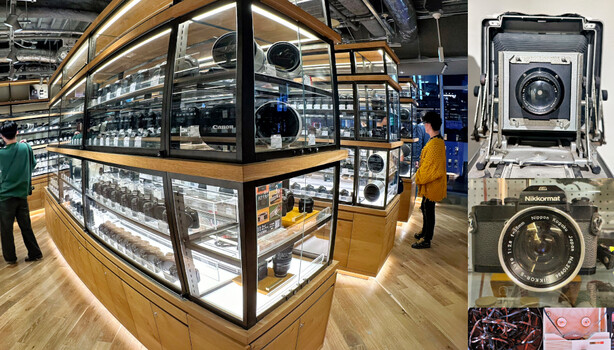
Japan’s cities often have popular, thriving camera stores with whole floors devoted to used film cameras.
Film photography has not been an exception to this movement toward the physical and the intentional. It’s slower, more deliberate, and less forgiving than digital. In fact, that’s the whole point.
You don’t shoot hundreds of frames and sort it out later. You think before pressing the shutter. You commit. Many younger photographers describe film as feeling more “real” and more meaningful than digital, even when they also own excellent digital cameras, as described here in Fstoppers.
This isn’t nostalgia, either. How could it be? Many of these photographers never shot film growing up. They discovered it recently. Market data reflects that reality, with renewed demand for film cameras, primarily driven by younger people. Even manufacturers like Pentax released a new film body, the Pentax 17, for the first time in decades. The demand for film has been so high that film manufacturers struggle to keep up production.
The same appeal applies to mechanical cameras, manual lenses, and darkroom printing. There is a sense of being real. It’s appealing. It’s physical. It’s fun.
Physical tools invite play.
Knobs, Switches, and Physical Control
Two Korg MS-20 analog patchbay synthesizers. The closer one is mine. Twenty of us rented the Integratron near Joshua Tree National Park and stayed up almost the entire night playing odd, improvisational music, an absolutely magical night.
In music, keyboards have followed a similar path. Analog synthesizers, modular rigs, and even electromechanical keyboards have exploded in sales. This was a direct reaction against the menu-driven keyboards of yesteryear and, later, software synthesizers and virtual keyboards found on computers. It continues to grow despite software synths being less expensive and more powerful.
Why? There is an appeal to electromechanical instruments. They feel real. A hammer strikes something and creates a sound. And even with analog synths, there is tactile satisfaction in turning physical knobs and sliders. It does something software doesn’t. It engages the body. It encourages exploration. It feels real. One walk past the analog and electromechanical booths at the NAMM Convention is rather convincing, as almost everyone at the booths is under 30 years old.
Cassettes, CDs, and the Power of Limits
Tape loops, part of a long evening of strange improvisational experimental music that about twenty of us played at The Integratron near Joshua Tree National Park.
The tangible appeal extends not only to vinyl, but even cassettes and CDs, formats once regarded as nearly dead.
If you play a vinyl record, cassettes, or even CDs, you do so with intention. You take it out of the package, put it in a device, and press play, knowing that it will play specific music for a finite amount of time.
Doing so is intentional, and it has limits.
A cassette has a beginning and an end. A CD plays an album, not an algorithm. These formats reward patience and attention. The Guardian recently noted that younger consumers are actively embracing these formats as part of a broader “analog resurgence.” The Guardian reports that sales of CDs are up 74% from last year.
“We’re seeing something of a retro renaissance.” – Heather Andrews.
Nikkormat (sold as “Nikomat” in Japan) were primarily consumer-level mechanical SLR cameras produced by Nippon Kogaku (Nikon) from 1965 to 1978.
Creating Identity
There’s also an identity component here. Researchers in material culture have long argued that physical objects help people express who they are and what they value.
A shelf of records, a film camera collection, or a rack of synths tells a story. These objects signal intention, taste, and commitment in a way digital subscriptions never can. You can’t hang your Spotify library on a wall.
What This Means for Photographers
Film photography, darkroom printing, and physical photo books aren’t about going backward. We all know there is an inherent amount of work a photographer does when using film instead of digital. We know about film’s limitations.
Using something more physical, like a film camera, is more about reconnecting with process, intention, and permanence. It’s about the tactile and the physical. In a world where everything is on a small screen you hold in your hand, creating something with a physical item like a film camera can feel quietly radical. Craving physical items isn’t because young people don’t understand technology. Quite the opposite: they crave them because they understand it all too well. It’s a way of connecting to the real world.