

In an interview with The Scotsman newspaper last November Rory McIlroy was asked about Tommy Fleetwood’s breakthrough victory at the Tour Championship. After 30 top-five finishes, including six as runner-up, Fleetwood had finally won a tournament on the PGA Tour at the 164th attempt.
Because of his popularity and his perceived vulnerability, Fleetwood’s triumph was one of the most heartwarming stories of the season.
Over the years some of his near-misses had been excruciating. Only a few weeks earlier, he had been ground down by Keegan Bradley at the Travelers Championship, gut-punched by a two-shot swing on the final hole.
All of this was still fresh when McIlroy was asked about his friend. “I would never say I questioned how much he wanted [to win],” McIlroy said. “But, like, he’s always been so nice … so nice!. Then I’m like, ‘Is he too nice?’. Because you need to have that little bit of edge, p**ck in you, whatever you want to call it. I know I have it and I feel like that’s what you need to win.
“I think it is harder for Tommy to feel that than others because of how nice and empathetic he is. But I feel like he has developed that little bit of edge this year.”
It brought to mind a story McIlroy told once about himself as a “cocky” amateur playing for Ireland in the Home Internationals.
He recalled walking up to his opponent Ben Evans on the first tee and showed him a golf ball on which he had written “loser”. In case Evans didn’t get the picture McIlroy added an oral caption: “I’m playing a loser today,” he said.
Within boundaries there is a subliminal stream of gamesmanship in match play golf. McIlroy vaulted those boundaries on the first tee. He won, 4&3.
When Tommy Fleetwood was asked about McIlroy’s comments at Pebble Beach a few weeks ago, he gave a typically sunny reply. “I don’t know what that stigma is about being too nice to win,” he said. “Nice guys can win, of course. I think I’ve always prided myself on being a good person and a nice guy, but I also love playing golf and competing.”
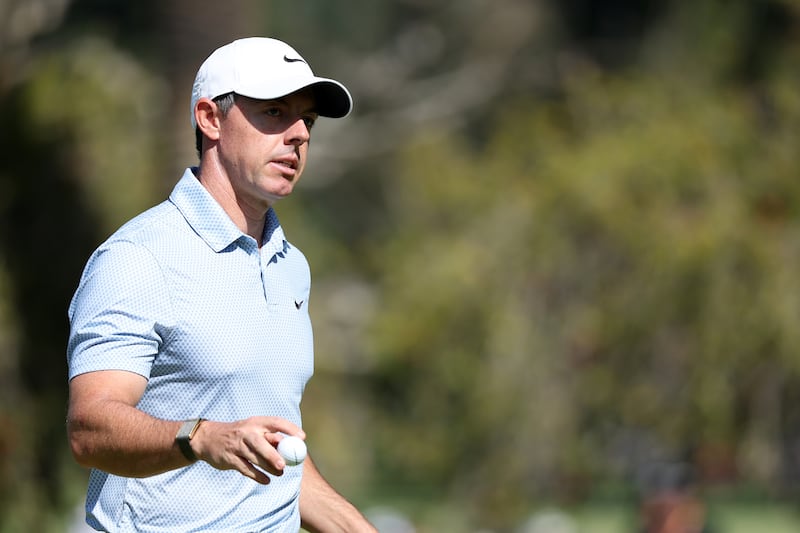 Rory McIlroy in action during the Genesis Invitational last month in Pacific Palisades. Photograph: Mike Mulholland/Getty
It is one of the most flogged aphorisms in sport that nice guys finish last. In this context “nice” is equated to weakness. The hackneyed psychological profile of a winner is that they must be killers: cold, ruthless, unblinking, merciless, like Anton Chigurh in the film No Country for Old Men.
But is that still absolutely necessary? Or is it possible for sportspeople to be nice and ruthless and just compartmentalise those settings like the hot and cold tap?
After Ireland beat England 42-21 at Twickenham in the Six Nations last month some of the post-match commentary centred around the contrast in leadership styles between Andy Farrell and Steve Borthwick.
It would be distortion perhaps to characterise Farrell as “nice” in the literal sense, but he is universally liked. He was a hard-nosed player in his day and as a coach he has made plenty of calls that would be impossible for someone who was predominantly “nice”, but in his interpersonal dealings he is fundamentally “nice”. He doesn’t project the demeanour of an old-school dressingroom dictator.
Players respond to him; they want to please him. The working environment he has created is underpinned by emotional intelligence and empathy. Johnny Sexton said that Farrell was the best coach he played for: tender and tough. Not always tough, not always tender. Nuanced.
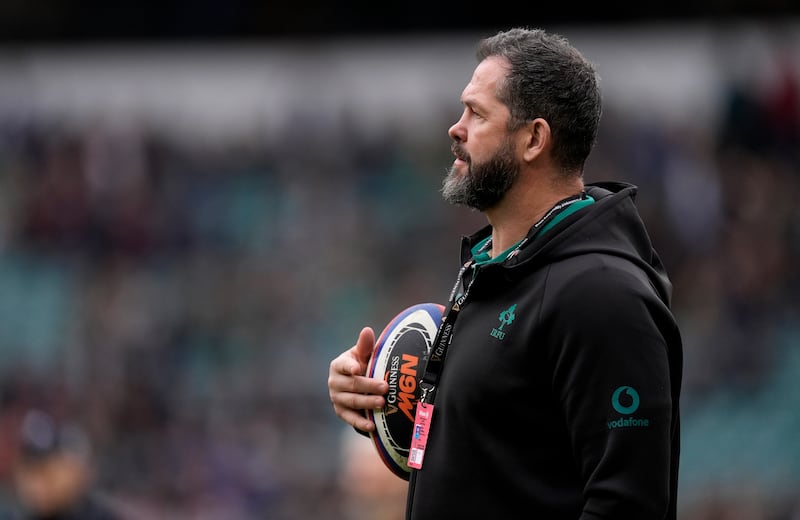 Ireland head coach Andy Farrell before the Six Nations match against England at Twickenham last month. Photograph: Andrew Matthews/PA
Farrell has been part of the Irish set-up for 10 years now, which is more than enough time for a player with a grievance to have a pop in public or brief against him off the record, but there hasn’t been a whisper. It has been a clinic in man-management.
Borthwick is not portrayed in that way. Geordan Murphy, the former Ireland international who worked with him briefly at Leicester Tigers, described Borthwick as a “tall Eddie Jones”, a depiction that was not meant as a compliment. Now that the England team has been plunged into one of their periodic crises, it is hard to imagine the players rallying around their pilloried coach on a personal level.
“He’s certainly not a people person,” Murphy said. “That wouldn’t be something that would ever be said about him.”
You wonder what works in elite dressingrooms now? Do players still respond to being bullied and shouted at and goaded? In modern sport, when there is a much greater emphasis on emotional regulation and information-led responses, do “nice guys” stand a better chance?
Jones is an interesting case study. Nobody ever accused him of being “nice”. Former England scrumhalf Danny Care, writing in his autobiography, described Jones as a “despot”. His staff, Care said, were routinely “belittled”. Dylan Hartley, who was Jones’s captain for three years, wrote in his autobiography how he “dreaded” going into England camp.
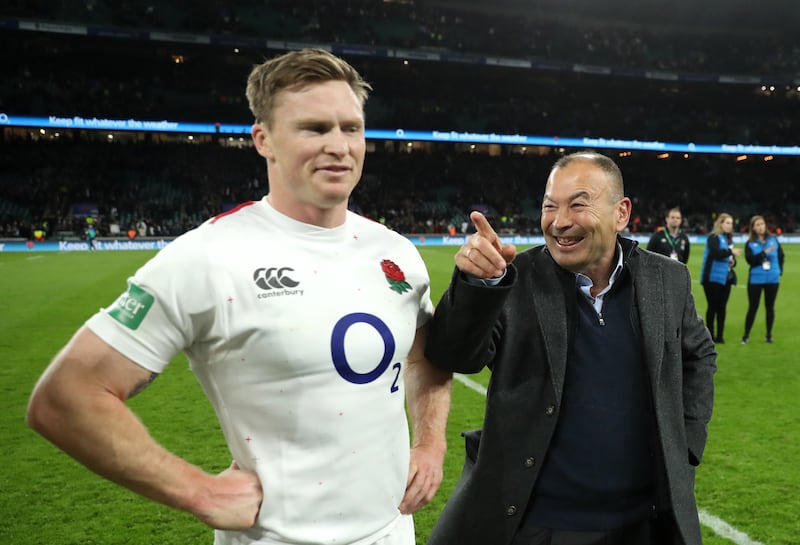 Eddie Jones, right, and Chris Ashton celebrate after England’s 12-11 victory over South Africa in November 2018 at Twickenham. Photograph: David Rogers/Getty
So if that is how players felt then how did Jones manage to have so much success? Jones won just five of his last 12 games in charge, but his overall win percentage was 73 per cent, the highest of any England coach.
It is not unusual for the most successful coaches not to court the affection of their players. That was also true of Alex Ferguson, Bill Belichick, Brian Cody and Bill Shankly, and is true of Pep Guardiola now. When it came to winning, they had no thought of being “nice” or liked.
Scientific studies have been conducted about how “nice” people fare in affairs of the heart and the conclusions are surprisingly disheartening. In team sports, though, hoping to succeed with a full hand of “nice” people must be an anthropological impossibility.
As Gavin Cummiskey reminded us in his interview with Heimir Hallgrímsson at the weekend, the Ireland manager wanted to “discover a few bastards” when he took over the Irish job. Is it possible to be one thing and the other?
Séamus Coleman must be one of the nicest men to ever play for Ireland, but on the pitch he is a different creature. And when somebody is bearing down on our goal or our try line we always want someone to cut them in half, don’t we. There is no nice way of doing that.
Maybe the balance will never shift. Maybe Tommy Fleetwood is a freakish outlier. I hope he never changes.