
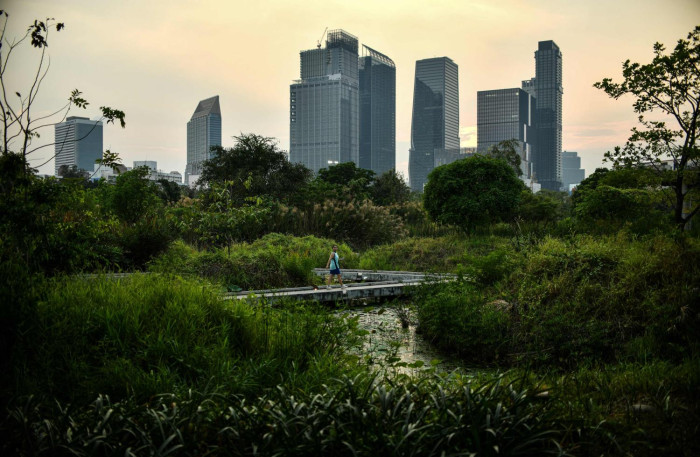
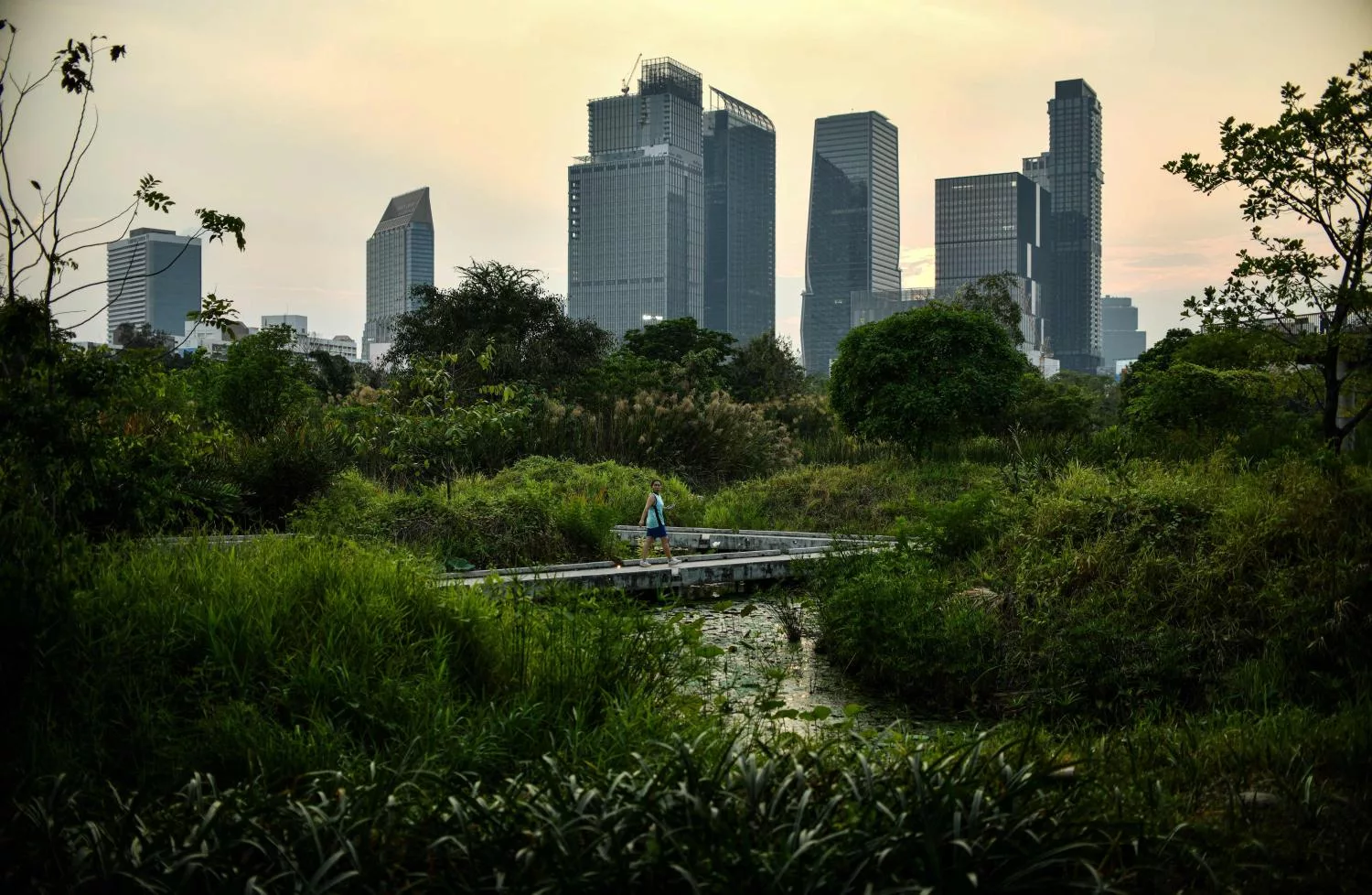
A woman walks in Benjakitti Park in downtown Bangkok onFeb 25. (Photo: AFP)
The Global Environment Outlook (GEO) is the United Nations’ Environment Programme’s (UNEP) flagship environmental assessment. The series began in response to the growing global understanding that environmental problems aren’t confined to national boundaries, but deeply interconnected across borders and sectors.
Addressing these challenges therefore requires policies which are backed by credible data and robust scientific evidence. Against this backdrop, the first GEO report was published in 1997, in an effort to bring science and policymaking closer together.
In December last year, UNEP released GEO-7, the seventh report in the series. The report, which drew on the latest scientific findings and is supported by case studies around the world, was developed through an extensive review process involving 287 experts from 82 countries and a wide range of disciplines. I was selected as one of the contributing experts to this report.
The report highlights the growing severity of four environmental problems, as well as the current and future impact of development on the environment under a business-as-usual pathway.
Climate change: Since 1990, greenhouse gas emissions have increased by an average of 1.5% per year, reaching a record high in 2024 and driving up global temperatures and climate-related extreme weather events over the past two decades. If no decisive action is taken, global temperatures are likely to rise by over 2°C within the next decade and continue to rise thereafter.
Biodiversity loss: It is estimated that 20–40% of the world’s land area is degraded, affecting more than three billion people. One million species out of an estimated eight million species worldwide are at risk of extinction, underscoring an escalating biodiversity crisis that is undermining the natural resource base that sustains human well-being and economic systems.
Land degradation: Each year, the world loses arable land equivalent in size to Colombia or Ethiopia. Meanwhile, climate change is projected to reduce global per capita food availability by 3.4% by 2050.
Pollution and plastics: Approximately nine million deaths occur each year due to various forms of pollution. Air pollution alone accounted for an estimated US$8.1 trillion in health-related damage in 2019, equivalent to about 6.1% of global GDP. In addition, the amount of plastic waste will continue to climbing, adding to more than eight billion tonnes of plastic waste already polluting the planet, driving annual health-related economic losses of around US$1.5 trillion linked to exposure to toxic chemicals in plastics.
The GEO-7 report makes a clear point — the world is not lacking the scientific knowledge to address these challenges. What the world needs is supportive policies and commitment to roll out the budgets, investment, and regulations needed to make a significant impact.
The report places strong emphasis on bridging the gap between evidence and action, focusing on how scientific findings can be translated into practical guidance for practical decision-making.
In fact, the report’s theme, “A Future We Choose”, was chosen to show that our future depends on today’s policy and investment decisions.
The report advocates investing in nature. Investment made to protect climate and nature should not be taken as economic burden, but as insurance for the future.
Examples of investing in nature are projects to restore natural habitats or reducing pollution at its source. These projects are not just “solving problems” — they benefit public health and uplift people’s quality of life.
Although the window for action is clearly narrowing, it has not yet closed. The scientific evidence presented in GEO-7 suggests that, even amid multiple and overlapping environmental crises, the world has not crossed an irreversible threshold.
Pursuing this transition pathway requires far and wide transformative changes.
• Economy and finance: We need to move beyond GDP figures to measure growth and start accounting for both positive and negative externalities in development planning. This includes phasing out, reforming, or redesigning subsidies, taxes, and incentives that cause harm to nature.
• Materials and waste: Implement circular economy–based product design; make it easier to see and trace products, parts, and materials; redirect investment toward circular and regenerative business models; and shift consumption patterns toward circularity through changes in societal attitudes and mindsets.
• Energy: Reduce carbon emissions from energy systems; improve energy efficiency; promote social and environmental sustainability across critical mineral value chains; and address energy access challenges and energy poverty.
• Food systems: We also need to transition toward healthier and more sustainable diets; enhance production efficiency and reduce food loss and waste.
• Environment: Accelerate the conservation and restoration of biodiversity and ecosystems; support climate adaptation and resilience through Nature-based Solutions (NbS); and implement systematic measures to reduce greenhouse gas emissions.
GEO-7 stresses that progress across these domains must advance in parallel and be informed by diverse knowledge systems, especially indigenous knowledge, which are necessary for a fair transition and environmental sustainability.
Thailand will soon get a new government. They should take the opportunity to pursue recommendations given in the GEO-7. Lest we forget, policy makers need to prepare the 14th National Development Plan, scheduled to take effect in 2028.
Addressing environmental challenges must not be done in silo approach; it must be done across multiple systems. Environmental crises are the outcome of past development structures; therefore, solutions require a systemic transition encompassing energy systems, food and agriculture systems, urban development and land use, industrial and material systems, as well as the financial system. Focusing on a single technology or sector will not solve the whole problem.
Environmental transition won’t succeed without environmental and social justice. That means no one must be left behind. That requires policies which are inclusive of vulnerable and marginalised groups, and local communities.
The knowledge is there. The challenge for this and following administrations is to translate these knowledge and recommendations into meaningful actions, which sounds easy but it is not. It requires effective policy instruments, robust data systems, and above all good communication strategy.
I am of the opinion that our environmental crises are not accidental, but the outcome of past development choices. So my question is: what development policy we will pursue in future?
The answer is already out there. The question is, will our policymakers take it or leave it?