
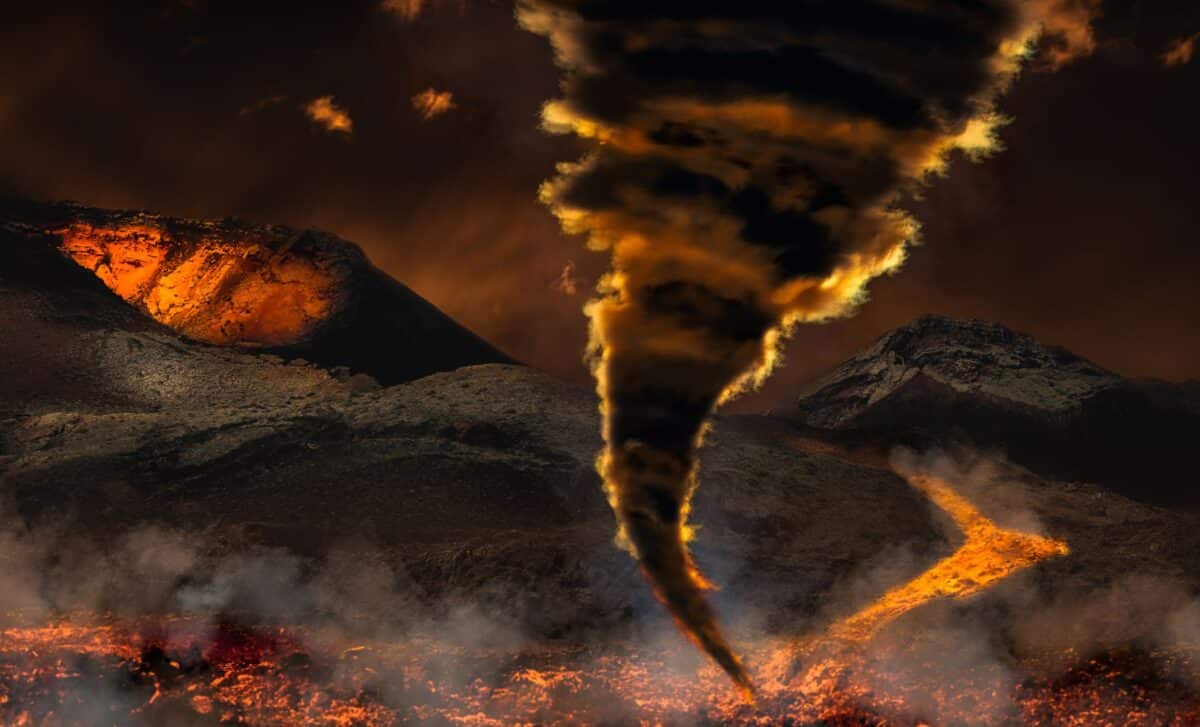
Scientists have created massive fire tornadoes that could offer a faster and cleaner solution to the ongoing challenge of cleaning up offshore oil spills. These towering, tornado-like flames burn through oil more efficiently than traditional methods, potentially reducing harmful emissions while consuming nearly all of the spilled oil.
Oil spills remain one of the most persistent and destructive threats to marine environments, and current cleanup methods are often slow and messy. Now, researchers at Texas A&M University have developed a more effective alternative: fire whirls, or fire tornadoes, which could burn oil more efficiently while producing fewer toxic emissions.
Fire Tornadoes Burn Oil Faster and Cleaner
In a large-scale experiment, the research team tested the use of fire tornadoes to burn oil spills faster and with less environmental impact than conventional methods. According to Dr. Elaine Oran, professor of aerospace engineering at Texas A&M, fire whirls are highly efficient because they generate much hotter flames than traditional fire pools.
As the fire whirl spins, it pulls in additional oxygen, allowing the flame to burn oil more rapidly and completely. This improved combustion means that the fire whirl can consume up to 95% of the spilled oil and reduce soot emissions by 40%.
As detailed in the study published in Fuel, the experiment, conducted at the Texas A&M Engineering Extension Service, involved creating a 17-foot-tall fire whirl using a specially designed triangular structure that directed airflow around a pool of crude oil. The results were dramatic: the fire whirl burned the oil nearly twice as fast as traditional in-situ fire pools.
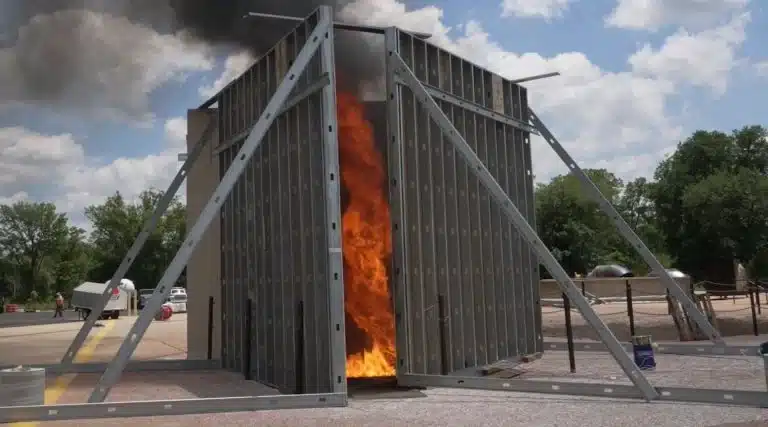 Fire whirls have been shown to burn oil spills faster and cleaner than fire pools in the first large-scale experiment. Credit: Texas A&M University College of Engineering
Lowering Emissions for Cleaner Air
Traditional oil spill burns produce thick smoke and soot that pollute the atmosphere, but fire whirls function more like industrial incinerators, breaking down these particles as the fire burns. As a result, fire tornadoes release far fewer pollutants into the air, improving air quality during the cleanup process.
“Our results show that fire whirls, compared to in-situ fires, dramatically reduce overall emissions,” Dr. Oran explained.
This could be a key benefit in future oil spill responses, where the trade-off between effective cleanup and air pollution is always a concern. The researchers are hopeful that fire whirls will contribute to cleaner air in regions affected by large-scale burn operations.
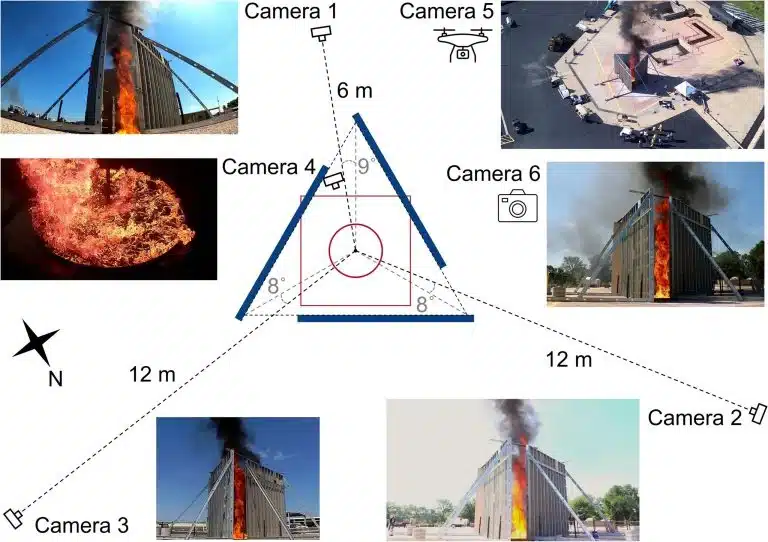 Overview of the fire whirl experimental setup. Credit: Elaine Oran/Texas A&M University College of Engineering
Overcoming Obstacles in Fire Tornado Scaling
Despite their promising potential, fire tornadoes are not without their challenges. As explained by Oran, they are highly sensitive to environmental factors, and the conditions need to be just right for them to work effectively The research team noted that strong winds can break apart the fire whirl, and poor airflow can turn it into a regular fire pool, reducing efficiency.
This delicate balance has prompted researchers to consider the “Goldilocks” zone conditions that must be precisely controlled for the fire whirl to perform at its best. However, the researchers are optimistic that with further technological advances and refinements, fire whirls could become a viable solution for future oil spill disasters. As Dr. Oran put it:
“This study is more than just an experiment; it’s a glimpse into a future where fire isn’t a force of destruction, but a tool to protect our oceans and planet.”