
The shell contains enough material to build a solar system. It should contain a lot of aluminum-26, and — crucially — it should contain very little iron-60. “I’m looking for a star that produces only aluminum-26,” Lugaro said. “The place where we can make only aluminum-26 is in the winds of these very massive stars.”
Astronomers have observed suns forming within the shells of Wolf-Rayet stars, Dwarkadas said. By his estimate, as much as 16% of all sun-size stars in our galaxy could have formed this way. “If it’s true, there’s no reason it should be true only for our solar system,” he said. “Ours will not be unique.”
Dwarkadas and his colleagues have laid out perhaps the most complete model for how the solar winds of a Wolf-Rayet star could have blasted aluminum-26 into our solar system as it formed. Afterward, the Wolf-Rayet star, with a lifetime of only a few million years, would most likely have collapsed into a black hole, although evidence for this would be long gone, Dwarkadas said.
There are problems with the Wolf-Rayet idea, Lugaro said. For instance, a Wolf-Rayet star creates such an energetic environment that it should have torn our newly formed solar system apart.
Boss still favors the theory that our cloud of dust was ignited by a supernova. Lugaro does not. “At the moment, from the nuclear-physics point of view,” she said, “I favor the winds of the Wolf-Rayet stars.” However, she said, new information could change her mind next week. “This is a problem that needs to be looked at from different angles. We are still fighting a bit about this.”
Gone Fishing
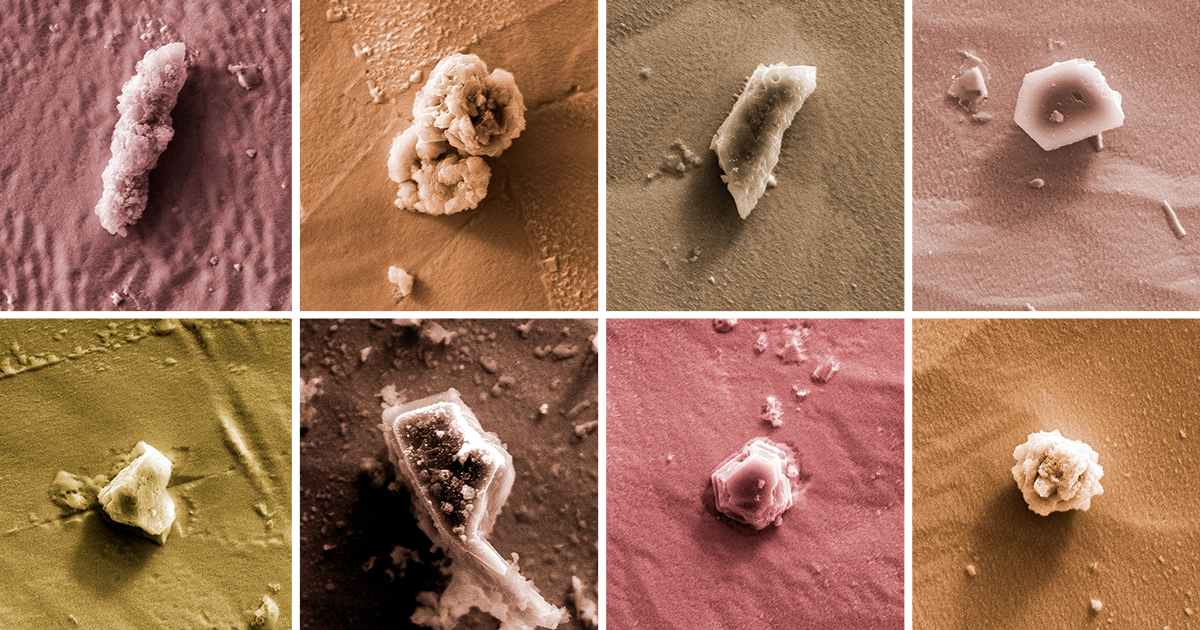
In Boston, Liu put the meteorite back in its safe. On her computer, she opened a live view through the microscope of a nanoprobe that can measure the chemical composition of tiny pieces of material. She and other researchers are using the device to study bits of meteorite dissolved in acid, on the hunt for grains with the right chemical composition to have come from a Wolf-Rayet star.
Liu operated the nanoprobe remotely (it was in Washington, D.C.), slowly scrutinizing the meteorite bits scattered across a field of gold foil. “This is like a fishing expedition,” Liu said. Her next step, assuming she can find a good number of grains with the right chemical composition to have come from a Wolf-Rayet star, would be to measure whether they show signs of having been enriched in aluminum-26. This chemical information could then be used to constrain astrophysical models of the Wolf-Rayet scenario for the start of the solar system.
Liu acknowledged that the presence of such grains wouldn’t be a slam dunk for the Wolf-Rayet star theory; for instance, aluminum-enriched dust could have been produced by much older stars long before our solar system formed. But the absence of such grains would suggest that the Wolf-Rayet idea is off.
She watched the nanoprobe at work, delving billions of years into the past. Studying these grains, Liu said, gives her a new sense of the unique circumstances that led to the existence of our planet. “If you think about these radioactive isotopes — these rock-forming elements and life-forming elements,” she said, “when you know how they are produced in stars, you realize it is not so easy to get the right amount. You have to form at the right time and place.”