
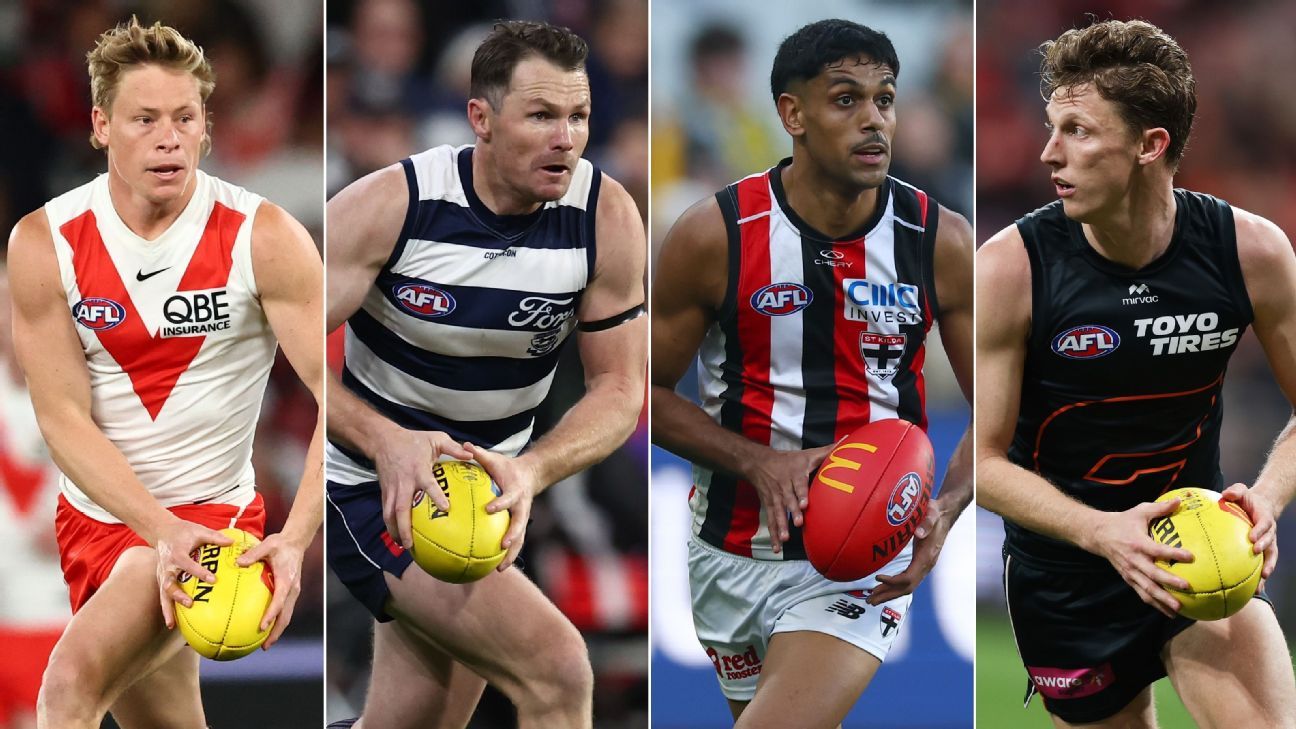
It’s always easy in footy circles, especially during preseason, to label a team as ‘formidable’, ‘the biggest riser’, or ‘bound to struggle’. But a lot of surprising truths can emerge when every club is meticulously dissected and ranked against each other.
Here are position-by-position rankings for all 18 AFL clubs, covering the backline, forward line, and midfield. Teams were ranked taking into account an array of factors, such as top-end best-23 talent, the balance of talls and smalls, the mix between offensive firepower and defensive prowess, and the overall depth of the unit on the list.
Editor’s Picks

1 Related
For this exercise, players with long-term injuries weren’t assessed. To determine a team’s ranking for each position, every ‘starting six’ player was scored out of 10 on the basis of sheer star power, and the side was scored out of five for both overall balance and depth, before being given a total score.
When discerning between two teams for a higher ranking, greater emphasis was placed on the significance of key position players, a nod to their pivotal role in shaping a lineup.
Included for each position is a brief outlook on the best and worst groups, as well as one intriguing team worth keeping a close eye on.
At the end, an overall ranking is shown, which is worked out based on the average ranking every team is given at each position. If multiple teams share the same average ranking, the one with the higher-ranked midfield was placed in the higher position.
Note, these are simply rankings looking at the individual players that make up each list going into the 2026 season. They are NOT predictions or long-term projections.
ESPN/Getty ImagesBackline
RANKTEAMRANKTEAM1GWS10CARLTON2HAWTHORN11PORT ADELAIDE3FREMANTLE12WESTERN BULLDOGS4BRISBANE13ADELAIDE5GOLD COAST14ESSENDON6GEELONG15NORTH MELBOURNE7COLLINGWOOD16RICHMOND8SYDNEY17MELBOURNE9ST KILDA18WEST COAST
 Best: GWS
The Giants conceded more total points than any other finalist last season, but since this exercise is purely about personnel, it’s hard to argue that many backlines appear as complete as Adam Kingsley’s on paper. Sam Taylor is one of the competition’s premier key defenders and reads the play as well as anyone, while Jack Buckley is an elite lockdown option beside him. Harry Himmelberg adds versatility and important aerial strength, and Connor Idun’s ability to match up on both talls and smalls gives the unit flexibility. With Lachie Whitfield and Lachie Ash providing elite rebound and ball use, the Giants boast genuine star power and balance across every role necessary, and there’s genuine depth we haven’t even touched on.
 Worst: West Coast
There are pieces for West Coast to work with down back, but compared to the rest of the competition this remains a developing group lacking enough proven star power. Harry Edwards began to cement his role last season but, sometimes through no fault of his own, has been exposed in a young side that regularly gets peppered with inside 50s. Tylar Young, Sandy Brock, Brady Hough, and Rhett Bazzo all have upside but are still yet to fully establish themselves at AFL level. Premiership Lion Brandon Starcevich is a valuable addition if fit, and Liam Baker, Liam Duggan, and Reuben Ginbey add a nice tough edge to round out the group. Still, right now, this unit isn’t reliable enough on a consistent basis.
 Backline to watch: Western Bulldogs
The Bulldogs’ defence is the line that could shape their entire season. Like GWS last year, their issue wasn’t scoring, it was stopping it from happening against them, finishing as the league’s highest-scoring side but only mid-pack defensively which halted their ability to be a top four contender. The personnel is solid rather than star-studded, with Rory Lobb and James O’Donnell holding down key posts and Buku Khamis providing aerial support. That’s enough structurally, especially with elite distributor Bailey Dale leading their rebound game. Improvement though hinges on those aforementioned keys, and players like Lachie Jaques and Lachie Bramble, while former Sun Connor Budarick is a worthy addition as a small lock-down defender. If this group does click, the sky is the limit.
The underrated Connor Idun is an integral part of the Giants’ defensive set up. Photo by Daniel Carson/AFL Photos via Getty ImagesMidfield
RANKTEAMRANKTEAM1SYDNEY10CARLTON2WESTERN BULLDOGS11ST KILDA3BRISBANE12ADELAIDE4GOLD COAST13GWS5FREMANTLE14HAWTHORN6PORT ADELAIDE15MELBOURNE7GEELONG16ESSENDON8COLLINGWOOD17RICHMOND9NORTH MELBOURNE18WEST COAST
 Best: Sydney
Splitting the competition’s best midfields was incredibly tough, with only marginal differences separating the ‘bottom’ of the top six teams and the ‘top’ of the bottom six teams. But Sydney gets the nod for its obvious blend of talent and depth. Brodie Grundy remains one of the league’s premier rucks and is perfectly suited to the new centre circle rules, Isaac Heeney, Chad Warner and Errol Gulden form a damaging trio, and Callum Mills only strengthens the rotation. They get quality support from James Rowbottom, James Jordon, and Taylor Adams (when healthy), too, not to mention the outside class of Justin McInerney on a wing. Don’t worry, there are others, and that’s why there aren’t many midfield groups that match the Swans’ balance, quality, and depth.
Worst: West Coast
For West Coast, it’s less about a lack of talent and more about a group that still needs to prove itself. It has been a changing of the guard for a while now and that will only continue, with a player like Tim Kelly no longer the focal point. Elliot Yeo remains a star when fit but has battled injuries in recent seasons, making his impact difficult to assess. Harley Reid has enormous upside and genuine superstar potential and he forms an exciting long-term pairing with the classy Elijah Hewett. Tom McCarthy adds a mature body to the mix, and we should see plenty of top draftee Willem Duursma, but overall this remains a promising midfield in the transition stage, and still a work in progress.
 Midfield to watch: Carlton
The injury-hit Giants were considered here to explain the too-low-to-the-naked-eye ranking, and their early mix looks like highly intriguing. But there’s something mysterious about Carlton’s on-ball group as well, and much of it centres around emerging talent Jagga Smith who returns after missing last year with an ACL injury. His eye-catching preseason included 37 disposals against Geelong last week and while expectations should stay measured, it’s only natural to think about the prospect of him lining up alongside two-time Brownlow winner Patrick Cripps and a hopefully-fully-fit Sam Walsh this season. That’s just your likely starting trio, and with fresh wing options in Campbell Chesser and Oliver Florent, too, there’s enough change and upside to make this midfield group one to monitor.
Carlton young gun Jagga Smith has turned heads this preseason. Photo by Russell Freeman/AFL Photos via Getty ImagesForward line
RANKTEAMRANKTEAM1GEELONG10ST KILDA2GWS11MELBOURNE3ADELAIDE12COLLINGWOOD4BRISBANE13ESSENDON5WESTERN BULLDOGS14NORTH MELBOURNE6GOLD COAST15CARLTON7FREMANTLE16WEST COAST8SYDNEY17PORT ADELAIDE9HAWTHORN18RICHMOND
 Best: Geelong
There wasn’t much between the forward lines, either, but last year’s grand finalists get the nod. The early part of their season could be hampered — Jeremy Cameron, Tyson Stengle, and Gryan Miers all under injury clouds, while Shannon Neale was also worse for wear after last week’s preseason match with the Blues — but this ranking focuses on long-term availability. At full strength, Cameron is the game’s best forward and is well supported by Neale as a reliable second tall, and the explosive presence of Patrick Dangerfield only aids that combination. With ground-level threats like Stengle, Miers, Brad Close and Shaun Mannagh applying pressure and hitting the scoreboard, Geelong’s attack is deep, balanced and always dangerous.
 Worst: Richmond
There’s clear long-term promise at the rebuilding Richmond. Tom Lynch is still a genuine star when fit, and he managed 26 goals from 16 games last season after injury-interrupted years, but much of the support around him is too inexperienced. Young talls such as Harry Armstrong, Jonty Faull, and Tom Sims have upside but are unproven at AFL level. Maurice Rioli Jr. and Rhyan Mansell bring pressure, and when Sam Lalor pinch-hits down there you’ll see some eyebrow-raising quality, but this team still lacks experience and cohesion, and the necessary firepower needed to consistently trouble opposition defences.
 Forward line to watch: Gold Coast
The Suns’ forward line is really interesting. Ben King headlines the attack after a 71-goal campaign in 2025, supported by exciting young talls Ethan Read and Jed Walter, though the former may spend more time up the ground. The addition of Jamarra Ugle-Hagan adds so much upside if he can rediscover his best form, and it gives the Suns many aerial threats. Even without the reliable Ben Ainsworth, Ben Long provides defensive pressure at ground level, and midfield stars Christian Petracca, Touk Miller, and Bailey Humphrey rotating forward will create many more headaches. Leo Lombard also looks to have taken a step forward over the summer.
How many goals will Ben King kick in 2026? Photo by Bradley Kanaris/Getty ImagesOverallRANKTEAMRANKTEAM1BRISBANE10ADELAIDE2GEELONG11ST KILDA3GOLD COAST12PORT ADELAIDE4FREMANTLE13CARLTON5GWS14NORTH MELBOURNE6SYDNEY15ESSENDON7WESTERN BULLDOGS16MELBOURNE8HAWTHORN17RICHMOND9COLLINGWOOD18WEST COAST
 Best list: Brisbane
No surprises here — the reigning premiers remain the benchmark with elite talent across every line. Their defence is anchored by captain Harris Andrews, who commands the skies first and sets the tone for a group of dangerous rebounders. The midfield is as deep as any in the competition and is perfectly balanced. And up forward, pressure at ground level and scoring nous is spearheaded by Charlie Cameron, Kai Lohmann, Cameron Rayner, and Zac Bailey, which perfectly complements the aerial presence of Logan Morris, with former Eagle Oscar Allen strengthening the attack even further. Like most teams, they wouldn’t want too many injuries to their key position players as, respectfully, there isn’t much behind them, but if health holds, Brisbane is clearly primed to contend again.
Worst list: West Coast
Much of this has already been touched on throughout the column, but West Coast’s list is heavily weighted towards potential and promise in the form of youth, rather than proven output. There are encouraging pieces on every line, but not enough established talent to create genuine balance across the ground or to inspire confidence in even the most die-hard Eagles fans that there will be consistent results this season. Admittedly, their forward line looks their strongest and Jake Waterman’s return is a big part of that, with the addition of Deven Robertson creating at least more useful depth. But this is still all about the youngsters, and getting games into highly-touted draftees Duursma, Cooper Duff-Tytler, and Josh Lindsay needs to be the priority. The list needs time to build, and there’s not enough experience yet to help them climb the ladder.
 Team to watch: St Kilda
St Kilda is probably the most talked-about team heading into the new season, but for good reason. Some are buying the hype, some are not after an aggressive offseason targeting proven talent in free agency such as Tom De Koning, Jack Silvagni, Liam Ryan and Sam Flanders, adding maturity and quality across multiple lines, all while retaining Nasiah Wanganeen-Milera which was equally crucial to their long-term outlook and 2026 ambition. On paper, the Saints now look ultra-balanced across the ground, with match-winners sprinkled across the park and enough depth to enter the finals conversation. They’ve been ranked around the middle of the competition on each of the three lines, but these rankings don’t account for upside — and that’s where St Kilda becomes really fascinating. The injury to Max King is unfortunate, but the broader list profile suggests it’s a side still ready to take that step forward. They’re all chips in, and all eyes will be on them to see if it’s a gamble that pays off.