
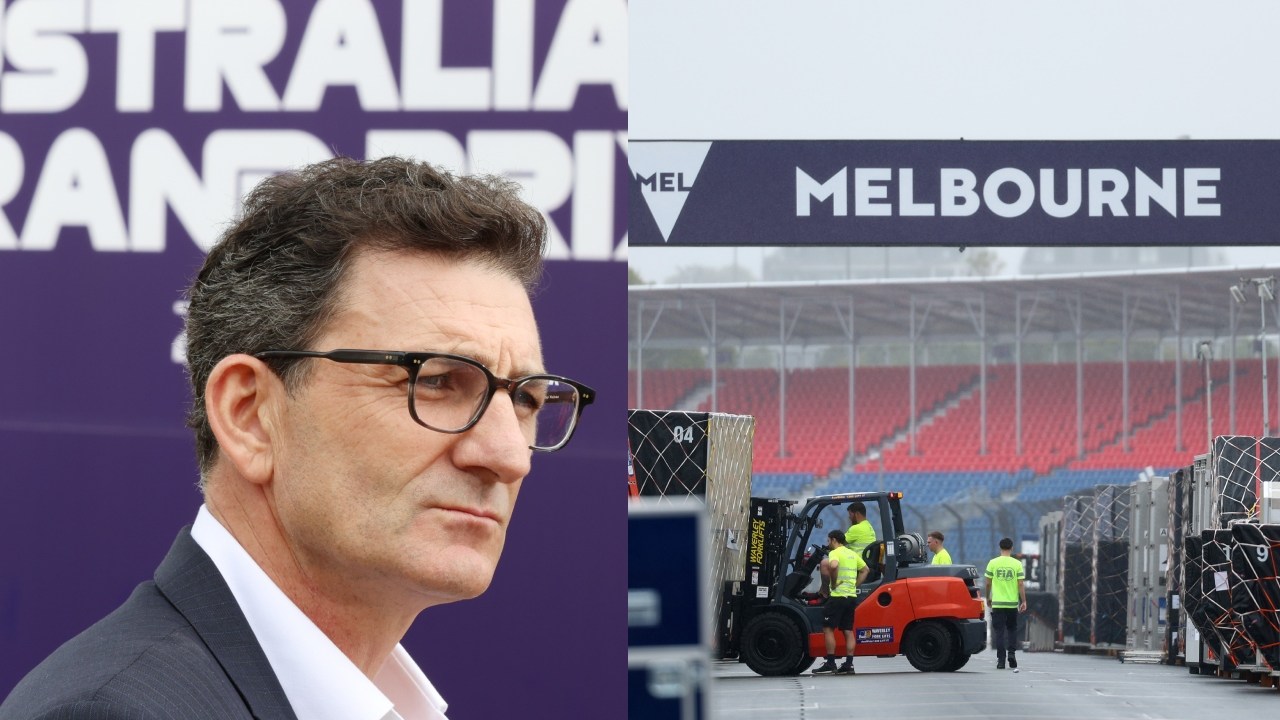
Formula 1 bosses have chartered flights to get key staff to Melbourne for this weekend’s 2026 Australian Grand Prix amid the ongoing conflict in the Middle East.
Approximately 1,500 paddock personnel – including team staff, race organisers and officials, and media and hospitality personnel – typically work at the annual event at Albert Park.
But staff have been forced to make last-minute changes to their itineraries this year as major aviation hubs, including Dubai and Abu Dhabi in the United Arab Emirates and Doha in Qatar, are shut down in response to fresh airstrikes by the US and Israel on Iran.
“You’re talking about teams, drivers, Formula 1 personnel,” Australian GP CEO Travis Auld told Channel Nine.
“I’m guessing there’d be close to 1,000 people who would have already booked their flights and be landing somewhere between sort of today, tomorrow, Wednesday.
“So they had to all be changed, but a lot of people around the world are on the same thing, and so you’re competing obviously with that increase in demand. But they’ve been able to sort it out is the important part.”
All equipment needed for the race had already been sent to Melbourne ahead of the attacks on Iran.
“All the freight is here and ready to go, and so we’re in a space where we’re really confident there’ll be no impact (on the race by the travel disruption from the conflict),” Mr Auld said.
“The drivers will be here, the engineers will be here, the team principals will be here – they’re the ones that have been prioritised.”
Sunday’s race kicks off the F1 season, which then goes to China and Japan before heading to the Middle East for races in Bahrain (April 12) and Saudi Arabia (April 19).

Foreign Affairs Minister Penny Wong said there are about 115,000 Australians in the Middle East.
The Department of Foreign Affairs and Trade has issued travel warnings for a litany of nations in the Middle East, Europe, and Africa.
Israel, Palestine, Iraq, Syria, Lebanon, Qatar, Iran, Kuwait, the UAE, and Yemen all have “do not travel” warnings from DFAT, while Australians have been told to reconsider their need to travel to Oman, Jordan, and Saudi Arabia.
The conflict erupted after the US and Israel on Saturday killed Ayatollah Ali Khamenei in a targeted strike.
Iran has launched strikes on Beit Shemesh in Israel alongside multiple Arab states that host US assets.
– With Reuters