
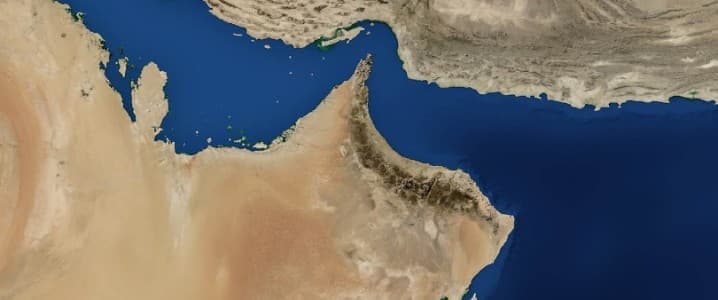
The Strait of Hormuz is back in the headlines. Again.
Roughly a fifth of globally traded oil passes through that narrow maritime corridor between Oman and Iran. And once more, geopolitical tensions in the Middle East have turned this chokepoint into a pressure valve for the entire global economy. Insurance premiums spike. Tankers hesitate. Traders hold their breath. Politicians rush to microphones.
And Europe wonders why its energy bills are rising.
There is something profoundly frustrating about this moment, not because it is surprising, but because it is so utterly predictable. Over the past years, I have written repeatedly on this platform about Europe’s structural vulnerability to imported fossil fuels. Not just to “imports” in general, but to imports that pass through narrow chokepoints controlled, directly or indirectly, by regimes and power structures that do not necessarily share Europe’s political stability, regulatory transparency, or strategic interests. The Strait of Hormuz is not a black swan. It is a recurring character in a story we refuse to finish.
Dependency Is Not an Accident, It’s a Choice
Europe imports the majority of its oil and gas. That reality is often framed as geography, as fate. But it is not fate. It is policy. For decades, we optimized for short-term cost efficiency rather than long-term resilience. We built an energy system that depends on molecules traveling thousands of kilometers, passing through maritime bottlenecks, pipelines crossing politically sensitive territories, and contractual relationships vulnerable to elections, revolutions, or sanctions.
Related: How China’s Rare Earth Ban Backfired into a U.S. Tech Breakthrough
When those routes wobble, our economies wobble. This latest de facto closure or severe disruption of Hormuz traffic exposes the fragility once more. Tankers reroute. Futures markets spike. Governments scramble. And almost immediately, the old reflexes resurface.
The Usual Panic Playbook
In the Netherlands, discussions about reopening the Groningen gas field quietly re-emerge. In the North Sea, calls for extended oil and gas exploration grow louder. Across Europe, the phrase “energy security” starts to be used as a synonym for “drill more.”
Give it a few weeks, and someone will inevitably shout “shale gas!” in a Brussels corridor, as if Europe’s geology and public acceptance magically changed overnight.
We have been here before. After every crisis, from supply disputes to wars to pipeline sabotage, we flirt with doubling down on the very system that created the vulnerability in the first place.
But let’s be honest: even if we squeezed every remaining drop out of the North Sea and Groningen, Europe would still be structurally import-dependent for oil. And if global oil prices spike because of Hormuz, domestic European production will not magically shield consumers from global pricing dynamics. Oil is globally priced. Gas increasingly so. We are not just dependent on supply volumes; we are dependent on a pricing system shaped by global instability.
Whims, Strongmen, and Market Volatility
When your energy bill depends on whether a tanker can safely pass a 33-kilometer-wide strait, you do not have energy sovereignty. You have exposure. Exposure to regional conflicts. Exposure to sanctions regimes. Exposure to leaders whose domestic priorities may not align with European economic stability.
This is not about demonizing any specific country. It is about acknowledging structural reality: import-driven fossil economies remain vulnerable to geopolitical shocks, especially when supply chains converge in chokepoints.
And yet, policymakers often act surprised when those chokepoints behave like chokepoints. Why do we keep forgetting this?
Renewables: Not Just Climate Policy, Strategic Policy
The conversation must move beyond climate rhetoric. Renewable energy is not only about emissions. It is about insulation. Wind and solar do not transit Hormuz.
Electrons do not queue at maritime bottlenecks. A diversified, electrified system anchored in domestic generation is structurally less exposed to geopolitical blackmail or regional instability.
Of course, renewables require materials, manufacturing, grids, storage, and supply chains. They are not geopolitically neutral. But their vulnerability profile is fundamentally different.
Instead of concentrating risk in a handful of maritime corridors and producing regions, renewable systems distribute generation geographically. They shift dependence from continuous fuel imports to upfront infrastructure and material supply chains, supply chains that can be diversified and strategically managed.
Don’t Abandon Globalization, Fix It
This is not an argument for isolationism. Europe cannot and should not attempt autarky. Global trade remains essential. But we can choose our dependencies more wisely.
Rather than relying heavily on unstable fossil chokepoints, Europe should accelerate cooperation with reliable, rules-based partners for renewable technologies, critical materials processing, hydrogen trade, and clean industrial value chains.
Strengthen ties with neighboring regions that offer solar and wind potential. Develop shared grids. Invest in joint manufacturing. Build strategic reserves of critical materials. Create redundancy. Globalization is not the enemy. Unbalanced, single-route dependency is.
The Real Cost of Delay
Each time Hormuz destabilizes markets, we pay twice. First, through higher prices and economic uncertainty. Second, through political panic that pushes us back toward short-term fossil fixes instead of long-term structural change.
Reopening gas fields that undermine public trust. Extending exploration licenses that lock in infrastructure for decades. Reigniting shale fantasies that distract from scalable solutions. All while the core vulnerability remains untouched.
The energy transition is often portrayed as expensive and disruptive. But what is the cost of recurring geopolitical exposure? What is the cost of industrial planning built on volatile input prices? What is the cost of strategic helplessness? Resilience has a price. So does dependence.
This Crisis Is Not a Surprise, It Is a Reminder
The Strait of Hormuz is doing what it has always done: reminding us that fossil fuel dependence is not just an environmental issue. It is a geopolitical liability. We cannot claim we did not see this coming. We have seen it repeatedly, in shipping disruptions, pipeline disputes, sanctions regimes, and regional conflicts.
The only surprising thing is how quickly we forget.
If Europe wants real energy security, it must accelerate electrification, renewables, storage, grid reinforcement, and domestic industrial capacity. It must build resilient supply chains with trusted partners. It must reduce exposure to volatile fossil chokepoints, not manage them slightly better. Every crisis is a test of whether we learned anything from the previous one.
Hormuz is testing us again. The question is simple: will we finally treat renewable acceleration not just as climate ambition, but as strategic necessity?
Or will we wait for the next strait to be blocked to get stuck before we remember?
By Leon Stille for Oilprice.com