
The first semi-final of the 2026 T20 World Cup, between New Zealand and South Africa, takes place in Kolkata on Wednesday. This is a contest where New Zealand have to do all the running, at least in terms of set pieces. South Africa’s batting matches beautifully against a New Zealand attack that lacks left-arm pace and mystery spin.
If you try to shut Aiden Markram down with early left-arm spin, for example, you have to contend with two left-hand batters around him who devour left-arm spin. In the middle, David Miller provides that left-hand batter who upsets match-ups. We saw all this in the first-round match between the two sides, where South Africa kept taking wickets to restrict New Zealand, and then chased 176 down easily in Ahmedabad. There is not a lot New Zealand can do differently, but these are some of the tactics that remain important.
Chase please
South Africa stand a better chance of recovering from a lost toss. It is critical for New Zealand to win the toss and secure the advantage of chasing at Eden Gardens. We saw the other night how India always remained calm and in charge of a chase of 196 against West Indies, although they kept losing wickets. Kolkata is a chasing den, and it might be a bridge too far for New Zealand if they are asked to bat first.
Editor’s Picks

1 Related
Ferguson has to strike
Markram is in the form of his life, and New Zealand have neither a left-arm wristspinner nor a left-arm quick to trouble him. Even if Mitchell Santner goes out of his comfort zone and bowls inside the powerplay, he is under threat from Quinton de Kock and Ryan Rickelton.
Lockie Ferguson, though, has had some success against de Kock and Rickelton in the MLC in the USA. He has got de Kock out three times in 23 balls, and Rickelton once in three balls. There is a thin line of discomfort for de Kock to pursue from over the wicket: short of a length, and on or top of leg. You have got to be careful, though, because de Kock is extremely good at the pick-up shot over long leg, should you err even slightly.
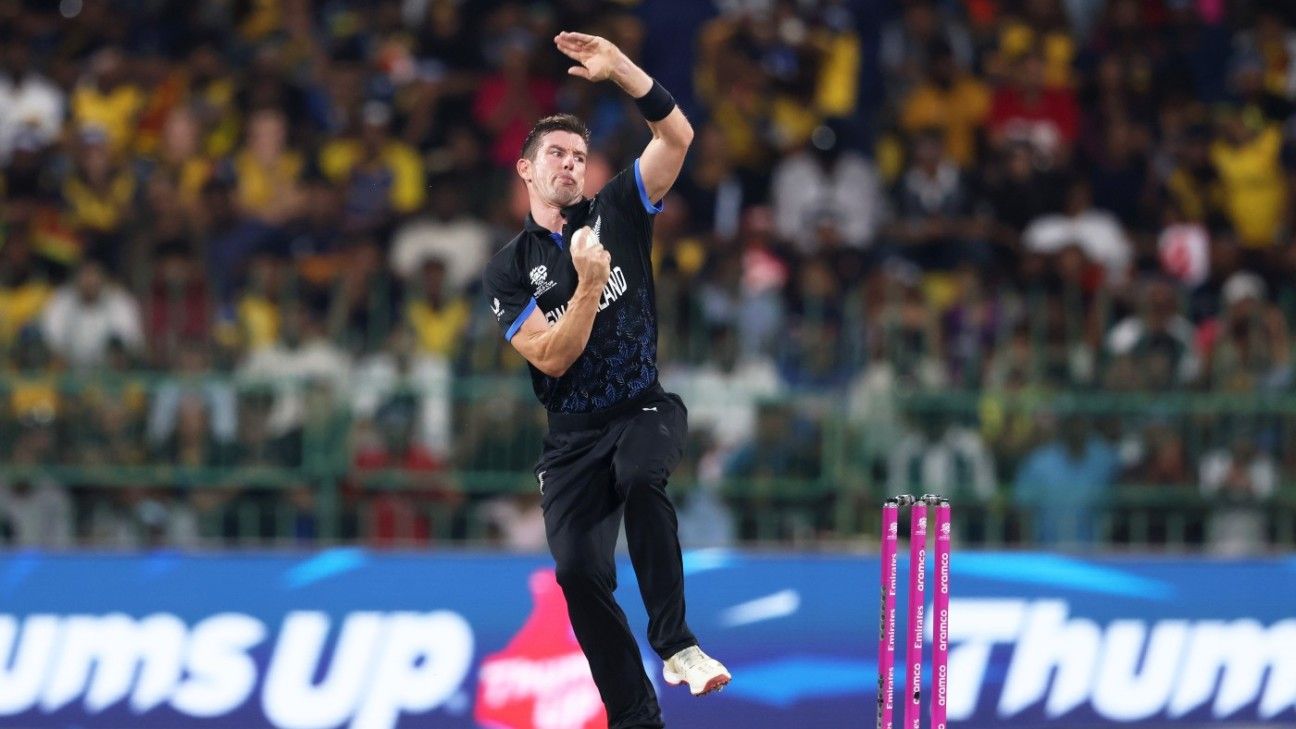
Cole McConchie bowls ICC/Getty Images
Ferguson can go around the wicket to Rickelton and hope for some seam movement against that angle. If recency has any say, even de Kock has struggled against this line of attack against Harshit Rana in recent times. Expect New Zealand to go for Jacob Duffy in place of Ish Sodhi to try and replicate what Rana does.
Maybe some offspin?
Cole McConchie could be given the big task of bowling one or two overs in the powerplay, or even open the bowling if he can, because here’s something to work with. Markram has got out to spin twice in his first 15 balls this World Cup. Since the start of the last IPL, Markram hasn’t had to deal with much offspin in the powerplay, but he has scored only 33 off 33 balls, while getting out twice. McConchie will also have the advantage of two left-hand batters around Markram.
Santner to control middle overs
Santner has the quality to be able to counter the left-hand batting of Miller in the middle overs. So he has to do the job of containing Dewald Brevis and Tristan Stubbs. The latter, especially, scores only 7.05 runs per over against left-arm spin.
Corbin Bosch sent back Aryansh Sharma AFP/Getty ImagesJansen for wickets
The last time these two sides faced, New Zealand met fire with fire and got off to a quick start, but Marco Jansen kept getting wickets. The mix of his high release and the non-cutter slower ball proved to be a handful for New Zealand, who lost their openers Tim Seifert and Finn Allen, and Rachin Ravindra and Mark Chapman to him. Although Allen and Seifert match up favourably against left-arm quicks, Jansen’s height makes it a different proposition.
South Africa actually don’t need to do anything differently to what they did in Ahmedabad against New Zealand: open with Lungi Ngidi and Kagiso Rabada, bring on Jansen early, and let Keshav Maharaj control the middle overs.
Bosch at the death
Corbin Bosch has bowled eight overs at the death – as many as any bowler – in this World Cup at just 6.25 runs an over. He has also bowled the 16th over three times, which makes it a total of 11 in the last five overs. Again, that is more than anyone else, while going at only 6.9 runs an over. Bosch has done so without attempting too many yorkers, instead relying on his height and hard lengths. Expect him to bowl at least two overs in the last five, especially if South Africa have taken four or five wickets by then already.