
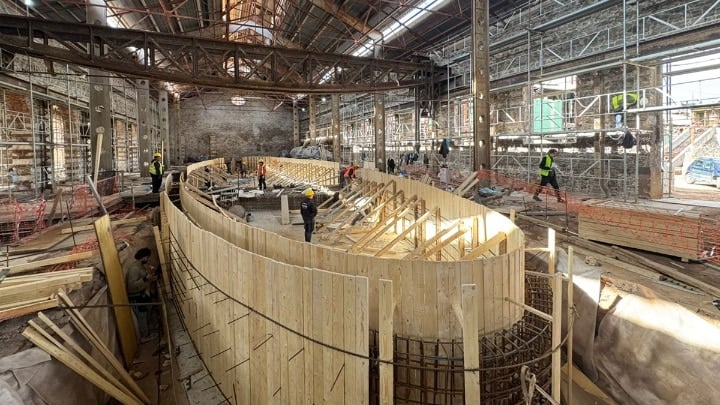
The supercomputer will launch in Lavrio, where facilities are being upgraded to house it this summer. Credit: Ministry of Digital Governance
Daedalus, the upcoming supercomputer set to transform Greece’s research and innovation landscape, is entering its final implementation phase.
The entire system has been assembled at the HPE factory in the Czech Republic. It is currently undergoing rigorous technical testing before its relocation to its permanent home: the Lavrio Technological and Cultural Park, part of the National Technical University of Athens (NTUA).
Photos of the new system have already been released, generating significant anticipation for its upcoming launch in Lavrio, where facilities are being upgraded to house it this summer.
Daedalus: A feat of engineering
The installation is a complex feat of engineering. It features specialized server cabinets equipped with direct liquid cooling and high-power density specifications. At its heart, it integrates over 2,000 NVIDIA Grace Hopper (GH200) superchips—hardware specifically engineered for large-scale artificial intelligence applications.
Currently, engineers at HPE are conducting extensive stress tests on the individual modules and their interaction as a unified system. This ensures the supercomputer’s stability and performance under real-world workloads before it is transported to Greece.
Funding and strategic vision
The project is being funded in phases:
Phase A: Supported by the Recovery and Resilience Fund and the Public Investment Program, totaling €29.2 million (VAT included)
Phase B: An upgrade funded by the EuroHPC Joint Undertaking, with a maximum budget of approximately €12.68 million (excluding VAT)
Beyond the hardware and infrastructure (cooling and power supply), the investment includes long-term costs for support, operations, and personnel to ensure the platform remains sustainable.
Dimitris Papastergiou, the Minister of Digital Governance, emphasized the project’s importance:
“Daedalus is not just another technical project; it is a strategic investment of national importance that places our country at the core of European computing and technological power. In an era where AI and data define economic and geopolitical influence, Greece cannot afford to be a mere consumer of technology. Daedalus gives us the capability to produce knowledge, innovation, and high-value applications right here.”
Pharos: More than just a machine
The project extends beyond the supercomputer itself. Daedalus will serve as the engine for Pharos, an AI φactory designed to act as a service layer. Pharos will provide:
Access rules and technical support
Data management tools and expert guidance
Safe, compliant, and efficient utilization of computing power for research centers, universities, startups, and public bodies
By handling the “nitty-gritty,” such as sensitive data management, anonymization, and preparing “AI-ready” datasets, Pharos removes technical barriers, allowing users to focus on innovation.
Real-world impact
Daedalus is expected to reach a processing power of over 89 quadrillion floating-point operations per second (89 PFLOPS). To put that in perspective, this allows the system to execute in hours or days computational problems that would take conventional computers weeks or months for:
Startups & SMEs: It provides access to high-end computing previously only available via expensive commercial cloud services. This reduces development costs and accelerates training and optimization of AI models.
Healthcare: Startups can rapidly train models to analyze medical imagery (e.g., X-rays or CT scans) and validate clinical applications, significantly speeding up the transition from prototype to real-world use.
The Public Sector: Enhanced data analysis capabilities allow for quicker crisis responses, energy grid optimization, and better environmental and resource management.
Daedalus will not operate in a vacuum. It is part of a European ecosystem of AI factories, acting as a regional hub for Southeast Europe and strengthening Greece’s geopolitical and technological standing.
Related: Greece Wants to Pursue Leading Role in Europe’s AI Development