
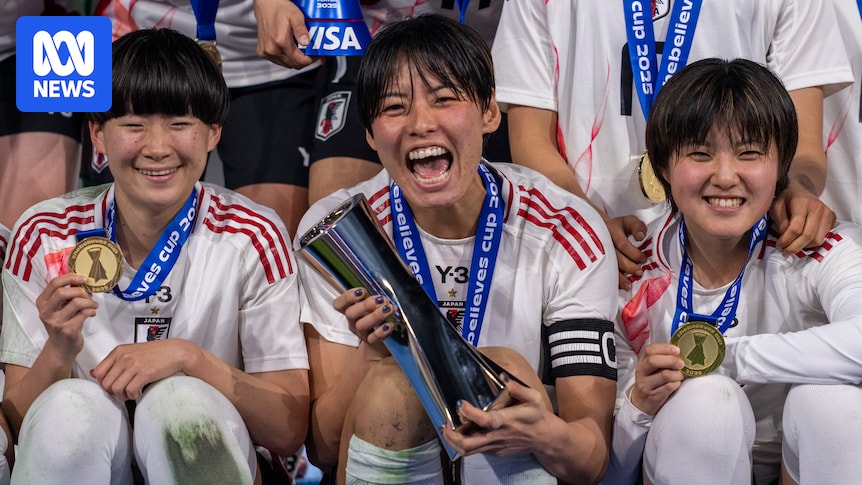
As they prepare for the 2026 AFC Women’s Asian Cup, Nadeshiko Japan arrive as a team that has quietly but unmistakably redefined its identity.
The traditional strengths that were once the hallmark of Japanese football — technical quality and tactical intelligence — have been reinforced with physical intensity and speed, forged through players competing in the world’s strongest leagues.
Playing overseas is no longer an exception, but a routine part of their careers.
By the end of 2025, 20 Japanese internationals or national team contenders were playing in the FA Women’s Super League in England, with a further seven in the National Women’s Soccer League in the United States — numbers unprecedented in Asia.
Get the latest:
Listen to ABC Sport for coverage of the 2026 AFC Women’s Asian Cup in Australia, and keep up to date online.
One emblematic figure is Hinata Miyazawa of Manchester United.
Reflecting on her adaptation, she explained that competing against physically larger opponents forced her to rethink how she won duels.
She now relies on timing, angles, and decision-making rather than strength alone.
As more players grow accustomed to world-class intensity while retaining Japan’s traditional strengths, the overall quality of Nadeshiko Japan’s football has moved to a new level.

Miyazawa plays for Manchester United and finished the 2023 Women’s World Cup as Japan’s top scorer. (Getty Images: Poppy Townson)
What a post-2011 stagnation revealed
Japan’s victory at the 2011 FIFA Women’s World Cup, followed by a runners-up finish in 2015, placed the nation firmly at the centre of the global game.
Yet that success was followed by a prolonged period of stagnation.
Japan failed to qualify for the 2016 Rio Olympics, exited the 2019 World Cup in the round of 16, and fell at the quarterfinal stage at the Tokyo 2020 Olympics, the 2023 World Cup, and the Paris 2024 Games.
As professionalisation and investment accelerated across Europe and North America, Japan increasingly found itself exposed to widening competitive gaps.
A coach working with teenage players in Japan voiced a deeper concern: while improving the top of the pyramid matters, neglecting grassroots development risks losing players altogether. The warning reflected a broader anxiety about sustainability.
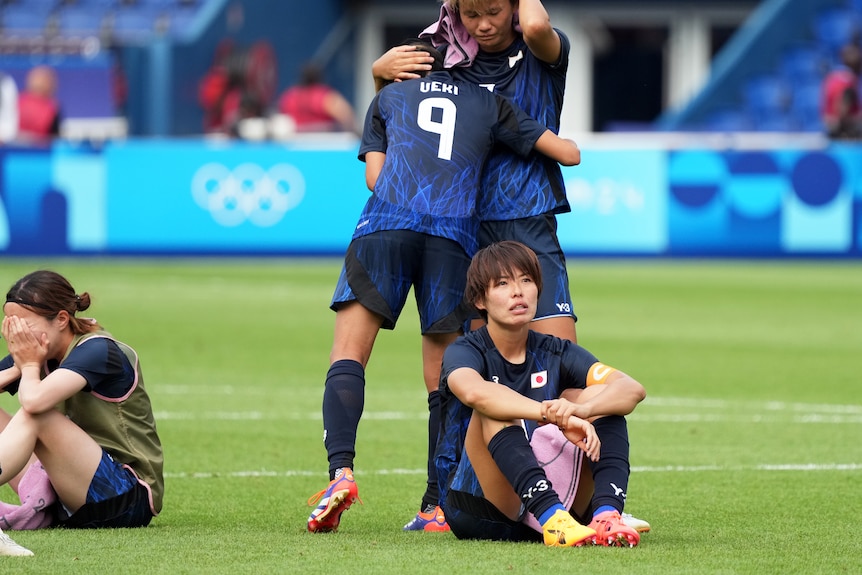
Japan was left dejected after their quarterfinal defeat to the United States during the 2024 Olympic Games. (Getty Images: Koji Watanabe)
Paradoxically, Japan continued to succeed at the youth level. Clubs and academies remained committed to mastering the fundamentals — first touch, passing, and developing players capable of performing multiple roles on the pitch.
The results arrived: Japan won the U17 Women’s World Cup in 2014 and the U20 tournament in 2018, becoming the first nation to lift world titles across every age group.
But that youth success did not automatically translate to the senior stage.
Against fully professional European and American sides, young Japanese players increasingly encountered a formidable barrier.
Midfielder Fuka Nagano, now wearing the number 10 shirt for Nadeshiko Japan, says training with Chelsea at a young age was a defining moment.
“Until then, I had only competed against other youth teams. Training with senior professionals, I realised I couldn’t do anything at all,” she said.
“I felt, from the bottom of my heart, that I wasn’t ready for the world.”
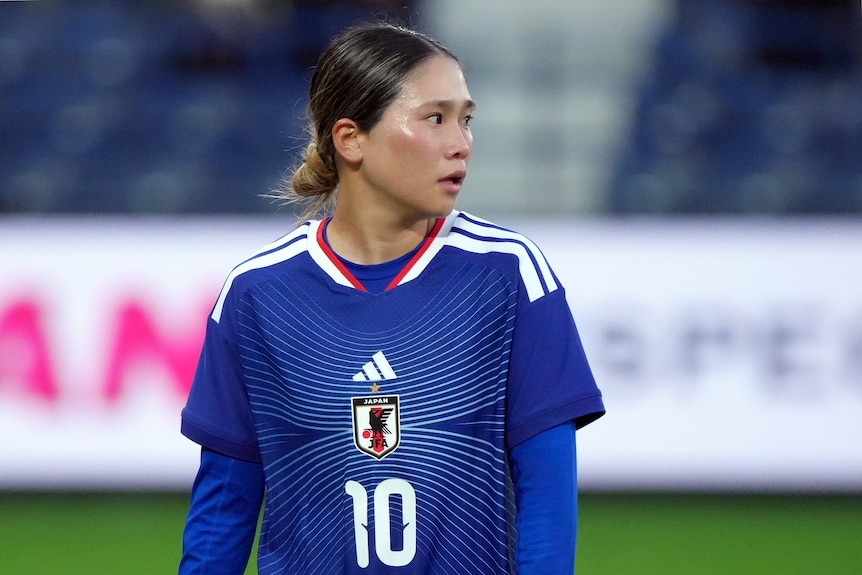
Midfielder Fuka Nagano joined Women’s Super League club Liverpool in 2023. (Getty Images: Koji Watanabe)
The WE league and expansion of overseas pathways
As women’s football advanced rapidly overseas, the professionalisation of Japan’s domestic league became unavoidable.
The launch of the Women Empowerment (WE) League in 2021 created an environment where players could commit fully to football, raising standards in training intensity, match demands, recovery and conditioning.
In parallel, overseas moves by players accelerated and the national team changed shape.
What was once a “point-based” pathway led by a handful of pioneers became a continuous line.
Following the success of players such as Manchester City midfielder Yui Hasegawa, overseas careers became the norm.
Today, nearly 90 per cent of the national team is based abroad.
Nagano’s own journey reflects that transformation. After feeling overwhelmed during her early exposure to Chelsea, she is now an established holding midfielder for Liverpool.
Loading Instagram content
The shift was vividly illustrated at the 2023 World Cup, when Japan defeated eventual champions Spain 4–0 in the group stage, despite conceding nearly 80 per cent possession.
Miyazawa scored twice, finishing the tournament as top scorer.
Japan exited at the quarterfinals at the Paris Olympics the following year, but defender Moeka Minami captured the prevailing sentiment: the team felt closer than ever to breaking through the quarterfinal barrier.
The Nielsen era and tactical evolution
What Japan needed next was a coach capable of uniting these individual gains into a coherent collective.
That figure arrived at the end of 2024 with the appointment of Denmark’s Nils Nielsen, the first foreign head coach in the history of Japan’s women’s national team, and the impact was immediate.

Nils Nielsen took the helm in 2024 and is the first-ever foreign head coach of the Japan women’s team. (Getty Images: Eurasia Sport Images/Paulo Dias)
Nielsen emphasised taking initiative not only in possession, but also without the ball.
At his first tournament, the SheBelieves Cup, Japan pressed relentlessly to disrupt opponents’ strengths, defeating the United States, Colombia, and Australia to claim the title.
“We played bravely and weren’t afraid to move the ball,” Nielsen reflected.
“That’s where the work paid off. We changed the team’s mindset in a very short time.”
Over the following year, through a demanding schedule against elite opponents, Japan continued refining a style aimed at controlling matches across all phases of play.
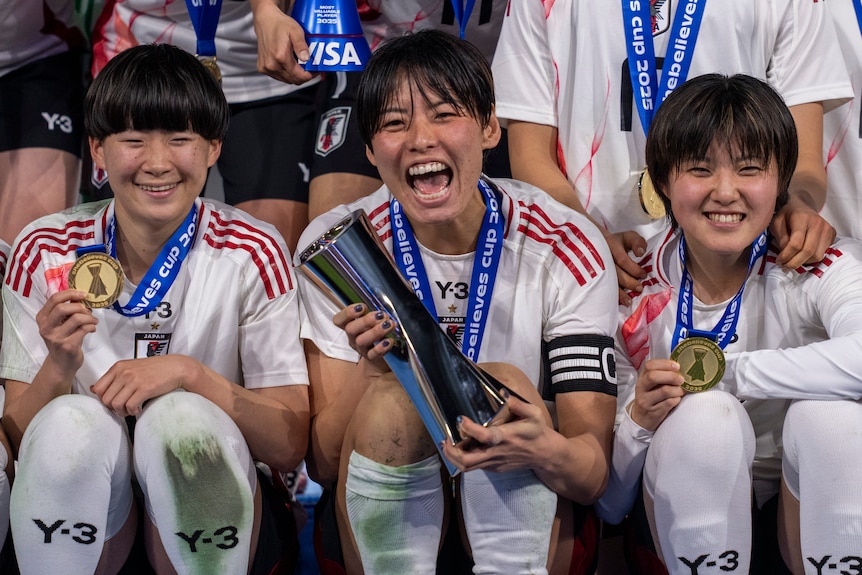
Japan won the 2025 SheBelieves Cup. (Getty Images for USSF: Brad Smith/ISI Photos)
Two figures linking the present and future
At the heart of this team stands captain Yui Hasegawa.
A product of Japan’s development system, she has transformed her game through daily exposure to the pace and physicality of Manchester City.
Now a world-class midfielder, she serves as the team’s stabilising core, connecting individual quality with collective structure.
“The atmosphere and unity are real strengths of this team,” Hasegawa said.
“Personally, I want to contribute on both sides of the ball, keeping the team composed while also influencing the scoreline.”
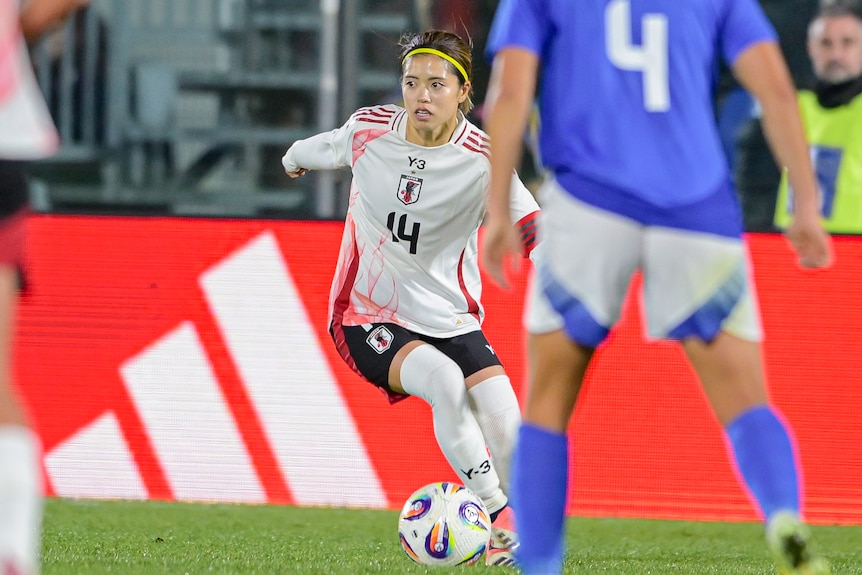
Yui Hasegawa is Japan’s captain and also plays for Manchester City. (NurPhoto via Getty Images: Andrea Amato)
Looking ahead, centre-back Toko Koga represents the next decade.
Raised at the JFA (Japan Football Association) Academy Fukushima, she established herself in Europe and, at just 20, has become a regular starter for Tottenham, forming a defensive partnership with Australian international Clare Hunt.
“At first, I couldn’t fully express myself in the national team, and I hesitated to demand things from senior players,” Koga admits.
“Now, I communicate clearly and play with confidence.”
The balance between Hasegawa’s leadership and the emergence of players like Koga defines today’s Nadeshiko Japan.
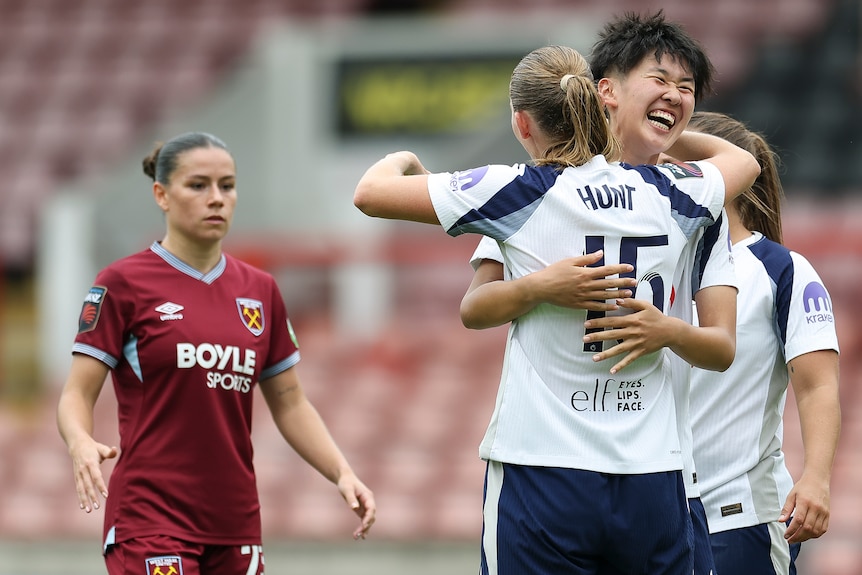
Toko Koga celebrates with Clare Hunt after winning a match between Tottenham Hotspur and West Ham United last year. (Getty Images: WSL/WSL Football/Maja Hitij)
The meaning of the Asian Cup and what lies beyond
For Japan, the AFC Women’s Asian Cup in Australia is not the final destination, but the starting line for another challenge at the summit of world football.
“We don’t want to respect our opponents too much,” Hasegawa said.
“At the Asian Cup, we want to win by playing our own football.”
With individuals hardened by elite leagues, a stronger domestic foundation, and a coach demanding initiative and courage, Japan enter the tournament as challengers, intent on turning long-term transformation into the next stage of global ambition.
Kei Matsubara is a freelance journalist who has covered the Japan women’s national team and domestic women’s league for 17 years.