
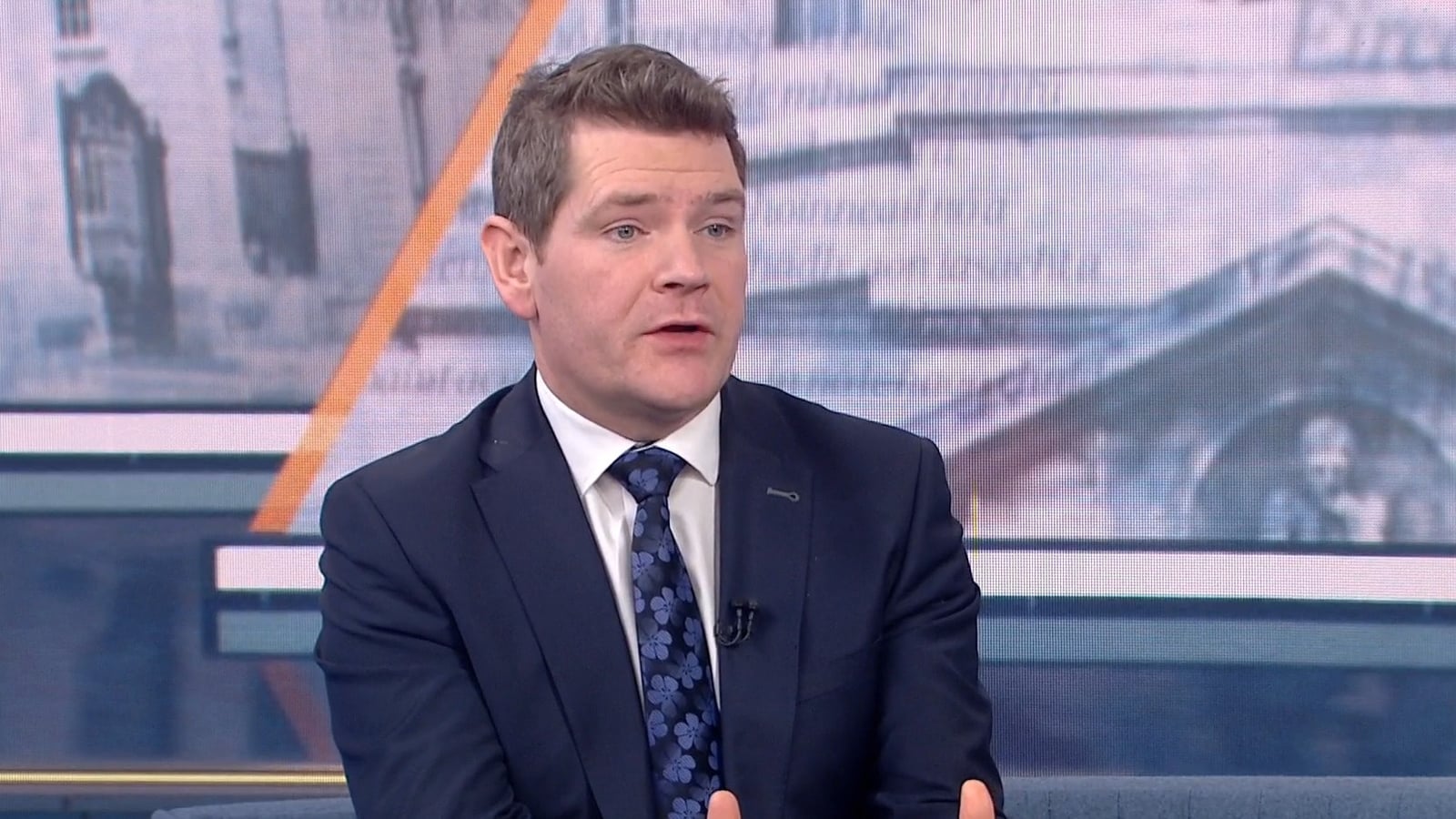
Minister for Enterprise Peter Burke has written to the Chair of the Competition and Consumer Protection Commission (CCPC) requesting it to carry out a review of the retail energy market.
The CCPC is an agency of the minister’s department and it can carry out investigations based on market evidence, or at the minister’s request.
Minister Burke believes the current crisis in the Gulf could push up energy prices.
“It is important to ensure that any such upward pressure does not lead to price increases for the consumer which are not proportionate,” he said.
The minister wants the CCPC to engage with other regulators and stakeholders during this review including the Commission for Regulation of Utilities.
“Ireland already experiences high energy prices; we are currently fifth highest in the EU according to the most recent Eurostat data.
“There are a number of historic reasons for this, including our dispersed population, low level of interconnection with European markets and our dependence on imported energy.
“It’s imperative that we ensure the market is competitive and fair for consumers, so that’s why I am asking to CCPC to carry out this review to ensure we are using all the levers at our disposal,” Mr Burke said.
Earlier, the Taoiseach warned against price gouging as the price of energy soars due to the ongoing conflict in the Middle East.
The disruption and fears of prolonged closure have caused oil and European natural gas prices to jump, with Brent crude futures up nearly 10% this week as the conflict triggered multiple oil and gas shutdowns in the region.
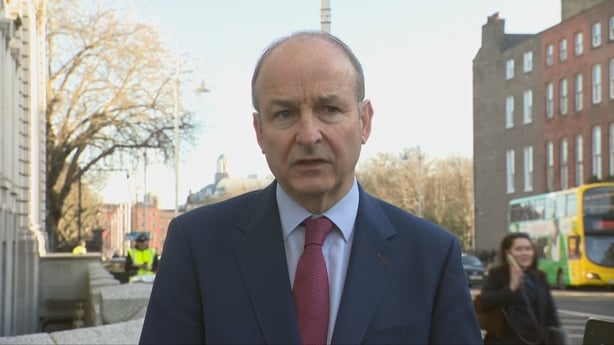
Taoiseach Micheál Martin warned against companies taking unfair advantage of Irish consumers
Micheál Martin warned companies not to take unfair advantage of Irish consumers.
Speaking this morning, Mr Martin said: “There is no excuse for prices going up at the pump yesterday or indeed anywhere as our oil is coming from the North Sea.”
“In relation to this, we met the competition and consumer authority yesterday and we have asked them to examine the industry and the sector, in terms of any unfair pricing practices,” he said.
He added that there will be economic implications if the conflict continues.
CEO of Fuels for Ireland Kevin McPartlan said just because the price of fuel has increased does not necessarily mean price gouging is happening.
Speaking on RTÉ’s Drivetime, he said: “I get the fact that if any price goes up 30% in 48 hours, that’s a pain and that’s going to hurt people and particularly when it’s a product that they have no discretion of whether they need it or not.”
“But the fact that the price has increased doesn’t mean this is price gouging and when I heard the Taoiseach earlier on today I was a bit dismayed because, if the Taoiseach is serious about wanting to reduce the price of fuel for Irish consumers, we should talk about the fact that we pay more tax on fuel in Ireland than in almost any other European member state, that we have the second-highest price for diesel in Europe and the third-highest price for petrol in Europe, that we’re paying more VAT for home heating or than we pay for gas for home heating,” he said.
We need your consent to load this rte-player contentWe use rte-player to manage extra content that can set cookies on your device and collect data about your activity. Please review their details and accept them to load the content.Manage Preferences
Mr McPartlan added: “So there are a number of levers that the Government have and we have been asking the Government to establish an expert group to review the tax, taxation and compliance cost on fuels to really look at this strategically instead of always having this knee jerk reaction”.
Social Democrat TD Jennifer Whitmore said she was “gobsmacked” by Mr McPartlan’s comments, saying she believed it was “clear that there were some retailers and distributors who were inflating the price so that they would get more money from the sale of a tank of fuel”.
She told the same programme: “I think it’s really unfortunate that they are doing it. You know the fact that within a couple of days of this war escalating, the prices were going up 20% I think that in itself is a clear indication that price gouging is happening.”
Concerns over supplies of natural gas
The International Monetary Fund said it is closely monitoring developments in the Middle East, noting disruptions to trade and economic activity, surging energy prices and increased financial market volatility.
The IMF said it was too early to assess the economic impact on the region or globally, which will depend on the extent and duration of the conflict.
Ireland will likely see the most impact from a disruption to natural gas supplies rather than oil, a Professor of Energy Economics at UCD has said.
Professor Lisa Ryan said that as Ireland gets much of its supply from the North Sea, the UK and Norway, prices here should not be immediately affected by disruption to supply through the Strait of Hormuz.
Speaking on RTÉ’s Morning Ireland, Prof Ryan said Ireland is “more affected by the natural gas disruptions. And we saw that natural gas prices increased by 33% yesterday.
“And that’s also partly to do with the Strait of Hormuz because liquid natural gas goes through there, and it comes to Europe from the Middle East. And also because Qatar Energy, which produces 15% of European liquid natural gas is all stopped,” she said.
She added that oil prices in Ireland should not have gone up immediately.
“Normally companies also have significant storage or they buy in advance and they hedge and so normally there’s a lag even between when the prices go up.
“It means that companies are expecting this to last a long time and they’re expecting scarcity and so they’re expecting prices to increase and so they’re pushing higher prices on now in advance of that.”
Prof Ryan said it is possible that companies are taking advantage of the situation because Ireland’s supply comes from the UK, which is coming from Norway.
“It is all interconnected, even if we don’t import directly from the Middle East.
“So, in European markets, if there’s a problem with the Middle East, it means that European oil will become more expensive because people will then be exporting it to elsewhere where they can’t get Middle Eastern oil.”
But, she said, oil prices were quite stable, especially in Europe.
“I think we have more to worry about on the natural gas side, where storage levels are low in Europe at the moment, they’re only 30%, which is normal at the end of the winter because we use our natural gas during the winter.
“And there we are reliant on liquid natural gas coming from the Middle East, which not in Ireland directly, but in Europe since the Russian invasion.
“And so that’s why natural gas prices are rising more dramatically and we’re very reliant on natural gas imported in Ireland”, Prof Ryan said.
We need your consent to load this rte-player contentWe use rte-player to manage extra content that can set cookies on your device and collect data about your activity. Please review their details and accept them to load the content.Manage Preferences