
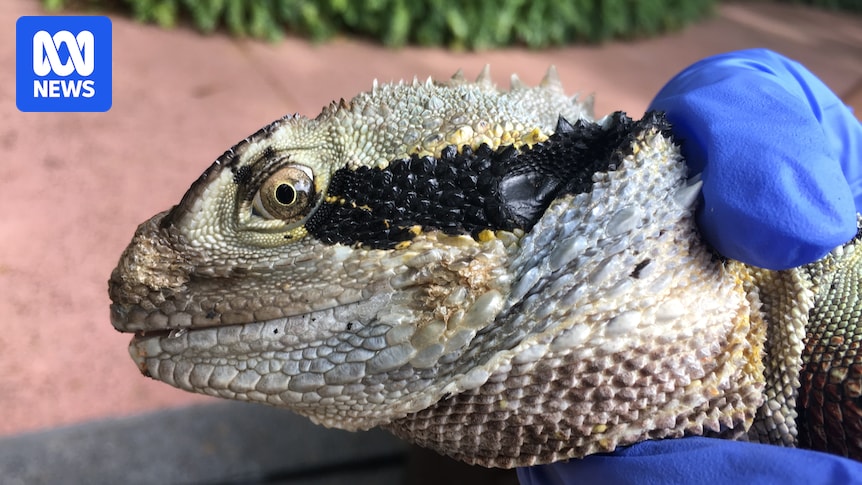
Queensland researchers studying eastern water dragons say they are concerned about the spread of a little-known fungus that could have major implications for Australia’s diverse reptile population.
The long-term study of water dragons in Brisbane has found a single case of the fungus has spread to about half of the Roma Street Parklands population over a 10-year period.
University of Queensland PhD candidate Sam Gallagher-Becker said the fungus — Nannizziopsis barbatae — causes fungal skin lesions and lethargy which can lead to starvation and eventual death.
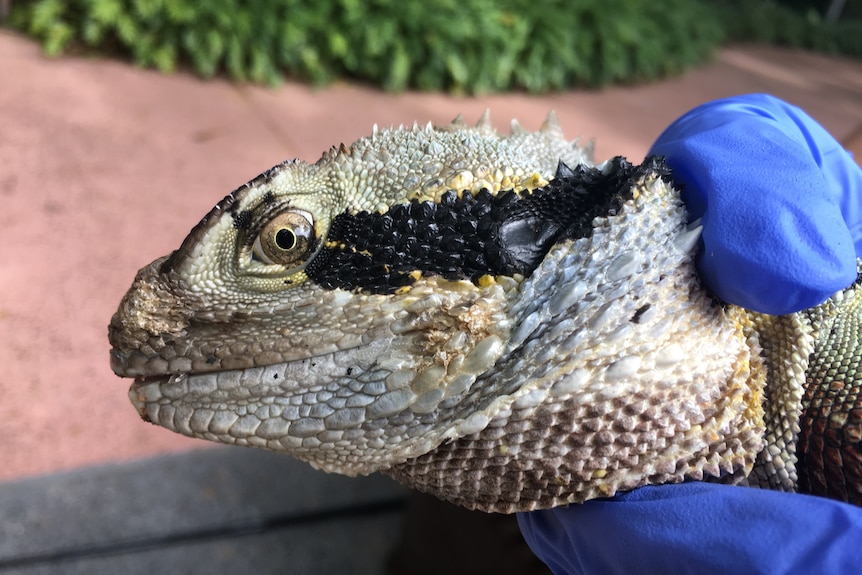
An eastern water dragon with a yellow lesion on its face. (Supplied: University of Queensland)
“It eats the keratin that’s in the reptile’s scales and then it produces these lesions and occasionally what can happen is the lesion gets so bad that the animal’s limb might fall off or they start to lose digits,” he said.
“In some animals we actually see that the flesh starts to die off and rot and the whole animal then just dies shortly after that.”
“It’s quite horrible when you find them and they’re covered in lesions and they’re just very sick and aren’t able to move around and eat.”

PhD candidate Sam Gallagher-Becker said infected water dragons die sooner than their healthy counterparts. (ABC News: Stephen Clarke)
Mr Gallagher-Becker said researchers had noticed a sharp spike in the number of infections two to three years ago, but the number had plateaued at around half of the Roma Street Parklands population.
But the disease isn’t just restricted to one small area or one species.
“It’s present in a lot of other populations of reptiles across Brisbane as well,” Mr Gallagher-Becker said.
“Some areas we go we actually find higher levels of disease than what we find here.”
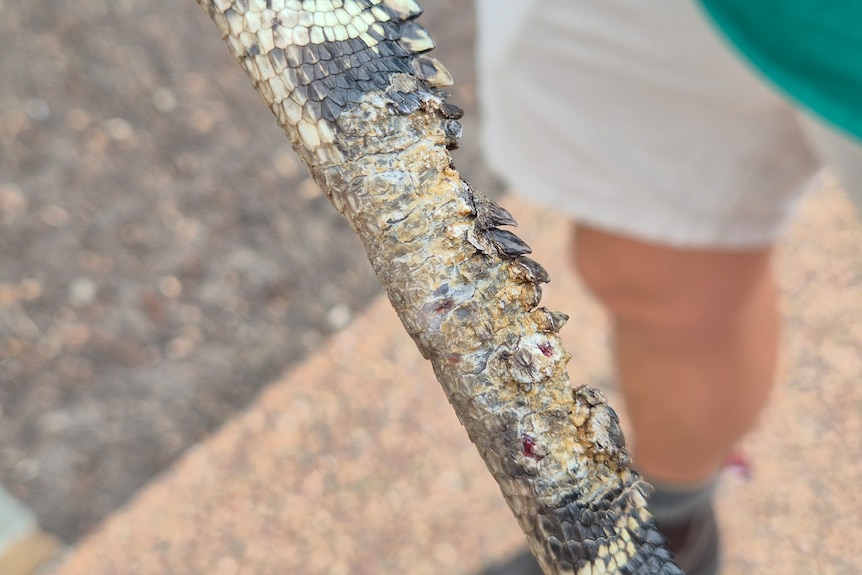
The fungus can enter through wounds on a water dragon’s body, according to researchers. (ABC News: Stephen Clarke)
Outbreaks have also been documented as far afield as Dubbo and Perth.
The researchers said there were still a lot of unknowns — including the origin of the fungus.
“That’s a big question that we haven’t been able to answer yet,” Mr Gallagher-Becker said.
Whether the fungus is native to Australia or introduced is a question with major implications, he said.
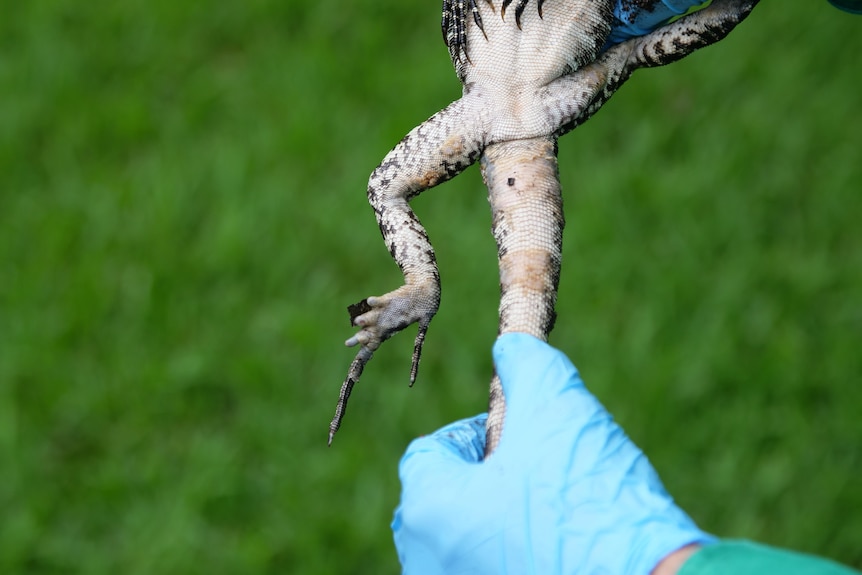
Mr Gallagher-Becker says the lesions can cause the loss of limbs or toes. (Supplied: University of Queensland)
“If it’s been introduced then it’s essentially a new pathogen that they haven’t encountered yet and that means the effects of it might be a lot worse.”
‘National emergency’
Researchers said the findings were more alarming due to examples like the chytrid fungus and white-nose syndrome, fungal diseases that have led to the extinction of more than 100 species of animals worldwide.
Studies show in Australia the chytrid fungus has led to the decline of 43 species of frog including the presumed extinction of seven species since first being detected near Brisbane in 1978.
“There’s a lot of areas that are just black zones where we have no idea if the fungus is in the soil and if reptiles are infected, and that’s really worrying,” Mr Gallagher-Becker said.

Associate Professor Celine Frere said just one water dragon in the study was identified with the fungal disease in 2013 – now about half of the population has it. (ABC News: Stephen Clarke)
Study lead Associate Professor Celine Frere said she was concerned about the potential impact for Australian reptiles.
“Australia has about a thousand different species of reptiles, and 90 per cent of those are endemic,” she said.
“It’s a national emergency because we now have a fungal pathogen that we know can cause death, it doesn’t have any treatment and can basically impact the majority of the reptile species we have in Australia.”
“Yet we know so very little about it, and that to me is a problem.”
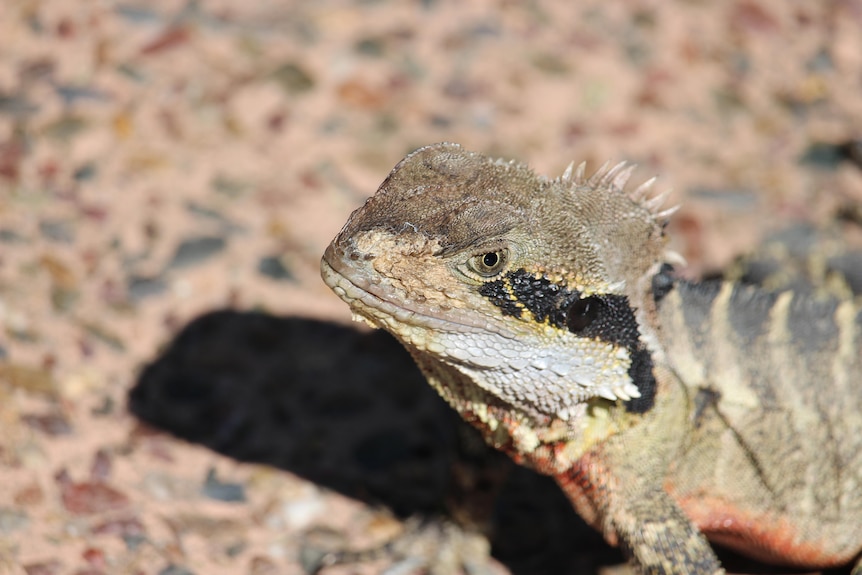
Reptiles infected with the fungal pathogen have also been detected in NSW and Western Australia. (Supplied: University of Queensland)
More surveillance needed
The Australian Museum’s curator of Amphibian and Reptile Conservation Biology, Dr Jodi Rowley, said wildlife diseases were “incredibly understudied”, especially in reptiles.
“It’s always terrifying when we discover a new disease in our wildlife.”
“The more we learn, unfortunately, like in this study, the more we realise what a potential threat it is to Australia’s biodiversity.”
Dr Rowley said climate change, extreme weather events and the increased movement of wildlife were all contributing to an apparent increase in fungal diseases around the world.
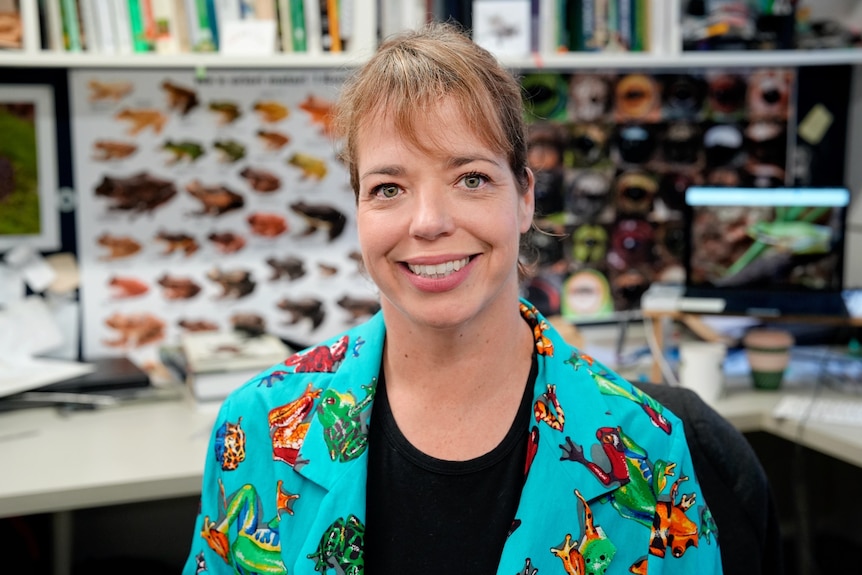
Dr Jodi Rowley said the discovery of a new disease in Australia’s wildlife was ‘alarming.’ (ABC News: Tamara Penniket)
“We’re also realising that fungal diseases can … and do cause a huge threat to human populations as well,” she said.
“I think it’s important when we think of wildlife disease, that we don’t think of it as just something that could particularly affect our biodiversity.
“It is becoming a big problem and there is a greater need for surveillance of wildlife so that we can detect and respond to these events, especially if they are [introduced] from overseas.”