
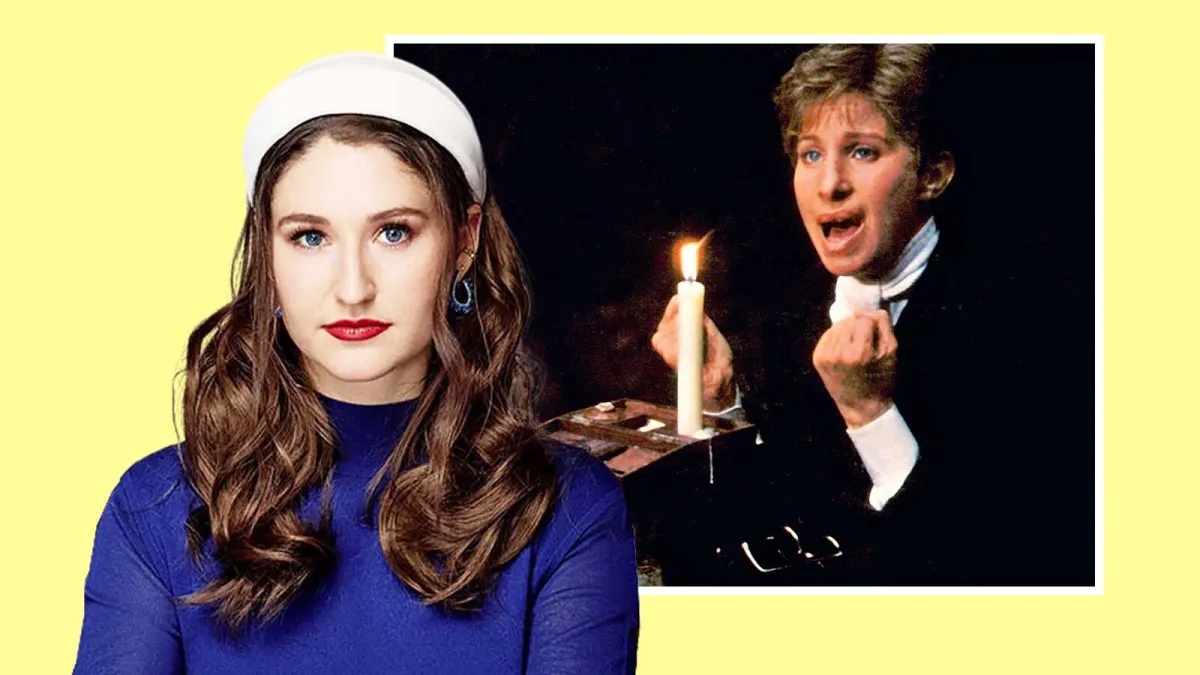
Chutzpah. Mensch. Schlep. Klutz. Shvitz. I am a Jew, but that is more or less the sum of my Yiddish — I know, what a schlemiel! (OK, now that actually is all of it). Yet here I am sitting in a rehearsal room at the Marylebone Theatre in London, watching an Australian woman reciting Yiddish while debating Jewish scripture — and pretending to be a man.
The woman is the actress Amy Hack. The show is Yentl. And this award-winning bilingual production from Melbourne’s Kadimah Yiddish Theatre (KYT) arrives in London this month after finding itself caught in a cultural and political crossfire far beyond anything its creators intended.
The story of Yentl celebrates so many key pillars of Jewish life: ritual, curiosity, debate, questioning (and questioning that questioning) and, of course, Barbra Streisand. Most people who know Yentl think of Streisand’s 1983 musical film but it began as a short story, Yentl the Yeshiva Boy, written in Yiddish in 1962 by the Polish-American Nobel laureate Isaac Bashevis Singer.
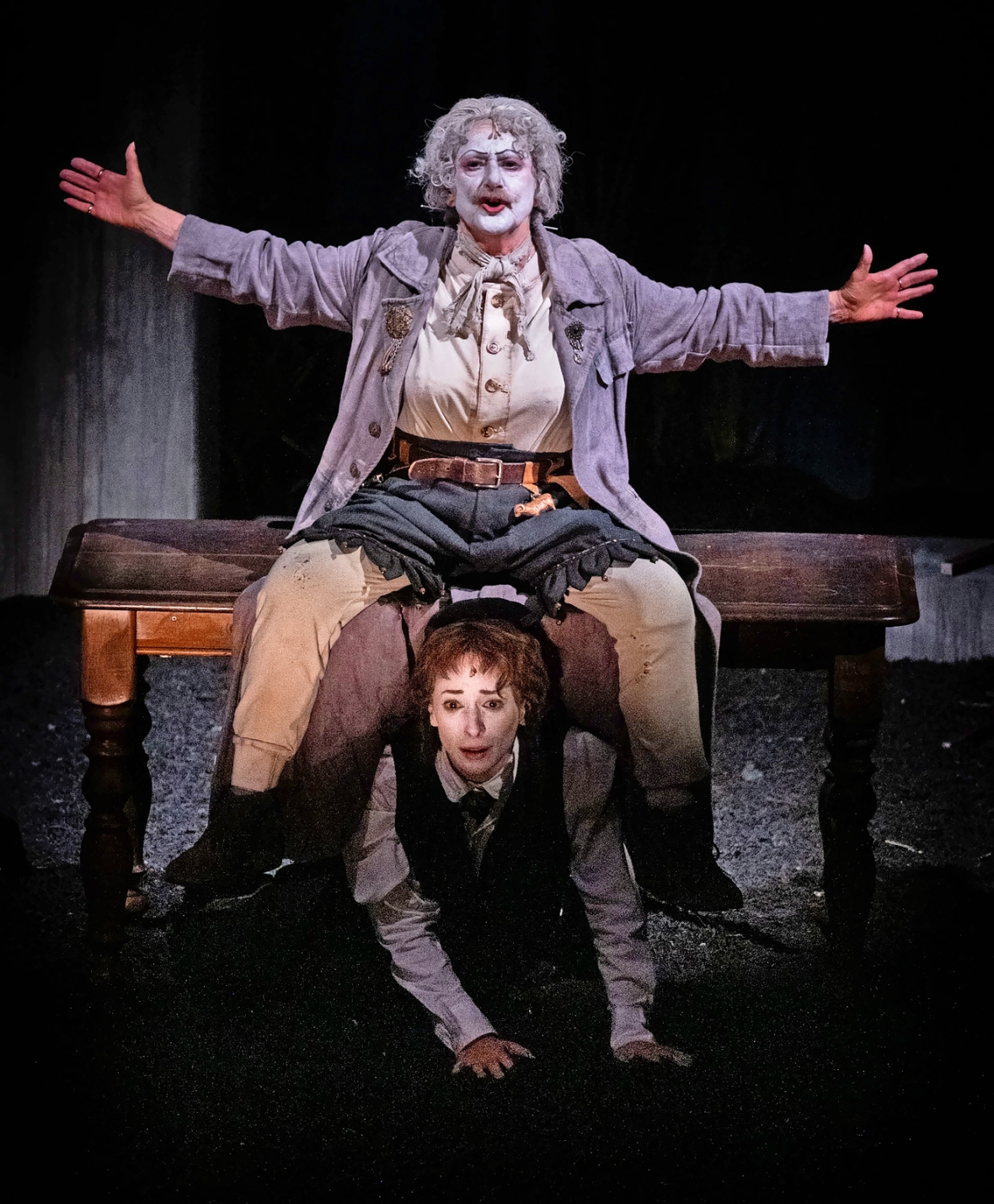 Evelyn Krape and Amy Hack in YentlTHEATERFOTOGRAFIE TURIN
Set in a 19th-century eastern European shtetl, it follows a young Jewish woman whose intellectual hunger exceeds the limits imposed by her gender. When her father dies she disguises herself as a boy and enrols in a yeshiva — a male-only seminary — determined to pursue the Talmudic study forbidden to her.
Singer was reportedly unimpressed by the Hollywood adaptation’s romantic optimism and the heroine’s flight to the USA. He once asked, tartly: “What would Yentl have done in America? Worked in a sweatshop 12 hours a day — where there is no time for learning?”
Yentl’s co-writer Gary Abrahams, who is also KYT’s director, seems similarly underwhelmed by the film, particularly in comparison to Singer’s work. “When I read the short story I was just so startled at how different it was from the film,” he tells me. “I just thought, this is actually an extraordinary study on spirituality and identity and gender and sex.”
His production is not a musical. It returns to the darker ambiguity of Singer’s prose and adds a bold theatrical device: a physical yetzer hara — the “evil inclination” of Jewish theology — depicted on stage, embodying Yentl’s inner turmoil.
“In the story, at times it almost feels like she’s possessed,” Abrahams says. “So we wanted to embody that conflict — make it visible.” Singer himself co-wrote a stage version in the 1970s that, according to a New York Times review, “has charm. But drama it lacks.”
Elise Esther Hearst, who joined the team as a co-writer, focused on distilling the story. “There’s so many big themes… so how do we ground this in real life, interpersonal drama?” she says. Where Singer’s play had a cast of 20 and expanded the world outwards, this production, with its cast of just four, tightens the focus, homing in on the fraught love triangle between Yentl, Avigdor (Yentl’s study partner) and Hodes (Avigdor’s ex-fiancée).
Theatre newsletter
Our chief theatre critic on what to see (and what to miss) in the West End and beyond.
Sign up with one click
The decision to perform part of the script in Yiddish is central too.
“Yiddish language is at the heart of our work,” Abrahams says.
“It feels soulful,” Hearst adds.
“Not that many people speak Yiddish any more, so we’re reviving it,” Hack says. “Keeping that chain of culture, ritual and language alive.”
English surtitles will ensure accessibility, but the language’s expressive, onomatopoeic rhythm carries its own emotional charge. The work is painstaking, relying on “a generous community of collaborators”, Abrahams explains. Sometimes they write in English, then work with translators, Yiddish specialists and dialect coaches to re-create in Yiddish. But they do also have “a number of writers and artists in our community who are able to write and create in Yiddish”.
Jewish life in Australia stretches back to the First Fleet in 1788 and Australian Yiddish theatre has existed for more than a century. Today, Abrahams says, “there is a huge resurgence in interest from younger demographics eager to reconnect to their ancestry”. Unlike other countries where Yiddish is largely restricted to ultra-Orthodox communities, Kadimah runs conversation classes and Australia has the world’s only secular Jewish day school where Yiddish is compulsory.
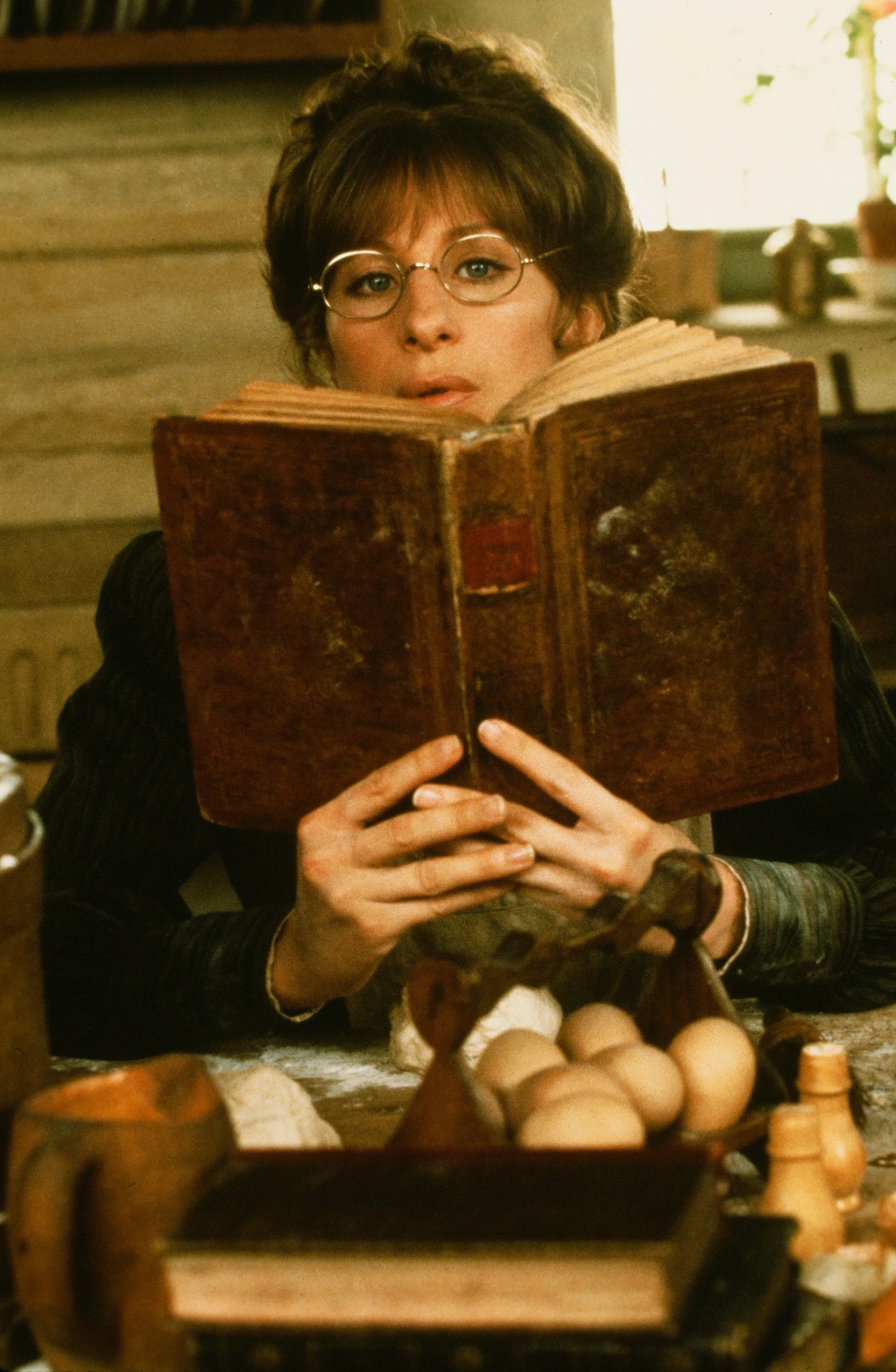 Streisand in the filmHulton Archive/Getty Images
When Yentl premiered in Melbourne in 2022 it was a great success: full houses, standing ovations, a fistful of awards. “We had such an amazing response,” Hack says. “A lot of my queer friends and my trans friends said to me so passionately, ‘This is my story.’”
“You’d see Orthodox Jews sitting next to drag queens,” Abrahams recalls, “completely different communities intersecting at the core of what the story was.”
Then came October 7, 2023.
The play has no connection to Israel, and since its inception KYT has been apolitical. But, Abrahams says, “there were many people… who conflated all things Jewish with Israel”.
When the show transferred to Melbourne’s Malthouse Theatre in 2024, posters were defaced. There were hostile comments on social media and threats of protests. Extra security measures were implemented and front-of-house staff received additional training in case of disruptions during the show from protesters in the audience. The season also collided with a significant doxxing incident (public sharing of personal details) that targeted Jewish creatives, affecting key members of the creative team.
Abrahams says: “The most difficult thing was dealing with slow ticket sales, from both Jewish audiences and non-Jewish audiences.” That meant Jewish audiences feeling unsafe in public spaces, and non-Jewish audiences scared that coming to see a visibly Jewish show could be interpreted as support for Israel. “It was a real double whammy,” he says. Yet by mid-season strong reviews and word of mouth began to reverse the trend.
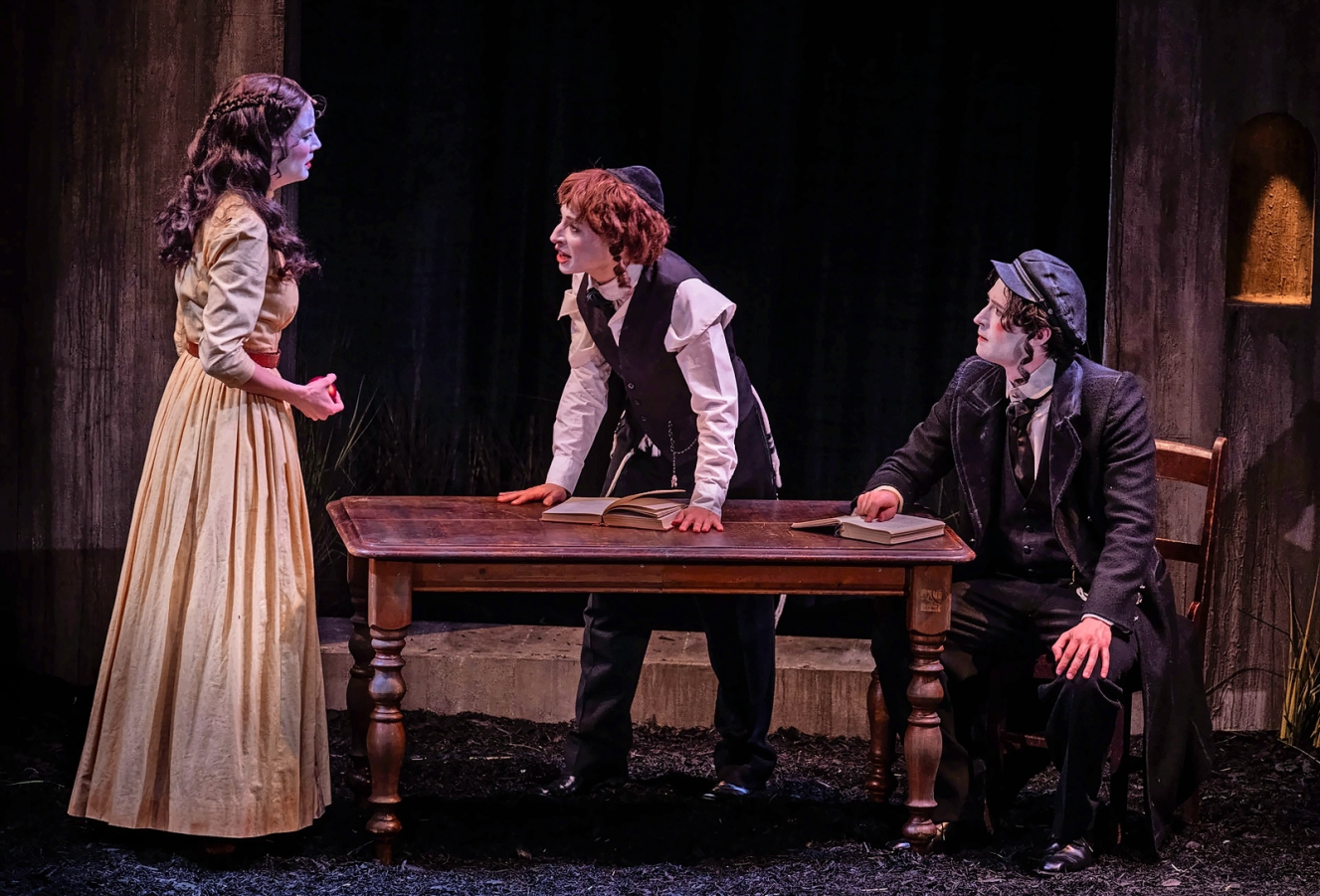 Genevieve Kingsford, Hack and Nicholas Jaquinot in the stage productionTHEATERFOTOGRAFIE TURIN
In October 2024 the show played at the Sydney Opera House. On the eve of announcing its London transfer, news broke of the horrific massacre on Bondi beach. “What was a moment of euphoria turned to shock, grief and fear,” Abrahams says. “Australia’s Jewish community is small and very connected. None of us are more than one or two degrees of separation away from each other.”
The announcement was postponed. Some cast members felt trepidation about travelling overseas. Abrahams admits it’s been challenging but says “it’s lit a fire under us”.
Hack shares the same ambition. “I really hope we get as diverse an audience as we can,” she says. “It’s sad to think that after everything that’s happened, we’re withdrawing into our communities out of fear. That’s not the answer. We have to resist that instinct.”
Even within the company, Abrahams notes, “most of the creative team are not Jewish, and not all of our cast are… We are not interested in existing in, and creating within, a silo.” Perhaps it bodes well that Yentl has already received Marylebone Theatre’s best advance sales to date.
As for me, I’m sitting in the rehearsal room thinking afresh about the issues Yentl raises. I am a modern Orthodox Jewish woman and a feminist, which some regard as a contradiction.
I recently celebrated my second wedding anniversary with my wonderful husband, Max, who spent three years undergoing a rigorous conversion to Orthodox Judaism — a process that tested our relationship, and us as individuals, to the utmost. It compelled us to confront difficult questions about faith, leaving us at times uncertain, frustrated, even angry. But the life we chose together (however challenging the journey there) now anchors our marriage in a shared Jewish future.
Orthodox Judaism is often perceived as rigid. Men and women occupy distinct roles. The world Yentl inhabits, where a woman cannot formally study Talmud, is historically accurate. But Orthodoxy is also argumentative and self-interrogating. “Two Jews, three opinions”, as the idiom goes.
After October 2023, Hearst says, there has been “a kind of silencing of Jewish voices”. Abrahams admits he had never particularly framed himself as a Jewish artist before recent years but the label has increasingly been affixed to him. So, like the rebellious Yentl, the team are pushing against boundaries imposed upon them.
I know full well that there is only so much one can push Jewish law without rewriting it, something Orthodoxy by its very nature can never do. Yet there is change.
In my own modern Orthodox synagogue, a programme was recently introduced focusing specifically on LGBTQ+ experiences — not to redraw the boundaries of Jewish law but to create space for conversations that previously didn’t quite have a home. At our weekly Kiddush (the synagogue’s unofficial Shabbat lunch, enjoyed just before everyone goes home for the real one), you can see clearly that the community is made up of people with very different levels of observance and political views.
Yentl dresses in her late father’s clothes to recite the mourner’s prayer, Kaddish, at his graveside — a prayer women historically could not say. But today, in my Orthodox shul, women are actively encouraged to participate in Kaddish, with volunteers guiding those who wish to join.
I know that if Yentl were to visit my synagogue today, she would be treated with kindness, and her intellectual rigour would be welcomed in one of the many classes offered. As would Streisand herself — Barbra, if you’re reading, please come for kiddush.
Yentl is at the Marylebone Theatre, London, Mar 6 to Apr 12, marylebonetheatre.com