
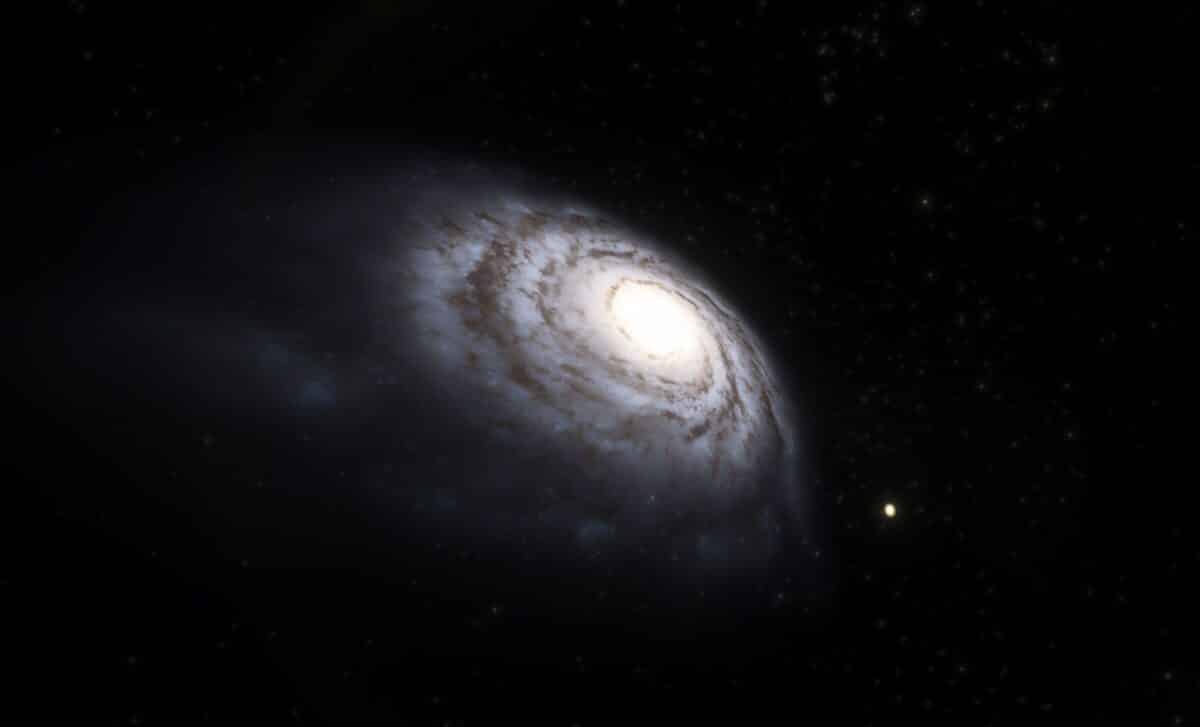
Astronomers have unveiled an extraordinary find: a ghostly galaxy almost entirely composed of dark matter. Located 300 million light-years away in the Perseus galaxy cluster, this faint, elusive galaxy, known as CDG-2, was only detectable through its sparse population of globular star clusters.
Low-surface-brightness galaxies like CDG-2 are notoriously hard to detect, as they emit very little light. Most galaxies are filled with vast numbers of stars, but these rare galaxies consist mostly of dark matter, making them incredibly difficult to spot using traditional methods.
The Hunt for Faint Galaxies
Detecting faint, low-surface-brightness galaxies is no easy feat. These galaxies are typically so dim that they evade the sensitive eyes of most telescopes. In the case of CDG-2, astronomers did not rely on brightness to find the cosmic entity. Instead, they focused on globular clusters, which are dense, spherical collections of stars that orbit larger galaxies.
According to David Li of the University of Toronto, globular clusters serve as a key indicator of nearby faint galaxies, acting like cosmic breadcrumbs leading astronomers to their discovery. This novel approach allowed the team to locate CDG-2, as well as several other potential dark galaxies.
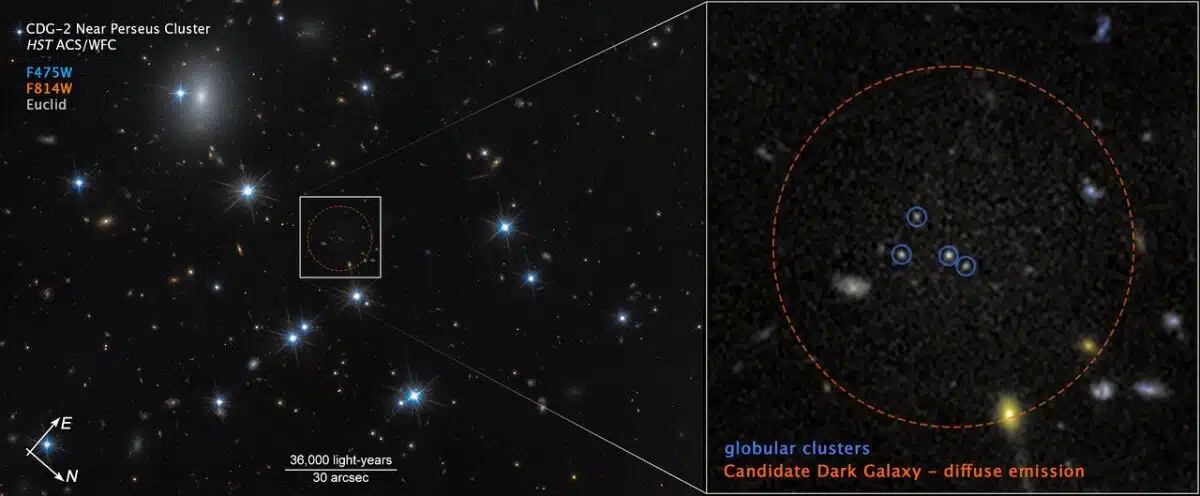 CDG-2 in the red circle, is mostly dark matter with sparse stars. Credit: NASA’s Hubble Space Telescope, NASA, ESA, Dayi Li.
Confirming CDG-2 with High-Tech Telescopes
As outlined in the study in The Astrophysical Journal Letters, confirming its existence after identifying the globular clusters required the use of advanced imaging tools. Observations from NASA’s Hubble Space Telescope, the ESA’s Euclid mission, and the Subaru Telescope in Hawaii all provided essential data. Hubble’s images revealed a faint, extended glow around the clusters, signaling the presence of the ghost galaxy beneath.
“This is the first galaxy detected solely through its globular cluster population,”Li pointed out. “Under conservative assumptions, the four clusters represent the entire globular cluster population of CDG-2.”
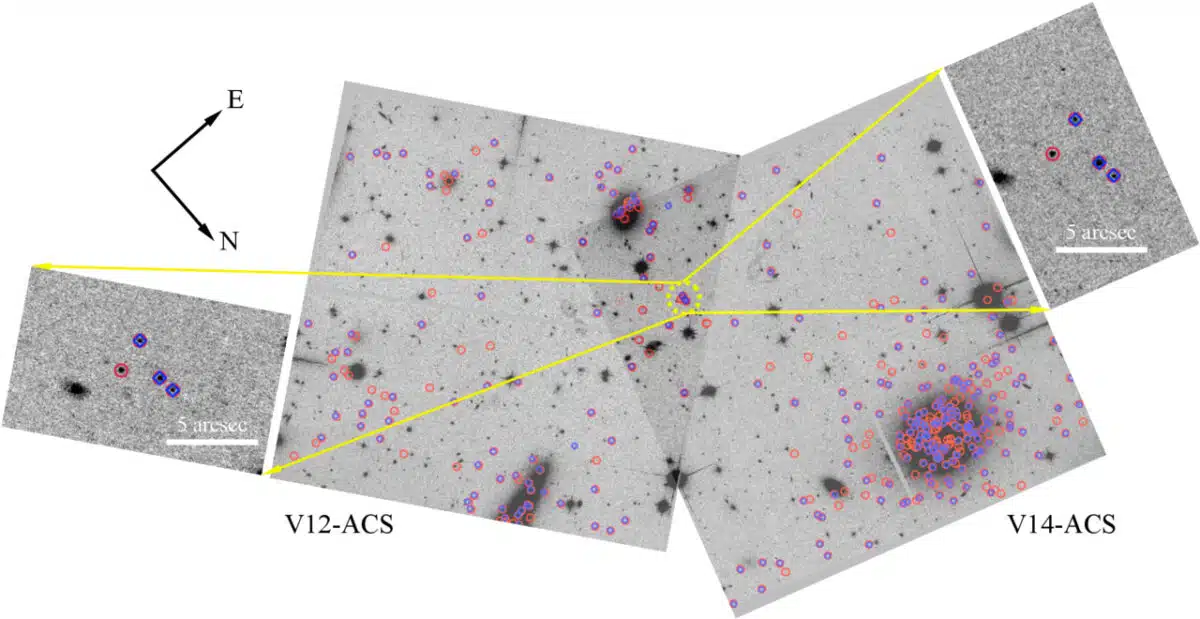 This image shows a detailed map of CDG-2, with globular clusters highlighted in red and blue circles. Credit: The Astrophysical Journal Letters
A Galaxy Dominated by Dark Matter
What makes CDG-2 truly remarkable is its composition. Early estimates suggest that around 99% of the galaxy’s total mass is dark matter, with the remaining 1% consisting of visible stars. It shines with light equivalent to only six million stars; quite a modest number compared to typical galaxies. The four globular clusters that orbit it contribute about 16% of the visible light. Based on the findings, most of the galaxy’s ordinary matter was likely stripped away by interactions with neighboring galaxies.
The identification of CDG-2 is a pivotal moment in the study of dark matter. As telescope technology and methods continue to advance, astronomers are likely to uncover more of these ghostly galaxies.