
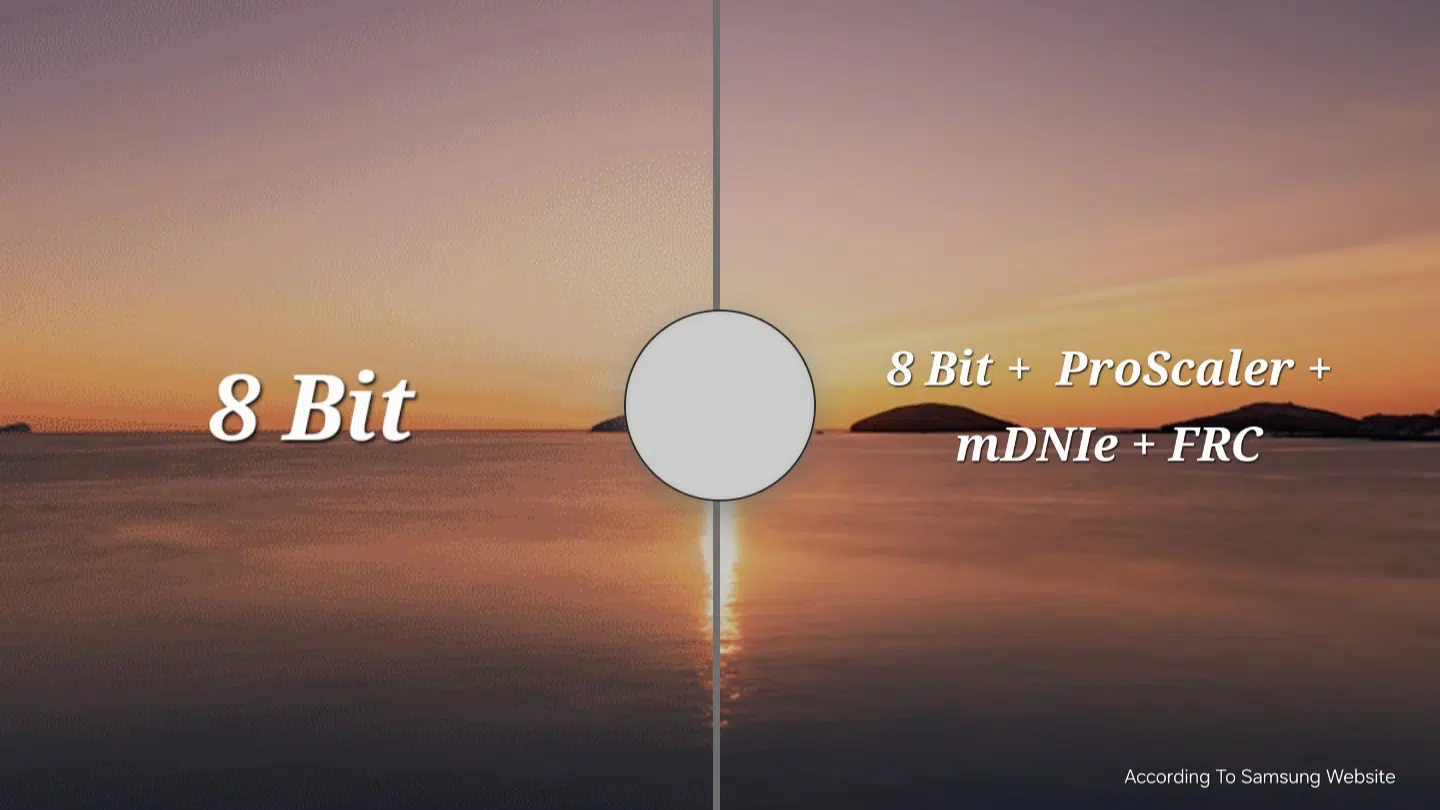
In Part 3 of the Smartphone Photography Chain, we shift focus to the display stage, examining 8-bit vs 10-bit panels, and how technologies like ProScaler and mDNIe influence the final image you actually see. Because smartphone photography doesn’t end at the sensor. Gradients, HDR rendering, color transitions, and even perceived sharpness are shaped by the display pipeline. Bit depth matters, but the full chain matters more.
Where your images are finally judged — and why format alone is not enough
When you capture a photo, you capture data: Linear light values, color information, tonal precision. But photography does not end at capture. The moment you view that file, it enters the display pipeline, and that pipeline determines whether your image’s precision survives. Display is not just a screen. It is a translation system. And in photography, translation defines truth.
Color space: The boundary of what you can see
A color space defines the volume of reproducible color. In smartphones, two major references dominate:
sRGB — the SDR baseline. Limited gamut.
Display P3 — wider primaries, especially in red and green; better aligned with modern OLED emission characteristics.
If you capture in Display P3 (HEIC/HEIF) but view on an sRGB-limited panel, the display must compress that color volume. Compression reduces the separation between adjacent hues. Subtle differences can collapse into similar values. This is not brand preference. It is colorimetry. Wide-gamut capture without a wide-gamut display is unrealized potential. And that leads to the next variable: tonal precision.
Bit depth: Tonal resolution
Bit depth defines how many discrete luminance steps exist per channel.
8-bit = 256 levels
10-bit = 1,024 levels
12-bit = 4,096 levels
In RGB terms:
8-bit = 24-bit color
10-bit = 30-bit color
12-bit = 36-bit color
In photography and video, higher bit depth primarily reduces:
Gradient banding
Posterization in shadows
Abrupt sky transitions
Skin tone stepping
But alignment across the chain matters. If your workflow is: Sensor (10-bit+ ADC) → HEIC / HEIF / RAW → HEVC / ProRes → 10-bit display pipeline, then display precision is relevant. If your file is JPEG or H.264 (8-bit), the limitation is already encoded. When you select JPEG for photos or H.264 for video, you are making a tonal decision.
JPEG is strictly 8-bit per channel. 256 luminance steps. No more. H.264 is more nuanced; the standard does include 10-bit profiles such as High 10. But in practical consumer workflows, smartphones, streaming platforms, and social media pipelines overwhelmingly use 8-bit baseline, Main, or High profiles. Not because H.264 cannot support 10-bit, but because 10-bit implementations are rarely enabled across real-world consumer hardware and distribution chains.
A display cannot reconstruct precision that does not exist in the file.
That takes us to the next layer of the smartphone photography chain Part 4 — the social media platform — in the next article.
Native 10-bit panels: What that actually means
A native 10-bit OLED panel means:
Each subpixel can physically address 1,024 voltage states
The driver IC processes 10-bit signals natively
Factory calibration is performed at 10-bit precision
Panel manufacturers such as Samsung Display, LG Display, and BOE have the capability to produce native 10-bit mobile OLED panels. However, marketing language often introduces ambiguity. Phrases like “1 billion colors” do not automatically confirm native 10-bit panel architecture.
Disclaimer: All references to 8-bit or 10-bit reflect official specifications only. If native 10-bit panel hardware is not explicitly confirmed by the manufacturer, it should not be assumed.
8-Bit + FRC: Perceptual precision
FRC (Frame Rate Control) is temporal dithering. An 8-bit panel produces 256 discrete levels per channel. FRC alternates between adjacent values across frames to simulate intermediate tones.
Example:
Frame A → Level 125
Frame B → Level 126
At high refresh rates, the visual system integrates these frames and perceives a value between them. As such, FRC improves perceived smoothness, but it does not increase physical voltage states. It is legitimate engineering, but it remains perceptual precision, not native electrical precision. For most viewing scenarios, it can be visually convincing. For strict signal integrity analysis, it is not equivalent to native 10-bit driving.
Samsung display processing: Separate precision from enhancement
On many Samsung flagship devices, additional display layers exist. These must not be confused with bit depth.
mDNIe (Mobile Digital Natural Image Engine): It manages gamma curve shaping, white balance calibration, contrast tuning, and viewing mode adaptation. mDNIe operates at the signal processing level and does not add voltage states. It also does not increase panel bit depth but optimizes tone mapping within hardware limits.
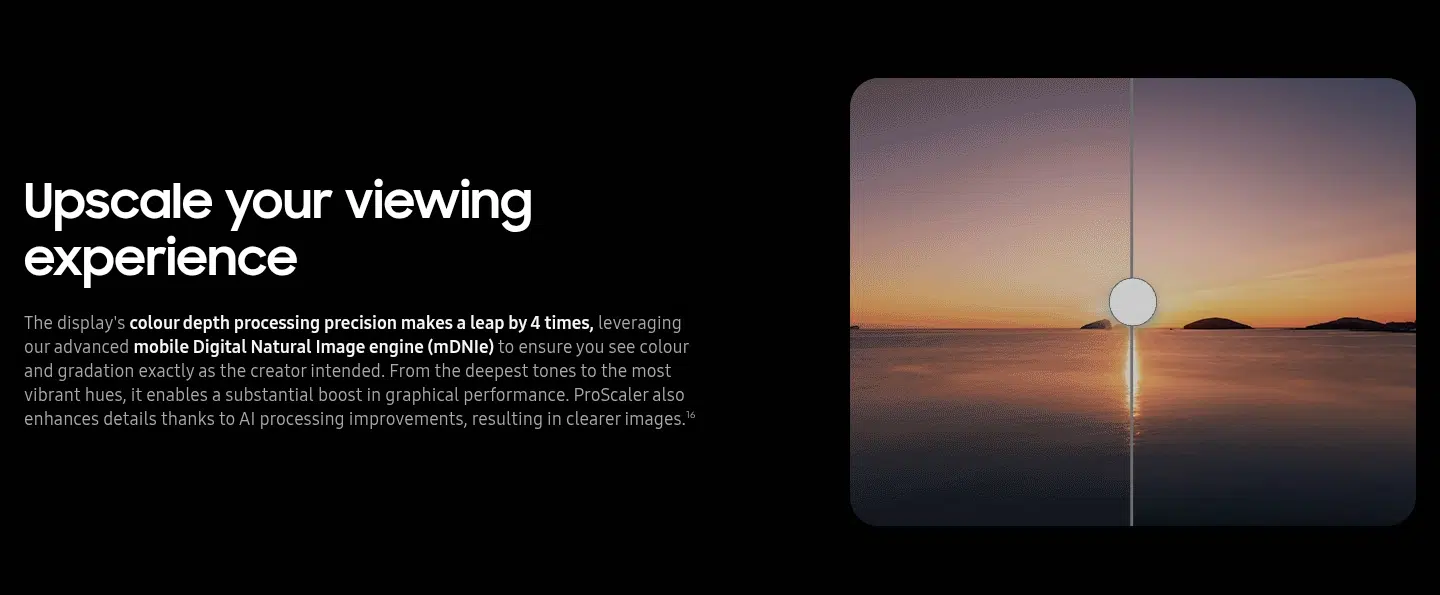
ProScaler: ProScaler is spatial processing. It upscales lower-resolution content, enhances edge definition, and improves perceived sharpness. It affects spatial detail, not tonal resolution.
Apple’s approach: Perceptual precision over spec sheets
When Apple describes wide color support on the iPhone, the language is consistent:
Super Retina XDR
Display P3 wide color
HDR support
ProMotion
What Apple does not publish in its technical specifications is the native panel bit-depth. There is no explicit “10-bit panel” declaration in official documentation. Instead, the company focuses on the perceptual result. Through tight hardware–software integration, the company controls:
Factory calibration
Color temperature consistency
Tone mapping behavior
System-level color management
This integration allows gradients to appear smooth, HDR transitions to remain controlled, and Display P3 content to preserve its intended look across the ecosystem. Whether the smoothness comes from panel architecture, internal processing precision, or advanced dithering strategies is not publicly detailed. What is measurable is the outcome:
Reduced visible banding.
Stable tonal transitions.
Consistent color reproduction across brightness ranges.
Bit-depth numbers alone do not define the experience. The entire pipeline does.
That said, if a manufacturer explicitly confirms native 10-bit panel hardware, the advantages are concrete. It means:
True 1,024 luminance steps per channel
Reduced dependence on temporal dithering
More stable gradients at low refresh rates
Cleaner HDR roll-off handling
Stronger alignment with 10-bit capture workflows
For photographers evaluating subtle tonal transitions, this improves confidence in gradient integrity. However, native 10-bit operation requires:
More complex driver IC architecture
Tighter voltage regulation
More extensive calibration
Potentially higher power consumption under full-precision driving
More electrical granularity demands more control.
Since smartphones operate within strict thermal and battery constraints, companies have to implement certain strategies to manage efficiency. Even with native 10-bit hardware, manufacturers may:
Dynamically reduce internal precision for SDR content
Reserve full precision for HDR playback
Adjust driving algorithms to balance power and luminance
Combine spatial dithering with hardware precision for efficiency
Native capability does not mean constant maximum precision.
Mobile display engineering is always a balance between fidelity and efficiency.
The photography perspective — The chain must align
The chain is linear: Sensor precision → File encoding precision → Display pipeline precision → Panel emission precision → Human perception. If any stage reduces precision, the chain is constrained. Display is not about spec sheet language. It is about color volume, tonal resolution, and signal integrity. Smartphone displays are layered systems:
OLED panel architecture
Driver IC precision
Temporal dithering (if implemented)
Calibration engines
Color management
Format defines potential.
Hardware defines limits.
Processing defines optimization.
Perception defines experience.
And in serious technical discussion: Native bit depth must be confirmed — never assumed.