
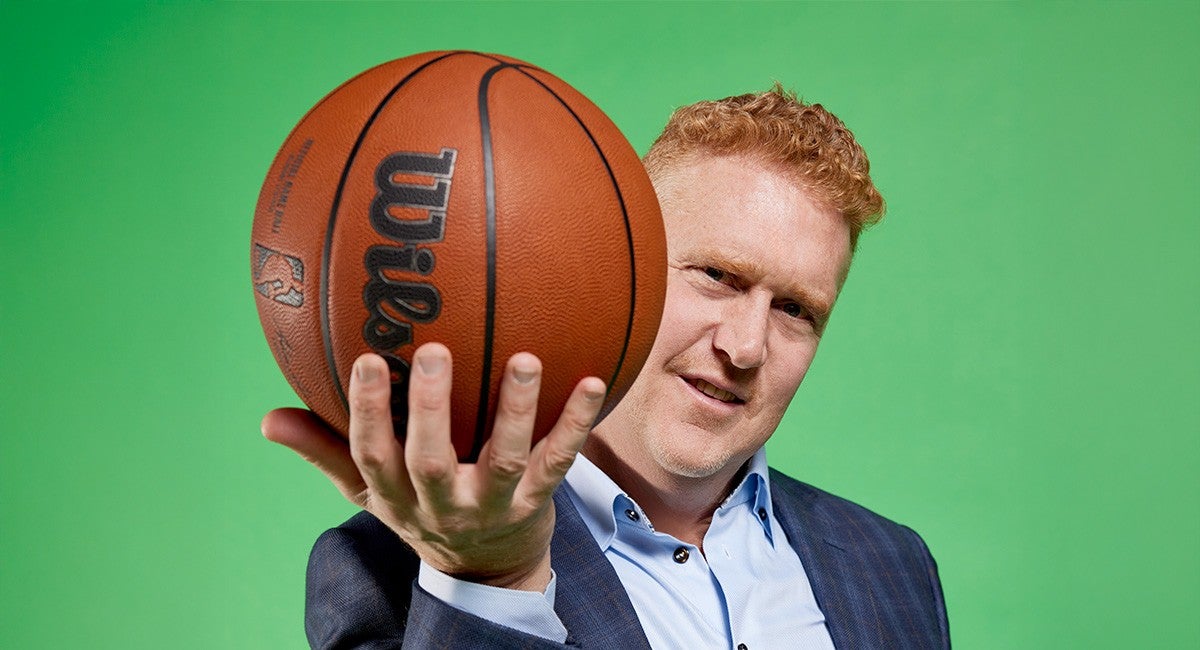
Brian Scalabrine first burst onto the scene in Boston as the ultimate cheerleader—a red-headed reserve player who became the secret weapon of the 2008 championship team. He never touched the court in the playoffs, yet somehow turned professional benchwarming into must-see television. Now, years into his second act as NBC Sports Boston’s team analyst, we asked him about the mentors who taught him to entertain, not educate, his most extravagant sneaker splurges, and why failure was actually the key to his success.
You’ve been on both sides of the game—as a player, as a coach, and now behind the mike. How different is it to narrate the action versus actually living it?
Well, learning curves are all dictated by who’s around you. And first of all, I had Tommy Heinsohn, who was the biggest straight shooter you’ll ever find in your entire life, telling me exactly what I needed to do on a daily basis. We used to sit down and have dinner together, and if I was being too technical about pick and rolls and single side bumps, he would just be like, “Scal, people don’t wanna hear about that garbage. It’s not a basketball video. Just make people laugh and be entertaining.” So I had a constant supply of that from Tommy. And Mike [Gorman] was the same way. Mike was way more diplomatic about it, like maybe we should focus on this and that. I’m also not me if not for my producer, Paul Lucey, who’s been producing games for thirtysomething years, and an 80-year-old man named Jim Edmonds, who’s also my producer and a straight shooter. So you get this guy who loves basketball, and he gets inserted with no experience whatsoever with a bunch of people who just nudged him exactly the right way to become the broadcaster he needed to become. I probably would’ve failed in this business if it wasn’t for those four people who were exactly what I needed. Let’s be honest, I played basketball in the ’90s and 2000s, right, so straight shooter is really the only language that I understand.
In some alternate universe where you never picked up a basketball, what do you think you’d be doing right now?
That’s really hard because I actually never thought I was gonna make the NBA. It was all about being a coach. My whole life, all I wanted to do was be a history teacher and coach basketball, and then see where it could take me. My goal was to play as long as I possibly could, so it would help my résumé for me to become a coach. But I fell in love with the game at such an early age that it was never a question. Anybody who knew me growing up knew that I would be involved in basketball.
You’re from Enumclaw, Washington, which I’m guessing isn’t exactly the Seaport or the North End. What was the most thrilling thing that ever went down there?
Well, you know the kid Kasey Kahne, who used to race in NASCAR, he’s from Enumclaw as well. But it’s a small town at the base of Mount Rainier. The story of me really starts with my parents moving right across the street from a park. And I lived at that park for six to eight hours every single day, in the summertime maybe more; during the school year, I’d go home when it was 11 o’clock at night. And whether I was playing one-on-one, two-on-two, or three-on-three, I was living there. You know the 10,000 hours rule? Well, I was more like 20,000 or 30,000 hours, and that’s probably how I ended up making it.
Give me one line each: Nets, Celtics, Bulls—how would you describe them?
The Nets were great because I was a rotational player on a championship team. We didn’t win it, but we went to the Finals. I learned a lot that I needed to know about the NBA, playing with Jason Kidd. The Celtics were amazing because of the teammates, winning a championship, and the relationship that I have with the city. And then the Bulls, Tom Thibodeau brought me in to be a mentor. And it really sparked that inner desire—you know, I love the game as a player, but I also love the game as a mentor and teacher to keep guys accountable.
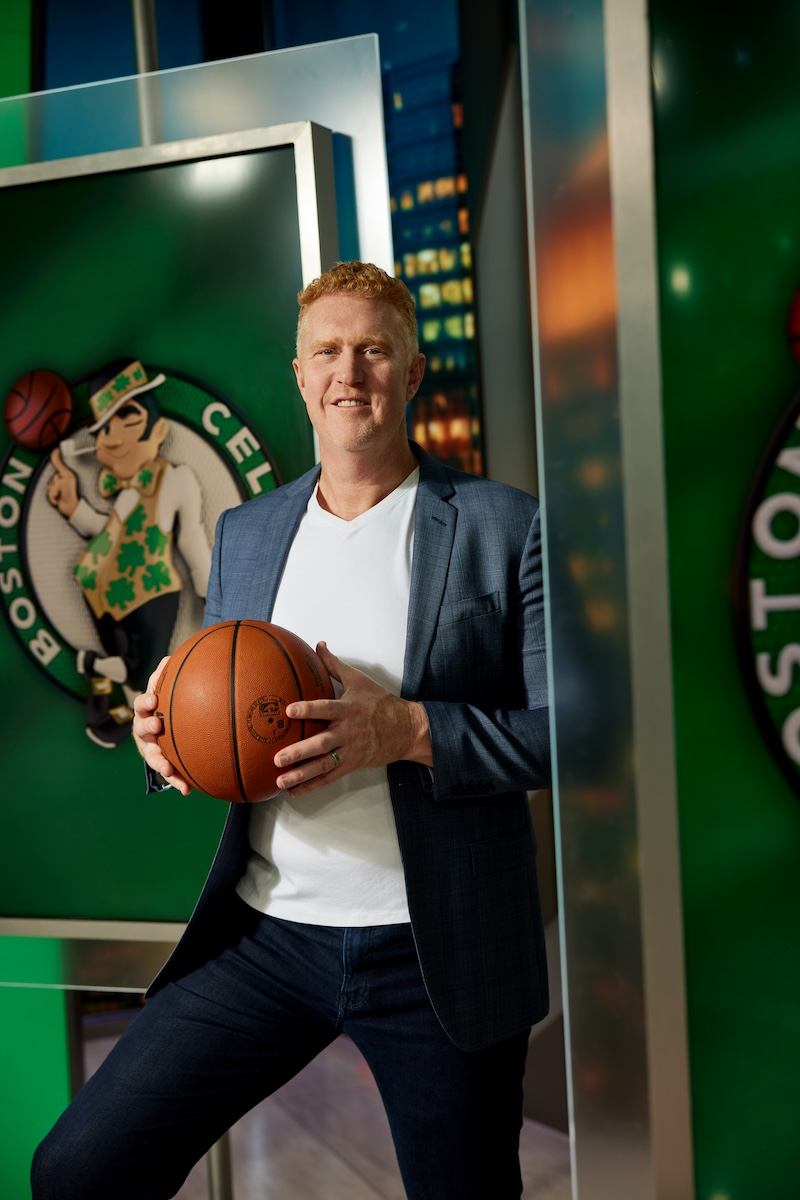
Photo by Ken Richardson
You had a few nicknames over the years—“Veal,” “White Mamba.” Which one did you prefer?
I like White Mamba—it’s a good nickname. There’s a lot of funny parodies involved, and I think that people like to know that I’m cool with the parody jokes.
Did you ever try to work “White Mamba” into a pickup line?
[Laughs.] I’ve been married since before I was the White Mamba, so I’m gonna have to say no on that one.
What’s the best piece of swag from your NBA career?
My favorite thing is we have a warmup jacket with every one of the banners on it. I think it’s one of the coolest things the Celtics have ever made.
Are you a sneaker freak?
A little bit, but not crazy.
What’s the most you’ve ever spent on a pair of sneakers?
$180.
That’s…surprisingly reasonable.
Yeah, I usually buy when the Jordans go on sale. But there were some Jordan 3s that had a great color combination I was looking for, and I splurged on them for full price. It’s the only time I’ve ever paid full price for a pair of shoes.
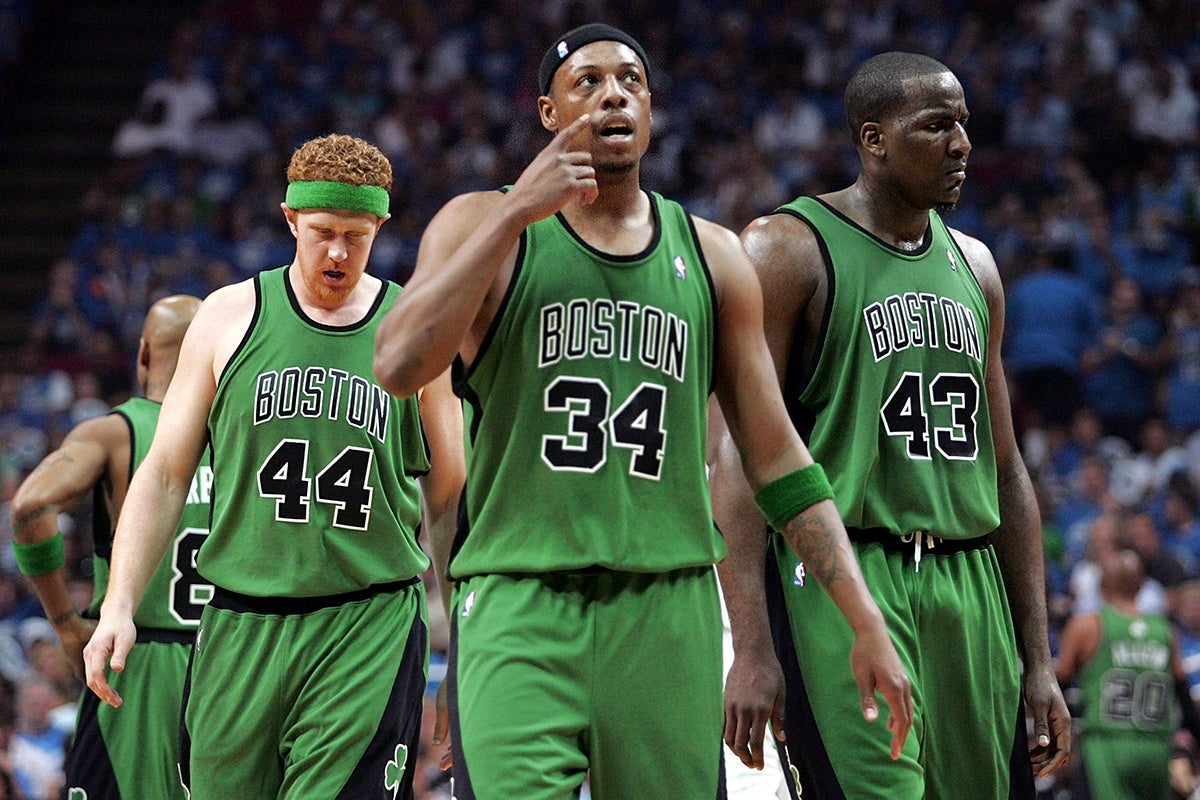
Scalabrine, Paul Pierce, and Kendrick Perkins in 2009, walking onto the court against the Orlando Magic in Game Three of the Eastern Conference Semifinals during the NBA Playoffs in Florida. / Photo by Marc Serota/Getty Images
What’s the best basketball game you’ve ever experienced, on the court or off?
I think the best I’ve ever played was Game 5 against Detroit in 2004. It was like a triple-overtime game where everyone fouled out, and I was just banging down threes in overtime. The exhilaration of that and the magnitude of it were phenomenal. Best game I’ve ever watched—I think the most excited I’ve ever been was the Jayson Tatum dunk over LeBron game, so that would be Game 7 of the Conference Finals. Tatum was a rookie, no Kyrie, no Gordon Hayward, no one thought this team would ever be able to do it. And I was certain when Tatum had that dunk that the Celtics were going to the Finals.
Which NBA venue has the best home-court advantage?
It’s all day Boston. Everybody I talk to always privately—they won’t do it publicly—they always talk to me about the Boston crowd. They’re like, “Is it like this every night?” and I’m like, “Yeah.” We are so spoiled, because I go to a lot of the other arenas, and it’s just okay, but Boston is completely different.
And that’s because of the fans?
Oh my God, yeah, I was in the building the year after COVID, but there were no fans. The Garden is not the Garden without the fans’ uniqueness and the way they dress up and paint their face—they’re all part of the show, and it’s really cool. It’s not like that everywhere.
What was the worst injury of your career?
After I was done playing in the NBA, I got my tooth knocked out during a pickup game, and it was by far the worst, because it takes maybe 10 to 15 different surgical procedures to get a tooth back—it would’ve been less rehab for an ACL. I’m telling you, it’s crazy how many appointments you have to do just to get your smile back right.
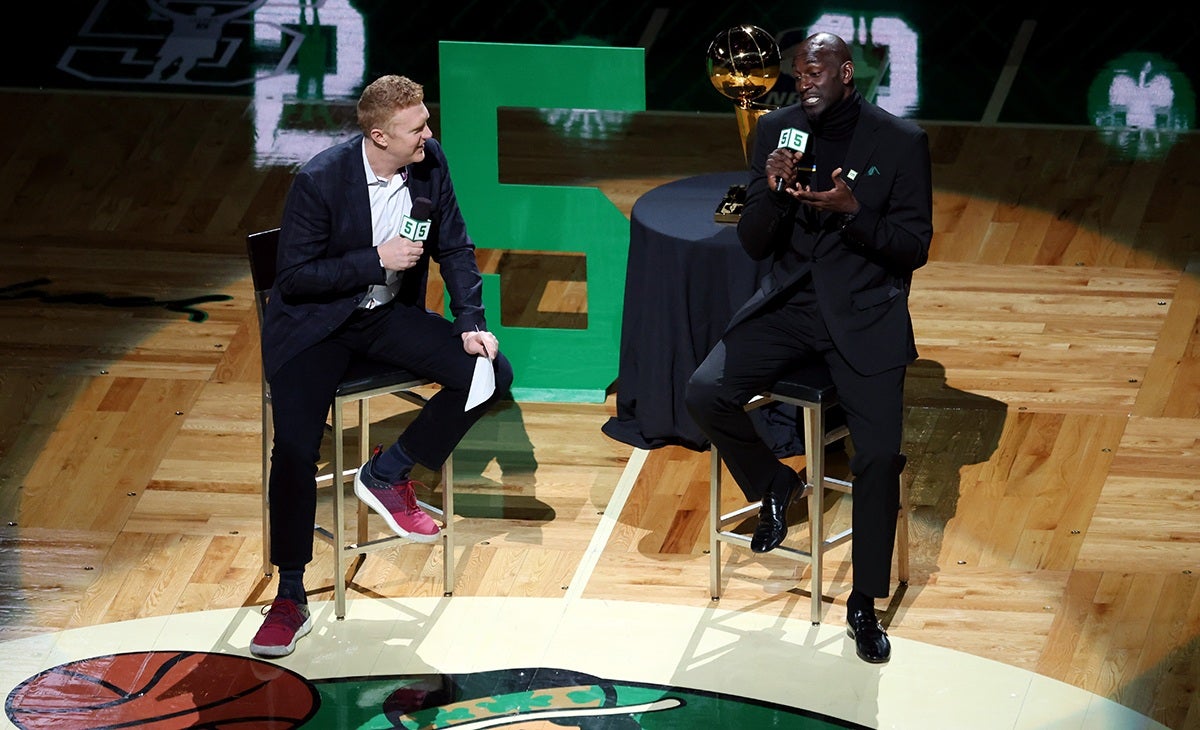
Scalabrine interviews Kevin Garnett during his number retirement ceremony at TD Garden on March 13, 2022. / Photo by Maddie Meyer/Getty Images
Who is the player you admire the most?
So Kevin Garnett is an incredible human being. The guy cared about everyone in the organization. I also got a chance to coach Steph Curry, and I never met a player who, whatever is going on, doesn’t really get caught up in all the drama. It was really eye-opening to see a star player just literally not be affected by all the crazy noise of the NBA.
How exhausting is playing an NBA game—physically, emotionally, all of it?
When you’re in the NBA, it doesn’t matter what you’re doing—when the lights go on and the ball is tipped, you can compartmentalize all of it. The only thing that you can really feel is injuries, but everything else goes away. I find it really amazing how athletes who play professional sports can block out the world and then focus in—not on the game, because that sounds like that’s a two-and-a-half-hour process. They can focus in on the second, make a read in that moment, and nothing else in their life matters, whether they’re exhausted or not.
What’s your take—are NBA players making too much money?
I mean, it’s the percentage of the revenue coming in, so no, I don’t think they’re overpaid.
Outside of basketball, what sports do you follow closely?
Uh, nothing, really.
Really?
Yeah, nothing. My life is all basketball. I don’t do anything else. I don’t know anything else.
Any regrets about your facial-hair choices over the years?
They’re based on laziness. It’s not a choice. It’s like choosing to shave or not shave, you know, but yeah, I mean, who doesn’t regret certain ways they look throughout the years?
Do you wear your championship ring?
I don’t wear it that often. I should wear it more. You know, to galas and stuff like that, but I don’t wear it as much as I should.
What’s your favorite basketball movie or show?
You know, I gotta be honest with you. I’m really turned off by basketball movies. I think when I grew up, I watched the movie Heaven Is a Playground probably 50 times, but now that I’ve experienced it, I’m a little turned off by it.
What’s your best advice for a kid who dreams of the NBA but doesn’t think they have a shot?
Yeah, you know I get this question a lot right now. Here’s the thing—I would never want to tell that kid something where he could skip a step. I think the reason why I made it is because everyone thought I wasn’t gonna make it. If I go and tell that kid he’s gonna make it, I’m not sure that kid does make it. I’m a success from my failures, so I wouldn’t want to try to curb those failures. If there was a way to go back and tell my eight-year-old self, like, you’re probably not gonna make it, that would be the best advice I could possibly give, because once you think you’re not, and you work like you’re not, when you finally do, the work habits are already established. So I would not want to go back and mess up my eight-year-old self. I don’t think I can replicate my life and make it better, given the circumstances, and end up in a better position than I am right now. I think I could only mess it up.

Photo illustration by Kristen Goodfriend
By the Numbers
Off-Court Champs
The numbers you need to know about the legendary voices of Celtics glory.
43
Years Mike Gorman spent as the Celtics’ play-by-play announcer—the longest
tenure in franchise history.
~2,800
Number of games Mike Gorman and Tommy Heinsohn broadcast together, one of the most enduring partnerships in sports television.
2
Number of Curt Gowdy Media Awards won by Celtics announcers: radio legend Johnny Most (37 years, 1953–1990) and Gorman.
10
Number of games per season Hall of Famer Bob Cousy called as a part-time Celtics analyst from 1999 to 2008.
13
Years Brian Scalabrine has been a Celtics commentator and analyst—and counting.
This article was first published in the print edition of the November 2025 issue with the headline: “The White Mamba Speaks.”