

The upcoming trade deadline will be completely unlike the first two of Brad Treliving’s tenure as general manager of the Toronto Maple Leafs.
In the midst of the most disappointing (and soon to be playoff-less) Leafs season in more than a decade, his team will unquestionably be selling — not buying, as in the past — ahead of Friday’s deadline.
What impact, if any, will his execution of those trade(s) have on his future as GM? In other words, could it save his job? Or is his job somehow safe already?
Given trading is on the docket, it’s worth taking a look back at Treliving’s history on that front with the Leafs.
To this point, Treliving has made a dozen trades as GM (not including minor-league transactions, draft-pick swaps or the acquisition of Chris Tanev’s rights before the start of free agency in 2024):
Fifth-round pick for Sam Lafferty.
Ilya Lyubushkin for picks in the third and sixth rounds and Kirill Slepets.
Joel Edmundson at 50 percent retained for picks in the third and fifth rounds.
Connor Dewar for a fourth-round pick and Dmitry Ovchinnikov.
Matt Benning and third- and sixth-round picks for Timothy Liljegren.
Scott Laughton and picks in the fourth and sixth rounds for a first-round pick and Nikita Grebenkin.
Fifth-round pick for Dewar and Conor Timmins.
Brandon Carlo for Fraser Minten and picks in the first and fourth rounds.
Matias Maccelli for a third-round pick.
Nicolas Roy via the Mitch Marner sign-and-trade.
Henry Thrun for Ryan Reaves.
Dakota Joshua for a fourth-round pick.
It’s difficult to find one that sticks out in an especially positive light, which isn’t encouraging ahead of the upcoming deadline. Most saw the Leafs give up too much and/or get back too little.
Weirdly, I think there’s a case to be made that the trade for Carlo was both the best and worst that Treliving has made with the Leafs, if that’s even possible. Best because the Leafs still will have gotten more value out of Carlo than all the others: a playoff run last spring, the season that followed (i.e. this one), and next season, potentially, all at $3.48 million on the cap.
Carlo could also be flipped again at some point, perhaps recouping the team some draft and/or prospect assets.

Treliving’s big bet on Brandon Carlo hasn’t paid off. (Claus Andersen / Getty Images)
But therein lies the problem with the deal. Treliving paid what turned out to be an exorbitant price: a first-round pick that could land in the top 10 this summer and a young player in Minten who, while not a future star, would have been useful to the team in the present and future.
There’s an entirely conceivable alternate world in which the Leafs, thanks in part to Carlo’s contributions, are decent enough to make the postseason and that pick falls in the teens or 20s. But that’s obviously not what happened. Carlo hasn’t performed to expectation and the team has been a disaster, making the pick the Leafs surrendered much more valuable than anticipated.
This is really the worst possible version of the trade. Part of Treliving’s job as GM is to conceive of that worst-case scenario and prepare accordingly — in this case, perhaps, by top-10 protecting the pick.
The deals for Carlo and Laughton are likely to go down in the pantheon of bad Leafs trades alongside those involving Phil Kessel, Tuukka Rask, and Nazem Kadri. What’s doubly bad about those two moves in particular is they’ve left the team short on assets to retool this summer.
Treliving will need to fare much better jettisoning talent in the coming days to help with that maneuvering.
Can he make some magic with Oliver Ekman-Larsson in the way that Don Sweeney, his counterpart in Boston, did last spring when he extracted all those goodies for Carlo, a player the Bruins didn’t have to move? Can he prey on the desperation of an opponent the way the Flyers did when they sold Laughton as a hopeful third-line centre one year ago? Can he capitalize on Bobby McMann’s best season in the NHL and bargain contract?
Finding success won’t be easy. The Leafs are (presumably) trading only role players with modest levels of value and doing so in an environment that may not be as fruitful as in years past, thanks to the impending playoff salary cap and inability to use double salary retention in trades.
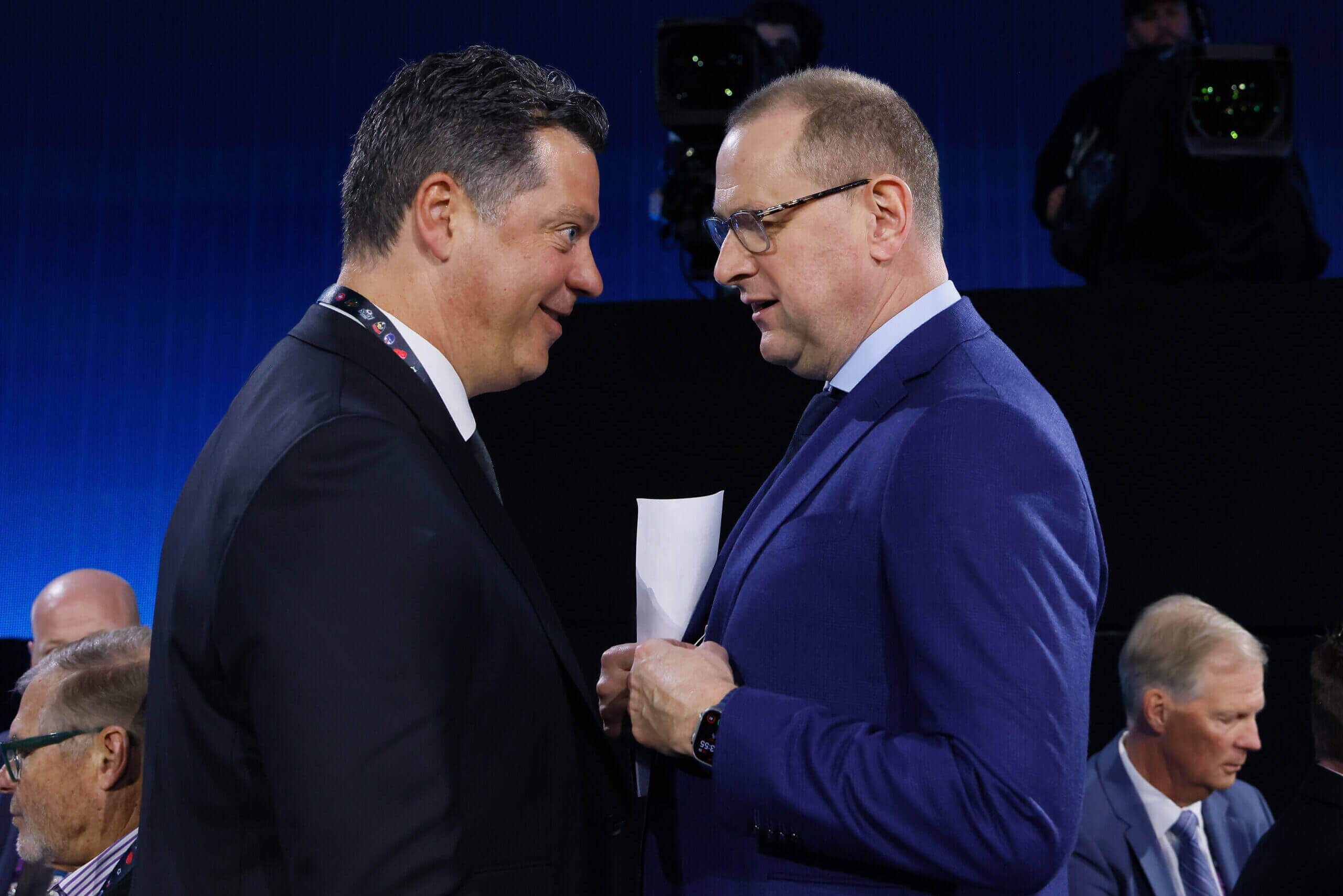
Brad Treliving will need to work the phones with his fellow GMs around the league. (Bruce Bennett / Getty Images)
What does a sharp deadline for the Leafs GM even look like? Can anything that doesn’t net the team a first-round pick or equivalent prospect qualify as a success? Is there an out-of-the-box swing in there somewhere that nets the Leafs help for next season now? And what does it all mean for Treliving’s future?
An ace execution, whatever that looks like, could make it easier for MLSE president and CEO Keith Pelley to make the case to bring him back for a fourth season in charge.
With how poorly things have gone this season, though, and with how little has been done to rectify it, it shouldn’t. Evaluating Treliving should be much broader than that, encompassing not only the many moves that led to this nightmare of a season but also the related difficulties that will come with getting out of it.
Still, it’s easy to imagine Pelley selling this as a plain old season from hell, one that went wrong largely because of injuries and a hectic schedule — and not subpar management (and coaching). His recent letter to season-ticket holders suggested as much.
In defence of a Treliving return, Pelley might also point to last season, when the team Treliving oversaw won the Atlantic Division for the first time and went seven games into the second round against the eventual Stanley Cup champs. That and qualifying for the playoffs the season before that, for what that’s worth.
He could even argue there is simply no obvious replacement for Treliving — never mind that this is the richest team in hockey, one that should be willing and able to hunt for, and acquire, the very best front-office talent, including a president to finally replace Brendan Shanahan.
The last time the Leafs had a season as nightmarish as this (2014-15) they fired the GM and (interim) head coach the day after Game 82.
It’s going to be difficult to justify not going that route again later this spring no matter how things go at the deadline.