
Dozens of protected areas in Cameroon’s anglophone regions, including parks that are home to great apes and other threatened species, have been swept up in a decade-long armed conflict between government forces and separatist militias.The ongoing conflict has blocked conservationists’ access to forests, and exposed conservationists, local civilians and the region’s wildlife to violence.Displaced people have turned to farming and hunting in forests in order to survive, while militias also hunt and camp in the forest.Conservationists have explored new strategies to keep their work alive, including working with local citizen scientists, but say the task of rebuilding organizations in the midst of a humanitarian crisis is huge.
See All Key Ideas
In August 2025, Louis Nkembi, founder of conservation NGO ERuDeF, was abducted by militia fighters in Cameroon’s Lebialem Highlands.
He was held for two weeks, hidden in a secret location inside a forest. “It was a traumatic experience,” he recalls. “I can’t go back to that area until everything is resolved.”
Though Nkembi was eventually freed, his ordeal sheds light on the risks facing scientists, researchers, eco-guards and conservation workers protecting apes in Cameroon’s conflict hotspots, including the Lebialem Highlands.
Lebialem is a global biodiversity hotspot in Cameroon’s southwest, host to dozens of endemic and threatened species, including critically endangered Cross River gorillas (Gorilla gorilla diehli), Nigeria-Cameroon chimpanzees (Pan troglodytes ellioti), African forest elephants (Loxodonta cyclotis), leopards (Panthera pardus), dwarf galagos (Galagoides demidovii) and white-bellied pangolins (Phataginus tricuspis).
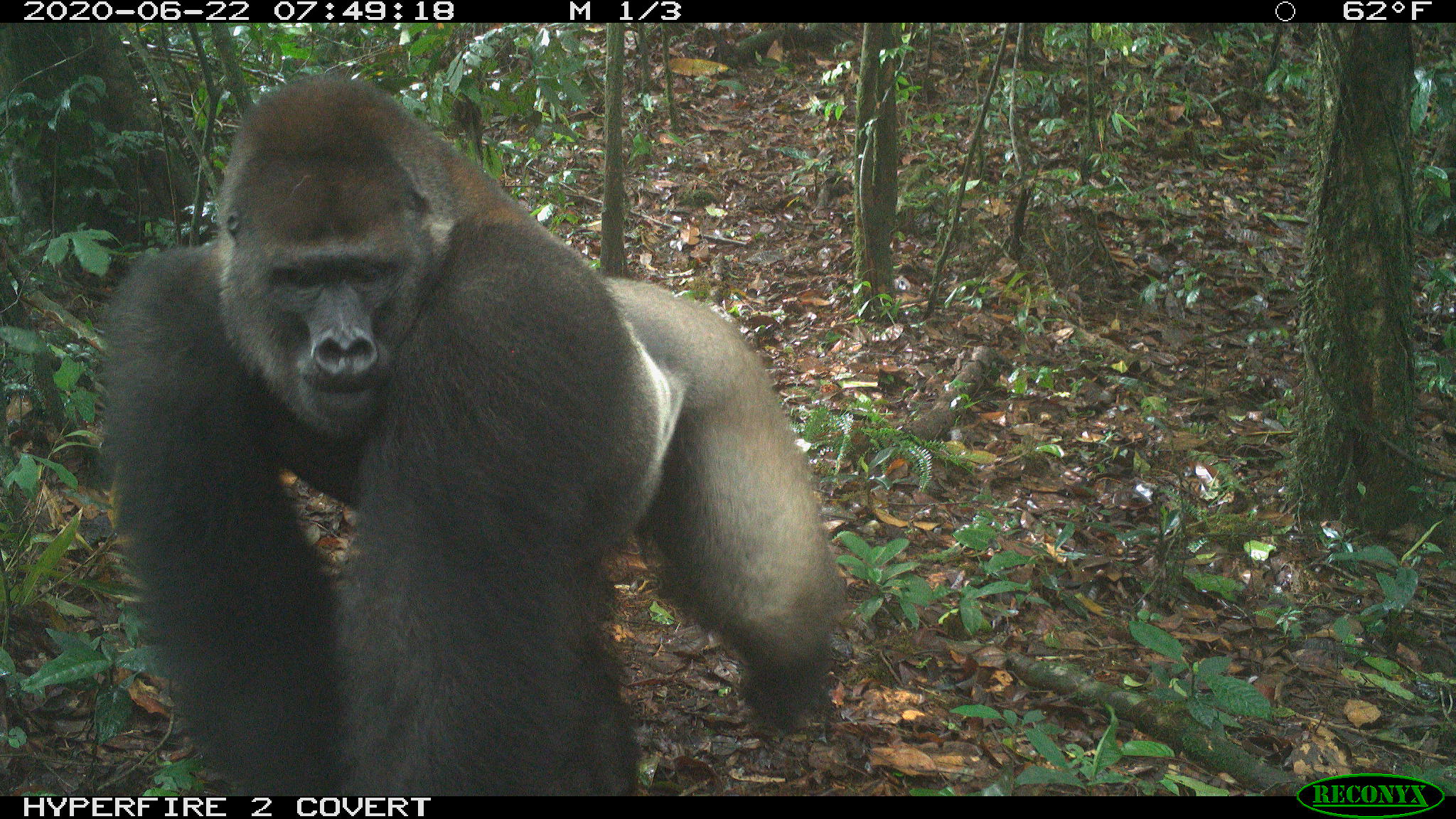 Camera trap photo of a Cross River gorillas(Gorilla gorilla deihli). Fewer than 300 are believed to survive, making them the rarest great ape subspecies. Image by ©WCS Nigeria.
This irresistible richness is the root of Nkembi’s love for Lebialem. He’s spent nearly three decades documenting, surveying and conserving the area through ERuDeF (the Environmental and Rural Development Foundation), which he founded in 1999.
In late 2016, Lebialem, like dozens of other parks, reserves and sanctuaries in the region, was swept up in armed conflict that continues to wrack Cameroon’s Northwest and Southwest regions.
“It was something that took all of us by surprise,” Ndimuh Bertrand, executive director of Voice of Nature (VoNat), a conservation organization based in the Southwest capital Buea, tells Mongabay. “We have never experienced anything like this.”
A casualty of conflict
Security experts trace the conflict to Cameroon’s complex colonial past, which ultimately created a nation from a merger of regions previously administered under distinct British and French colonial systems. As a result, two of Cameroon’s administrative regions are majority English-speaking, while the other eight are Francophone.
In late 2016, the central government launched a deadly crackdown on protests against the obligatory use of French in schools and courts in Anglophone regions. In turn, Anglophone separatists declared a breakaway state of Ambazonia, comprising the Northwest and Southeast regions, sparking a civil war between state-backed soldiers and separatist fighters.
Since then, more than 6,000 civilians have died, with more than 600,000 displaced, according to Human Rights Watch figures. Nearly 1.7 million people are in need of humanitarian aid.
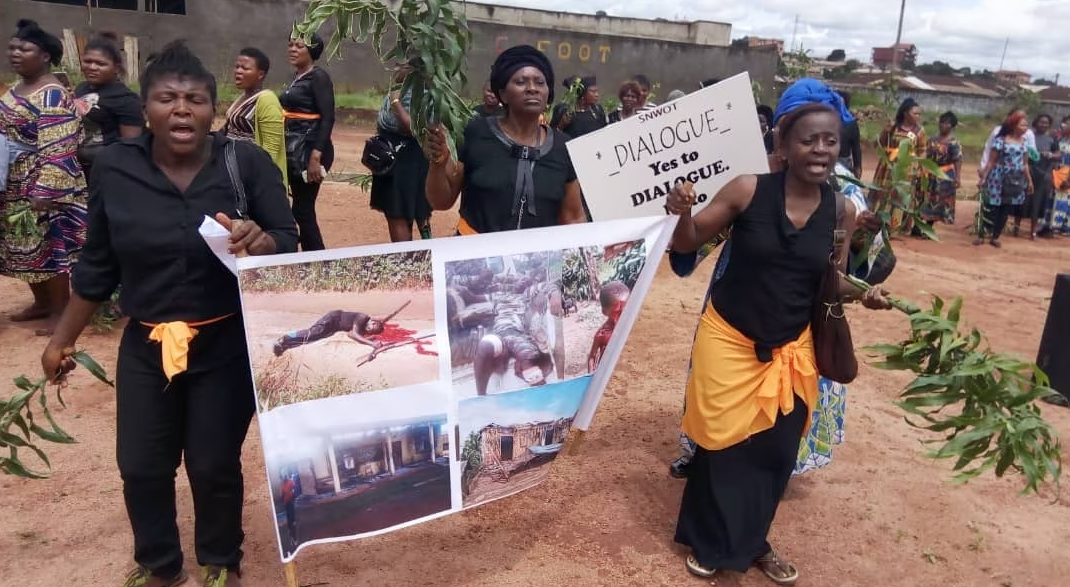 Women protest, holding up a poster with images of atrocities committed in an ongoing conflict between government forces and armed separatists, in Bamenda, Cameroon, Sept. 7, 2018. Image by Moki Edwin Kindzeka (VOA),( CC0 1.0).
Conservation, like everything else, became a casualty of the conflict.
In April 2017, Nkembi’s ERuDeF, like most other conservation NGOs in the region, halted operations due to the risk of death and abduction. Wildlife conservation efforts were abandoned as forest guards, conservation workers and scientists fled for their lives.
“Everybody was laid off, except for a few who were working at the head office. Over 100 workers were affected,” Nkembi tells Mongabay. “We lost 100% funding when the crisis began.”
Limited funds began trickling back in starting in 2021, but Nkembi says his abduction has led some donors to express doubts about the feasibility of continuing work in the region.
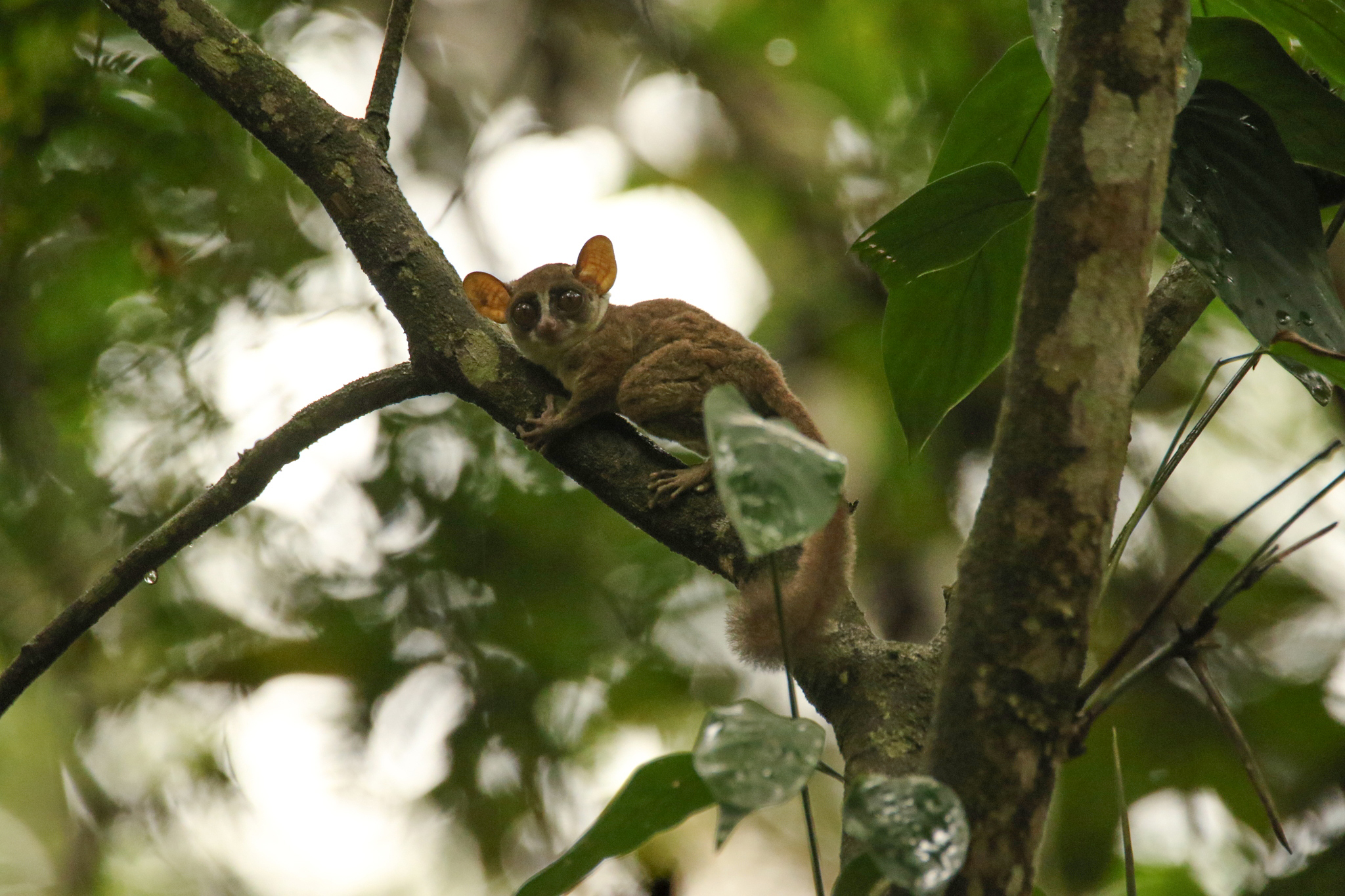 Demidoff’s dwarf galago (Galagoides demidoff), one of the many primates that inhabits Cameroonian forests being reshaped by conflict and an influx of refugees. Image by ©bureaubenjamin (CC BY-NC 4.0).
The blackout, ghost town and citizen scientists
Lebialem didn’t suffer alone. Some of the region’s most notable protected areas have been affected, including Korup, Takamanda, Bakossi and Kimbi-Fungom parks.
Mongabay interviewed a dozen scientists, researchers and conservation experts, who all said the war has cut off access to crucial data and updates from the field.
“There was a total blackout for a number of years,” Voice of Nature’s Betrand says. “It was challenging to know what was happening to the species.
“It is possible that many killings might have gone unrecorded, but there is no way to get accurate data on how many gorillas, if any, might have been killed as a result of this crisis,” he adds.
In 2017, Betrand was studying how totems and taboos influence conservation, when militia fighters ambushed him at Mundongo, a community adjacent to Mount Cameroon, gazetted as a park in 2009 and home to a population of Nigeria-Cameroon chimpanzees.
The militia members tore up his questionnaires, accused him of spying, and only freed him after locals firmly vouched for his intent and integrity, Bertrand says.
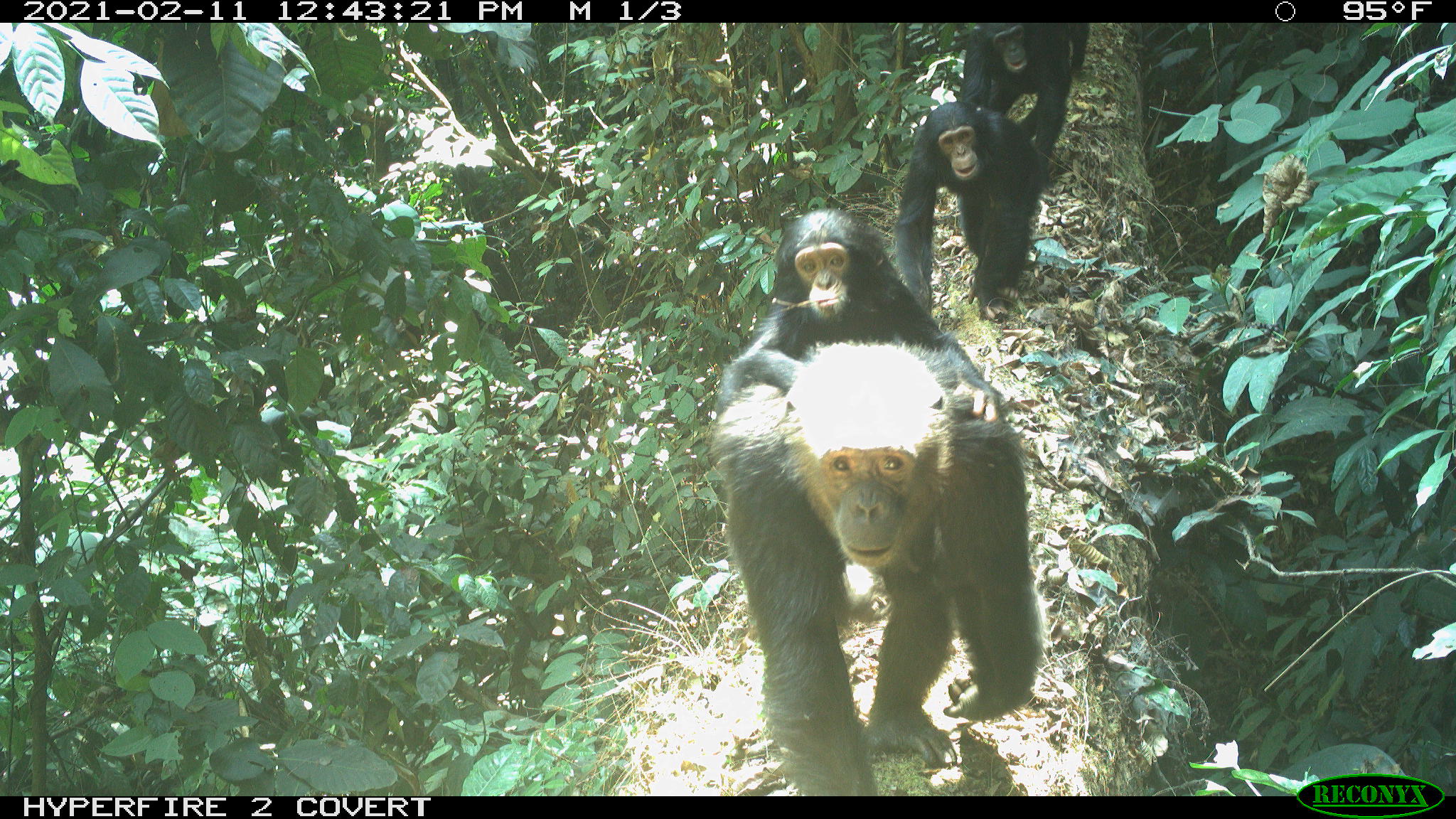 Camera trap photo of Nigeria-Cameroon chimpanzees (Pan troglodytes ellioti), an endangered ape native to the border zones of Cameroon and Nigeria. Image ©WCS Nigeria.
Across the conflict zone, strict lockdown orders, referred to as “ghost towns,” fuel the information blackout. Using threats of bombings, assassination and other forms of violence, militias coerce residents, including conservation workers, to stay at home or risk being killed if they travel on specific days or weeks.
“There are many risks,” says Sumo Raoul, senior researcher at the South Africa-based Institute for Security Studies. “They can be killed if they go to their work. The idea here is to instill fear within the local population in order to control them.”
After years of caution, scientists like Amos Zeh, an environmental geographer at the University of Buea, have begun exploring new strategies to keep their work alive.
They train small groups of citizen scientists who live in and around the peripheries of protected areas. Then, researchers equip them with information-gathering tools such as camera traps, GPS recorders, internet-enabled mobile phones, survey plans and maps, along with questionnaires and data collection sheets for field surveys.
“Conservationists are relying on citizen scientists, who understand the people, who know the terrain and who can maneuver the murky waters to get things done,” says Shuimo Trust, a Cameroon-based specialist in conservation communication.
Data collected from the field include signs of gunshots, such as spent cartridges, as well as camera-trap footage of animal sightings, and GPS coordinates of surveyed areas. Raw reports, maps and images are now sent to scientists for review, analysis and report writing.
“We are now working with the local people to discover the threats and co-create the solutions,” Betrand says. “This gives hope for sustainability.”
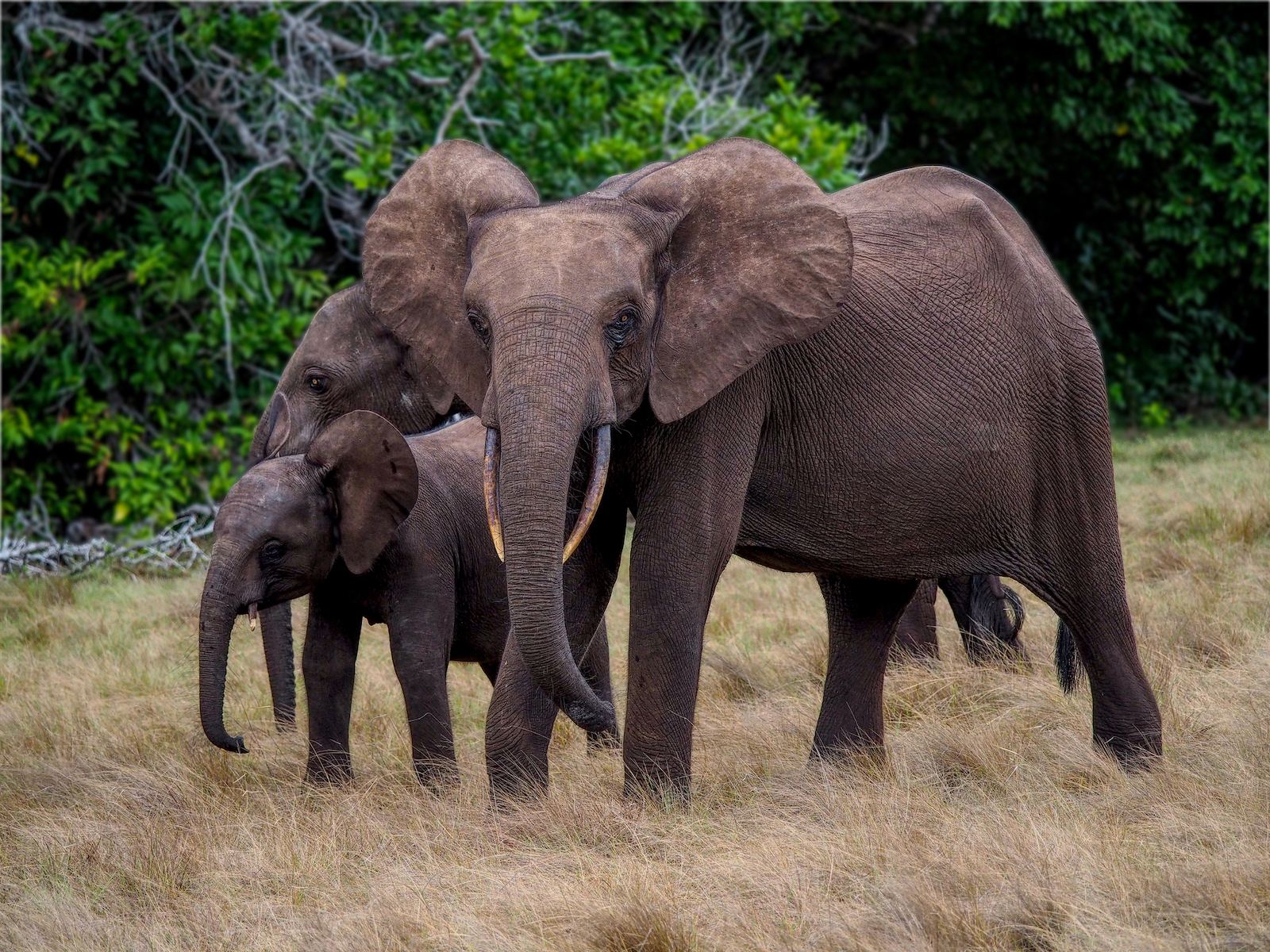 Forest-dependent animals like forest elephants (Loxodonta cyclotis) face habitat loss as displaced people turn to living and farming in previously forested areas. Image by thewildgtrv (CC BY-NC 4.0).
Life and death inside the forest
While citizen scientists continue their work, thousands of civilians are camping in the forest to escape combat and militia raids. One of them is Christ Tanyi, 28, born and raised in Obonyi III, a Cameroonian town on the border with Nigeria.
Obonyi III blends the diversity of the two countries, with languages, marriages and cultural rites intertwined. More than half of the children, including Tanyi, are products of binational marriages. Walls of forest, mountains and rivers mark the town’s borders.
Three years ago, militias began to occasionally camp in the community or use it as a transit hub, taking advantage of the village’s isolated location, Tanyi says. The community also became a corridor for refugees escaping to the Nigerian side of the border.
Tanyi says the militias coerced locals into paying levies on harvested crops, adding that youths with mastery of hunting and the forest terrain were forced to join the fighters or risk torture and death.
“They were coming to terrorize the communities or steal goats, sheep, chicken or anything else of value. Whenever we hear the sound of motorcycles or gunshots, people will run into the forests,” Tanyi tells Mongabay.
In October 2024, the Cameroonian military launched an operation in Obonyii III, targeting militias and local collaborators. “They killed a lot. They destroyed a lot. I thought it was my last day on Earth. I was making my final prayer,” Tanyi recalls. “That same day we recorded about 14 deaths … My uncle lost his life.”
This cycle of terror has forced Tanyi and other locals to build makeshift houses inside forests that were previously the domain of apes and other wildlife. Ripped from their villages and farms, displaced people turn to foraging, hunting, snaring, and clearing land for agriculture, just to survive.
“The crisis has impoverished a lot of community members, and when poverty grows, the people will have to turn to the forest,” Nkembi tells Mongabay.
On the Nigerian side of the border, the spillover of the crisis is also displacing communities. In December 2023, when the Cameroonian militias stormed Belegete, a remote village on the Nigerian side, they burnt down several houses, tortured local youths, and killed the community chief, residents recall.
Ola Agatha says she was awakened from sleep by relentless gunshots, and fled into the forest with her two children, then aged 6 and 4. “We usually run into the forest anytime we hear gunshots. They burnt our houses. There was nowhere to stay,” Agatha tells Mongabay. “Some families lost everything and decided to live in small sheds inside the forest. When I recall that experience, I become teary.”
Here, too, Agatha says the survival of many displaced people inside the forest is tied to hunting, trapping and farming.
Recent and ongoing studies by Nkembi, Ndimuh and other scientists confirm the toll this is taking on the forest. “The biggest consequence of the crisis is the increased number of young people who are setting up farms inside protected areas.” Nkembi says. “The number of new farms being created on a weekly basis has also been on the rise.”
Life in the forest is tough, Agatha says: “Some died of pneumonia. Some died of chickenpox. Some died due to bites from poisonous insects. Some died of mosquito bites. Some died from snakebites.”
Both Tanyi and Agatha say they occasionally encounter wild animals, including pangolins, antelopes, duikers and snakes. They also say hunting is ongoing, but don’t mention whether apes are specifically targeted.
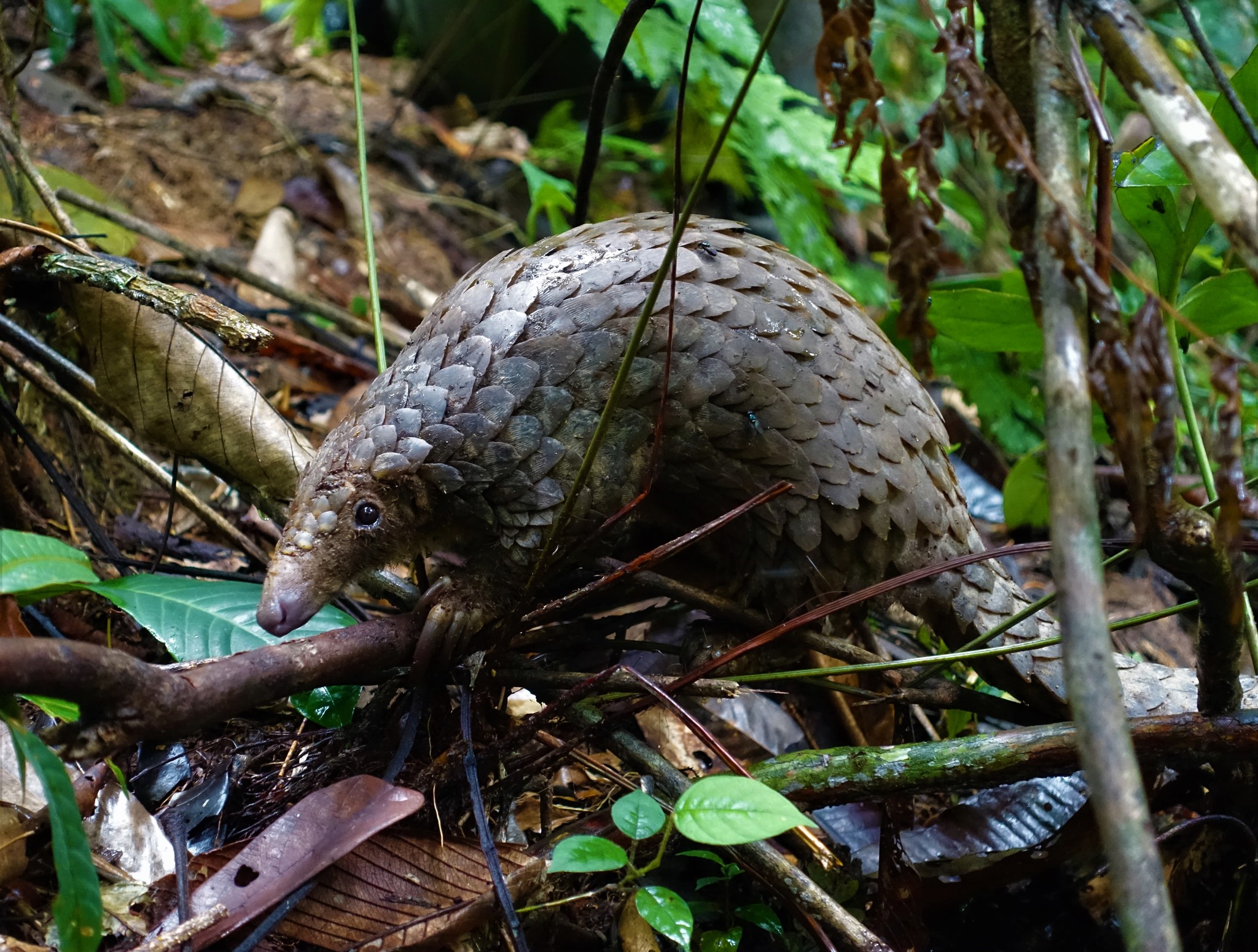 White-bellied pangolin (Phataginus tricuspis), an endangered species found in Cameroon’s southwest. Pangolins are the world’s most trafficked mammals, and experts say the conflict in Cameroon has led to an uptick in wildlife trafficking. Image by koenbetjes (CC BY-NC 4.0).
The trends of the war and future outlook
As the war lingers, experts tell Mongabay that restoring degraded ecosystems could take decades due to new dynamics created by the crisis. One of the most profound trends is the firearm confiscation initiative. In the early stages of the crisis, thousands of firearms, mainly owned by hunters, blacksmiths or licensed arms dealers, were seized and destroyed by government forces to deprive the militias of weapons for their war.
This, Nkembi says, created divergent impacts: hunting with guns decreased, but trapping soared. “Shooting eliminates larger charismatic species and hence degrades ecosystem functionality and overall perspective faster than trapping,” Nkembi says. By contrast, he says, “Trapping helps degrade the small mammal population given that trapping specifically targets them. Larger mammals like apes don’t easily fall prey to traps.”
More recently, however, militias have developed smuggling routes to get weapons back in, and a black market for more sophisticated guns has flourished. Sources say some of them might be used to revive poaching.
“There is a lot of trafficking happening,” says Trust, the conservation communication specialist. “There is also a trafficking of critical timbers from Cameroon to Nigeria.”
Compounding the problems, militia groups have converted portions of protected areas into strategic operation bases, which has drawn an increasing number of attacks by government forces on these forest hideouts.
Several sources, including Nkembi, who spent two weeks as a hostage in one of these camps, confirm that militias kill wildlife in the forest. They cut down trees to build shelters, cook meals and fortify their defenses. Gun battles inside reserves, parks and sanctuaries rattle the animals, which risk being hit by stray bullets or intentional strikes.
“When a place that ought to be a safe haven for gorillas, chimpanzees and other species is transformed into a war zone, there is a big possibility that there may be a stray bullet hitting any animal,” Betrand tells Mongabay. “The separatist fighters who had camps in the areas are equipped with guns. With a gun in their hand, you can’t tell the fate of any species, be it the chimpanzees or the gorillas or so.”
Even NGOs have faced suspicion from both sides of the conflict. The Cameroonian government accuses them of financing the war by proxy, while separatists often see them as state spies disguised as researchers.
In 2021, Doctors Without Borders shut down its lifesaving humanitarian operations in the Northwest region after the government arrested and detained its members for weeks. Nearly 100 medical personnel, including nurses and doctors, were laid off.
“The government for the most part has been suspecting nongovernmental organizations of funding this war,” Trust tells Mongabay. “They view them as a funding machine that has helped to fuel the crisis.”
Conservationists and researchers protecting apes are struggling to recapture the funding they lost before the conflict, Trust adds. “Conservation hinges on funding and there are not many funders who are willing to fund projects in locations with ongoing armed conflicts. There are very few who will risk their funding in such a conflict zone.”
As organizations struggle to rebuild, they’re working from scratch. Many former workers with technical expertise have either left the country, moved to other organizations, or pivoted to new careers entirely. Those who remain say they’re desperate to regain control of the forest by partnering with humanitarian organizations to resettle hundreds of thousands of displaced persons and the armed militias. The task ahead is huge.
“We need to reestablish what has been destroyed,” Nkembi says, “and begin to provide a future for the people.”
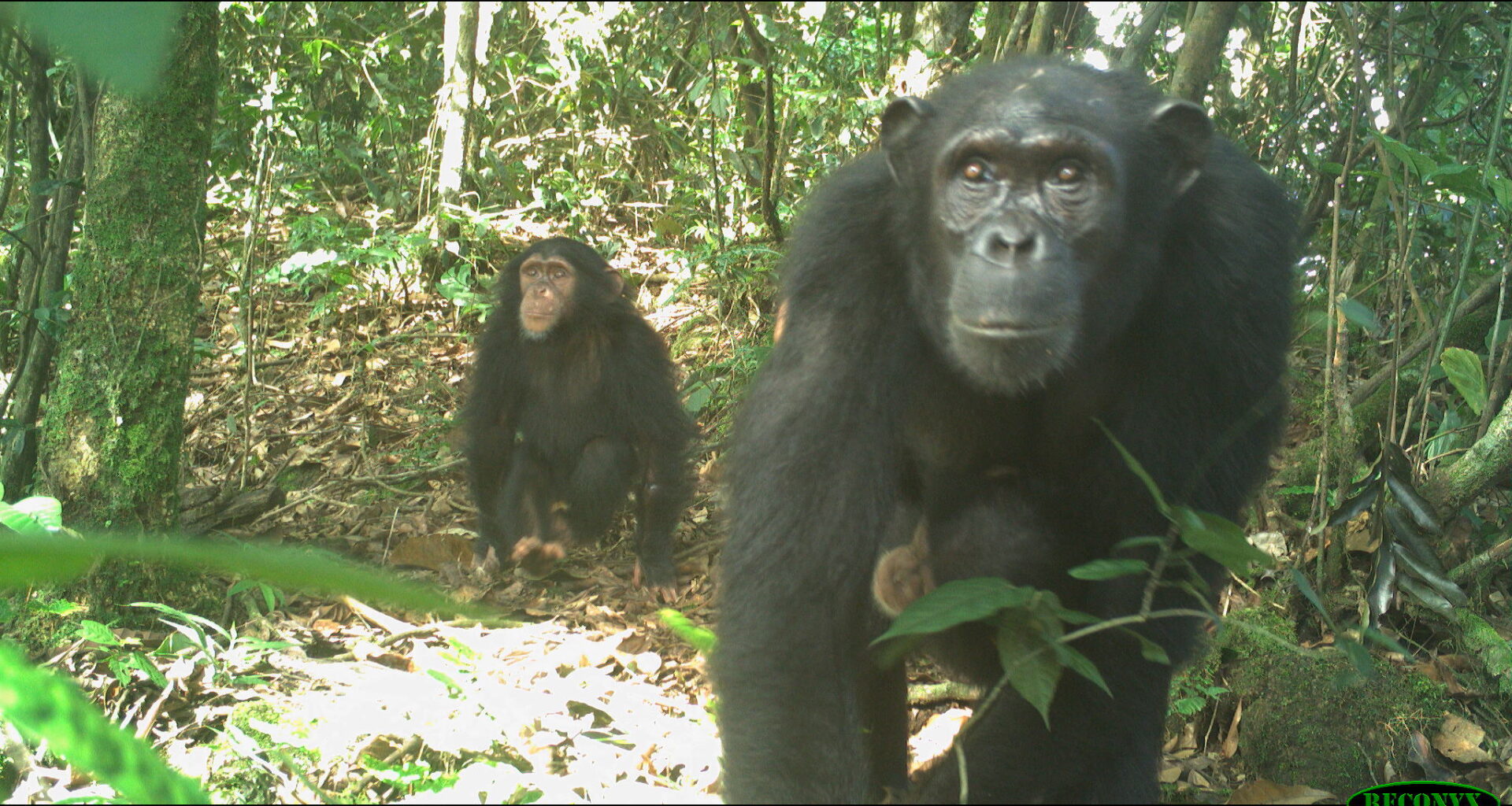
Banner image: Camera trap photo of Nigeria-Cameroon chimpanzees (Pan troglodytes ellioti), ©WCS Nigeria.
In Cameroon’s forgotten forests, gorillas and chimps hang on
FEEDBACK: Use this form to send a message to the author of this post. If you want to post a public comment, you can do that at the bottom of the page.
