
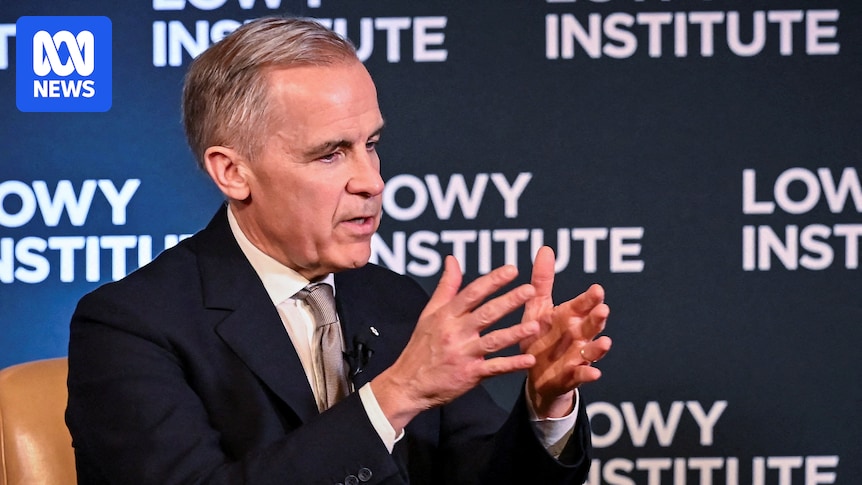
Mark Carney has warned economic integration has “subordinated” middle powers to predatory hegemons, declaring countries like Australia and Canada must band together to develop critical technologies, defend free trade, and protect human rights.
Canada’s prime minister used an address at the Lowy Institute on Wednesday evening to echo many of the themes from his high-profile speech in Davos in January, when he declared the post-war international order was “over.”
Mr Carney expanded on this theme in Sydney ahead of his address to federal parliament on Thursday, warning prioritising economic efficiency had led governments to “develop supply chains and relationships that create dependence on hegemons and in some cases, hyper-scalers, for essential determinants of our sovereignty.”
Canadian PM Mark Carney speaks out against Trump in Davos
He didn’t point fingers directly at the US and China but pointed to critical sectors which are dominated by American and Chinese companies and state entities, including Artificial Intelligence, payment systems, clean energy technology, computing and space-based communication.
And he said Canada had a “strategic imperative” to build “sovereign capabilities in critical sectors at home, and with trusted partners like Australia, to ensure integration is never again the source of our subordination.”
As in Davos, Mr Carney said Canada wanted to build “ad hoc coalitions” on key issues with partners which share common ground rather than “negotiating from a position of weakness” with great powers.
“Countries like ours can compete with each for favour, or combine to create a third path with impact,” he said.
“This creates enormous opportunities for Australia to work together. At a minimum to limit risk. But really, fundamentally and positively to build an increased prosperity and build our collective sovereignty.”
He pointed to critical minerals cooperation as a key example.
Canada and Australia are widely expected to sign new agreements on critical minerals during Mr Carney’s visit to Canberra on Thursday, and the Prime Minister said the two countries could create “the largest critical minerals reserve held by trusted, democratic nations.”
He also said the two nations could expand cooperation on defence.
Canada has launched a multi-billion-dollar plan to strengthen the Canadian military and reduce reliance on the United States, and the bilateral relationship has nose-dived since Donald Trump regained office, with the US President threatening crippling tariffs and even annexation.
Mr Carney said around 70% of Canada’s defence spending currently went to US entities, which “doesn’t make sense from a risk management perspective.”
And he struck a bullish tone about the future, saying countries like Australia and Canada could help set global rules and shape the next global order because they had “two advantages the hegemons lack.”
“The first is legitimacy and the second is trust,” he said.
“In contrast the hegemons can compel, but that comes with cost: both reputational and financial. Change with compulsion doesn’t last.”
“Middle powers have more power than many realise. Europe, Australia, Canada, Japan, South Korea: this coalition has a GDP larger than the United States, three times the trade flows of China (and) the largest research and development spend in the world.”
But Mr Carney used more careful language when he was asked about his relationships with the leaders of both hegemons – US President Donald Trump and Chinese President Xi Jinping.
Mr Carney has had public disputes with Mr Trump, but suggested the President was less confrontational in private.
He told the audience it was important not to be “obsequious” while still showing the President respect.
“You don’t want to say anything in public you can’t back up,” he said.
“(But) it’s quite different in private … he is more interested in your viewpoint on various things, in private.”
“That creates an ability to work through things. But it’s not easy to be clear. It’s not easy.”
The prime minister said when he met Chinese President Xi Jinping for the first time last year, Xi urged him to raise any issues with him personally, rather than raising them publicly.
“The second thing I’d say is we take from Australia a number of lessons in terms of how to engage with China,” he said.
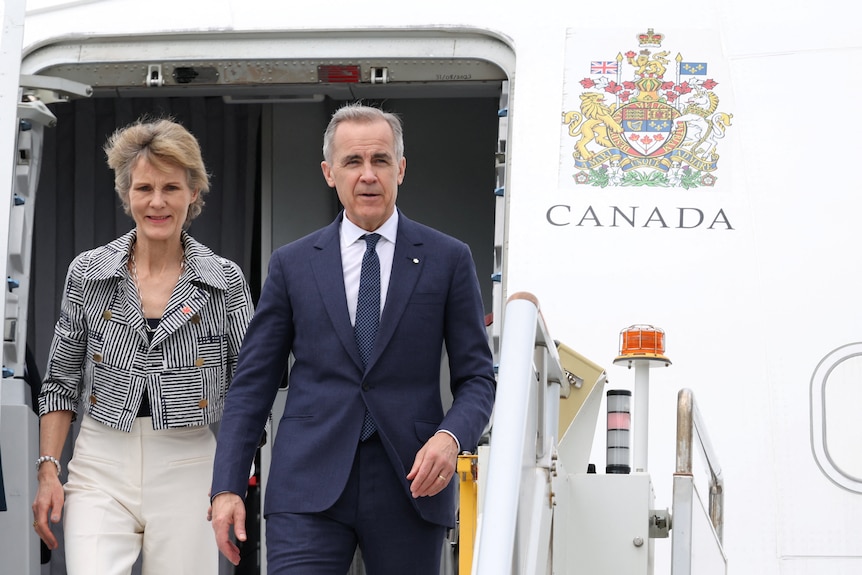
Canadian Prime Minister Mark Carney reacts as he and his wife, Diana Fox Carney, arrive at Sydney Kingsford Smith Airport. (Reuters: Hollie Adams)
“Which is to be very clear about where we are looking to cooperate, and where we are not. I call it guardrails on the relationship.”
Mr Carney arrived in Australia after visiting India as the two countries try to move past an extraordinary diplomatic dispute which saw the former Canadian Prime Minister Justin Trudeau accused New Delhi of orchestrating the 2023 murder of a Sikh separatist activist in British Columbia.
The prime minister said Canada was facing “an issue with a number of countries” involving “transnational repression (and) cross border security” and was now “much more cognisant” and “aggressive” on the issue.
“But at same time having engagement with these countries, so we can have security dialogue so we can go directly and call things out and start to address them,” he said.
“Because vigilance alone won’t be enough.”