
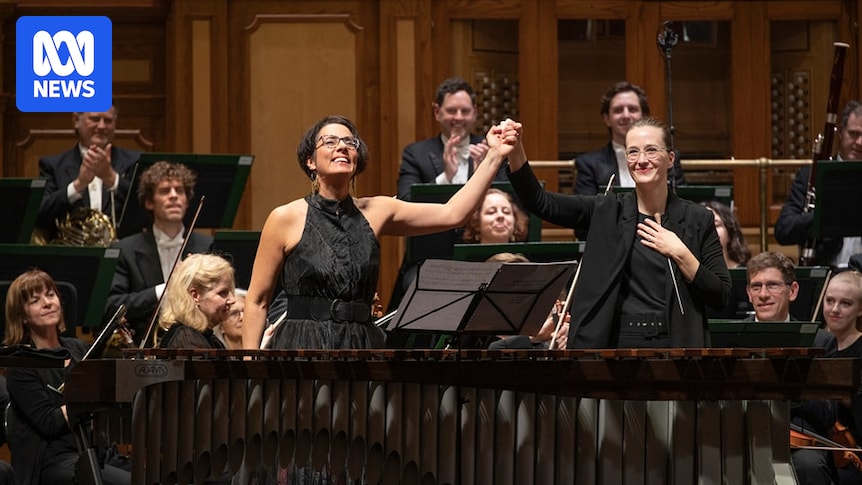
In September 2015, when ABC Classic tracked who composed the music being played on air, female composers received a minuscule share of 2.2%.
This galvanised the network to be more deliberate in how it was supporting the music of female composers, especially through a project championing music by women which started in 2016.
The project evolved into a multi-day Festival of Female Composers, which continues to form the backbone of ABC Classic’s celebration of International Women’s Day each March.
It’s possibly the biggest radio festival of its kind in the world.
Many in the classical music world are also considering ways to improve gender equity in the industry.
We explore some of the initiatives that are working to level the playing field, as well as the structural barriers which are holding female and gender-diverse composers from reaching parity.
What the data is saying
Data gathered from ABC Classic, major music organisations and independent data trackers helps paint a picture of how female composers’ participation in classical music has increased in recent years.
Your guide to listening to the Festival of Female Composers on ABC Classic
In the 2024-25 financial year, music by female composers made up 15.7% of airtime on ABC Classic and 19% of overall tracks being played.
The station is on track to achieve similar figures this year, a far cry from 2.2% a decade ago.
More encouragingly, audiences are becoming increasingly familiar with the names of female composers.
“Every year during the Festival, I do a request show of just music by women, and for three hours we get inundated by listeners asking for their favourite pieces by these queens,” says ABC Classic presenter Vanessa Hughes.
Hughes has been tracking the diversity of composers played by the station.
“[Over the past year], ABC Classic has broadcast the music of 1,294 women and non-binary composers.”
Australian composer Elena Kats-Chernin, whose works include Eliza Aria, Butterflying and Unsent Love Letters, is the station’s most‑played female composer, and the eighth most-played composer overall in the last 12 months.
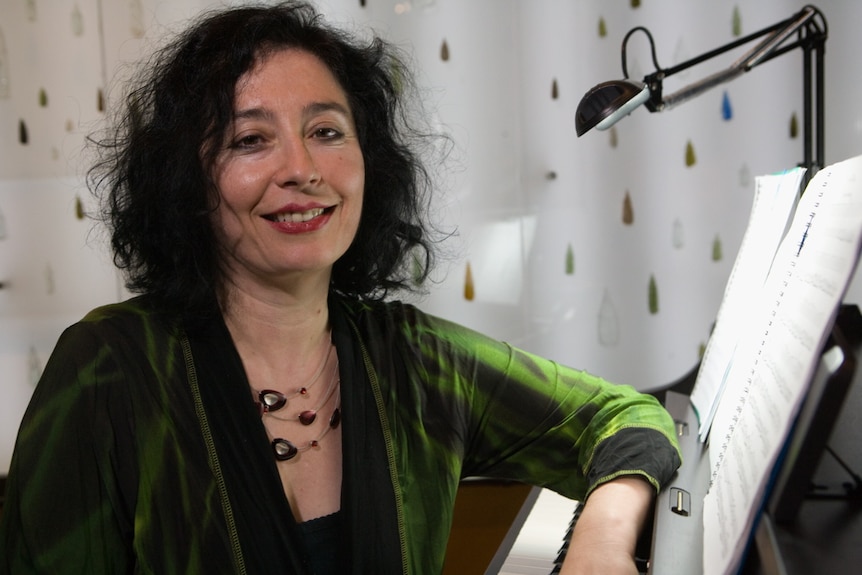
Elena Kats-Chernin is ABC Classic’s most-played female composer. (Australian Music Centre: National Museum of Australia)
There’s also momentum across the Australian classical music world.
“We have had a 30% increase on hire of parts for female-identifying composers, which is a significant increase over the last five years,” says CEO of the Australian Music Centre Catherine Haridy.
Meanwhile, APRA AMCOS reports steady growth of women and gender diverse music creators joining the organisation, close to 5% year-on-year.
Data from Australian stages and performance venues is equally encouraging.
Perth-based musician Hannah Lee Tungate has been tracking the diversity of music programmed by Australian state orchestras through her Tenth Muse Initiative.
“Overall, total music by women for 2025 is 14.5% of the works, an increase of 2.6% from the previous year which was 11.9%.”
“[In comparison], in 2024, Mozart, Beethoven, Bach were 14.2% of all the programming across the country. In 2025 it’s gone down to 13.1%,” Lee Tungate says.
“It’s the first time that I’ve done these stats where Mozart, Beethoven and Bach are less than the amount of women which have been programmed for the year.”
Despite these positive trends, there are still challenges faced by female composers in Australia’s classical music world.
What’s happening in recording studios
Before you can play music by female composers, whether on radio or streaming platforms, the music needs to be recorded.
In the past, not all music was equally loved or prioritised by musicians.
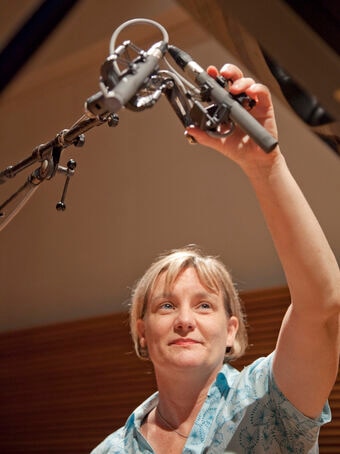
Virginia Read has recorded hundreds of albums that are played on ABC Classic every day. (ABC)
“When I first started out, there was this sense that doing an Australian work was a token,” says Virginia Read, ABC Classic’s veteran sound engineer.
Read, who has recently retired, is still the only woman who has received the ARIA Award for Best Sound Engineer.
The under-represented groups Read is alluding to include living composers, Australian composers and female composers: “Anything outside what was considered standard classical repertoire.”
“Often musicians will come in, and they haven’t had a lot of time to prepare the music,” Read says, adding the same could be said for live performances.
“It wasn’t really ever prepared well or performed well, which is why people’s response would be: ‘oh, this music isn’t very good’.”
“Sometimes I would do a masterclass for the performers to come to terms with these compositions as we’re recording in the studio,” Read shares.
But there have been wins.
Read cites Kats-Chernin’s Eliza Aria, which was used in a well-known bank advertisement in the UK, as one of the success stories of investing in music by a living Australian female composer.
Beyond ABC Classic, there are plenty of musicians championing music by diverse composers.
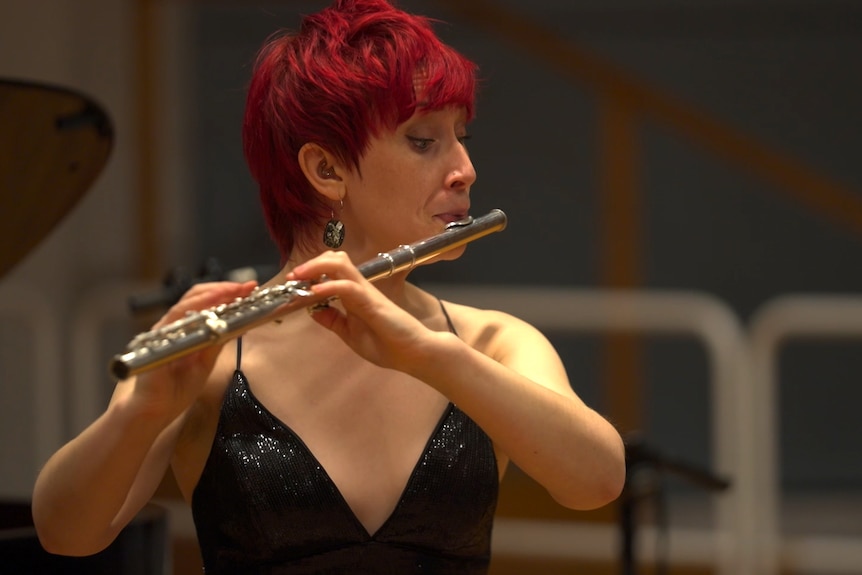
Flautist Eliza Shephard has saturated herself in the music of women every March since 2020. (ABC Classic)
March of the Women, spearheaded by flautist Eliza Shephard, began after she realised she could count on one hand the number of works by women she had learned across decades of study.
Shephard decided to “saturate myself in the music of women by releasing a recording every day of March.”
Now in its seventh year, the project has grown to include other female flute players and six new commissions from Australian female composers.
Virtuoso percussionist Claire Edwardes is another long-term champion of living composers, including women.
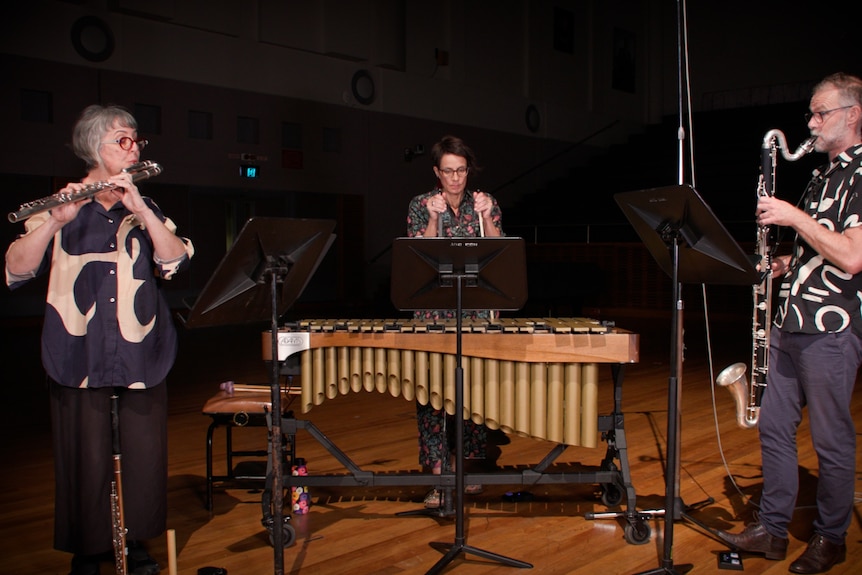
Clare Edwardes (centre) is the artistic director of Ensemble Offspring, a group which programmed music by women for an entire year in 2017. (ABC Classic)
Edwardes’s newly-released seventh album, Dual Attractor, features female composers from around the world, including Edwardes herself.
ABC Classic has also released a multi‑year album series, Women of Note, which showcases music by Australian female composers. Across eight volumes, the series has celebrated the music of 63 composers.
What’s happening on Australian stages and in live performance
Read says that in some pockets of the music world, especially chamber music, choirs and ensembles, music by living, Australian or Female composers are “becoming a draw card as opposed to a token.”
But the picture is more mixed for major orchestras, according to Lee Tungate.
“Looking at the percentage of works for the whole program, Adelaide, Canberra and Melbourne are the strongest,” Lee Tungate says.
“Western Australia, Queensland, Sydney and Tasmania are at the lower end.”
Lee Tungate explains how this plays out.
“In 2025, Sydney Symphony Orchestra programmed 127 works and only eight of those were by women, which made up 6.3% of their total,” Lee Tungate says.
“It’s not nothing, but it is at the very low end of the scale.”
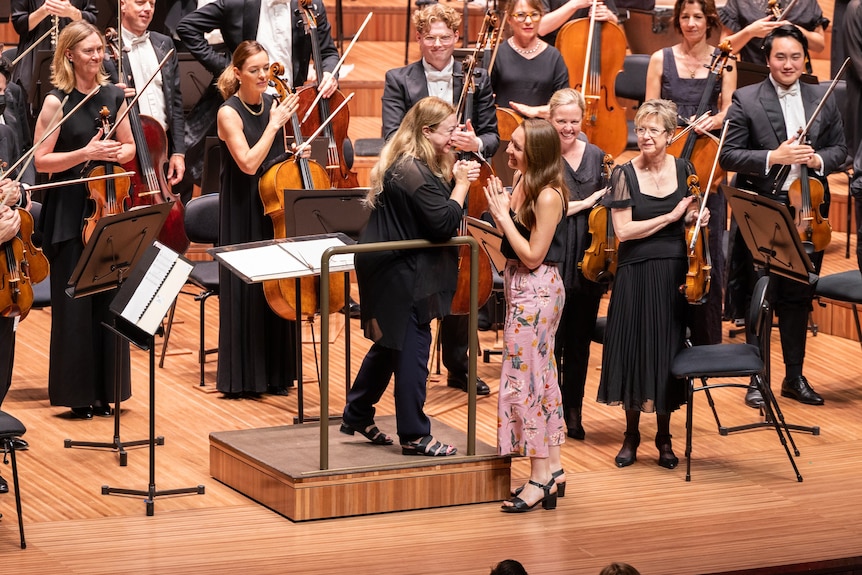
Ella Macens (right) was one of the composers commissioned by the Sydney Symphony Orchestra in their 50 Fanfares project. (Sydney Symphony Orchestra: Craig Abercrombie)
Lee Tungate points to the 50 Fanfares project as one of the initiatives which has increased the orchestra’s performances of music by female composers.
“In comparison, Melbourne Symphony Orchestra has 21% of their program by female composers,” Lee Tungate says.
But averages aren’t the only indicator of diverse programming.
Lee Tungate advocates for integrating music by female composers into general programming as well as special events like an International Women’s Day concert.
When female composers aren’t integrated, “it makes the works by women more marginalised,” she says.
Read and Lee Tungate note that when women’s works are programmed, they are often shorter overtures rather than major multi‑movement symphonies.
Historically, women weren’t able to get major works performed or were discouraged from even writing them, resulting in a dearth of repertoire.
Read points out this hasn’t become easier over time.
“Getting a large-scale work programmed and performed more than once [is a challenge] affecting all composers, not just women,” Read says.
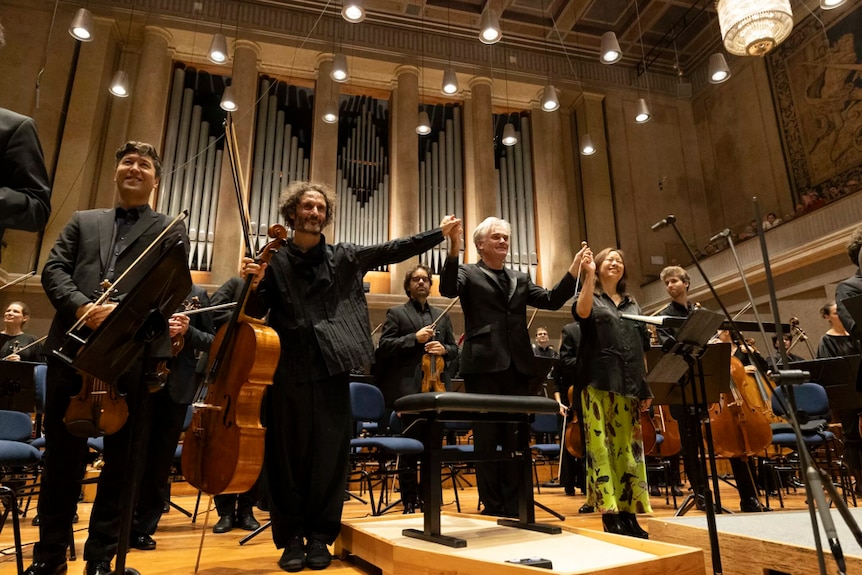
Liza Lim’s recent cello concerto won the 2025 Grawemeyer Award, one of the world’s most prestigious composition prizes. (BRSO: Astrid Ackermann)
The average length of music written by women is 20 minutes or less, according to Lee Tungate.
“The most commonly played piece by a woman in orchestral concerts in 2025 was This Midnight Hour by Anna Klein, a 12-minute overture,” Lee Tungate says.
Being programmed isn’t the end of the challenges that female composers face.
“Works by women are often segregated to the cocktail hour, or get cut from some concerts,” Lee Tungate says.
Read adds: “[Music by female composers] often only gets programmed for one performance as opposed to three or four performances.”
This means limited rehearsal time and a limited soundcheck, which in turn makes it “a struggle to record it well for broadcast or for commercial release.”
What we can do to achieve parity
There’s still a long way to go for female composers to achieve parity in the music world.
Echoing Read, Lee Tungate says: “When we don’t back our own composers, it has a knock-on effect for women composers.”
Orchestras also tend to rely on new commissions to redress the balance rather than widen their programming to include historical female composers.
Lee Tungate singles out Louise Farrenc, a 19th-century composer, as an example of music that can be programmed alongside Beethoven, as she was directly influenced by his music.
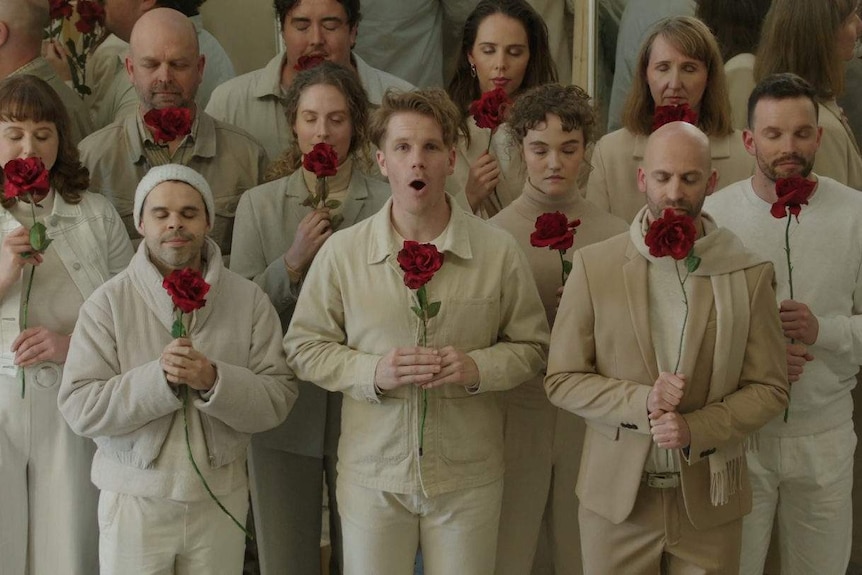
The music of Barbara Strozzi, a 17th-century composer, has been revived by performers today, including Australia’s Pinchgut Opera. (Pinchgut Opera: Still from “A Delicate Fire”)
In an already limited space for programming, music by composers of colour and Australian First Nations people often have to compete with female composers.
“If we’re not moving forward intersectionally, there’s no point in trying to push the change,” Lee Tungate says.
This is where audiences have an enormous influence.
“If you’re a regular attendee of orchestral concerts, buy a ticket when your orchestra is putting on works by women,” Lee Tungate says.
The same applies to engaging with radio stations and platforms like ABC Classic.
Read hopes for “a renewed love of an understanding of the process of recording music and seeing more people doing it, including women.”
Hughes declares that female composers are not going anywhere, even as the spotlight of International Women’s Day fades.
“In our Antipodean bubble, many of these voices have taken root and are now sitting right at home in the fabric of classical music.”Get the latest classical music stories direct to your inbox