
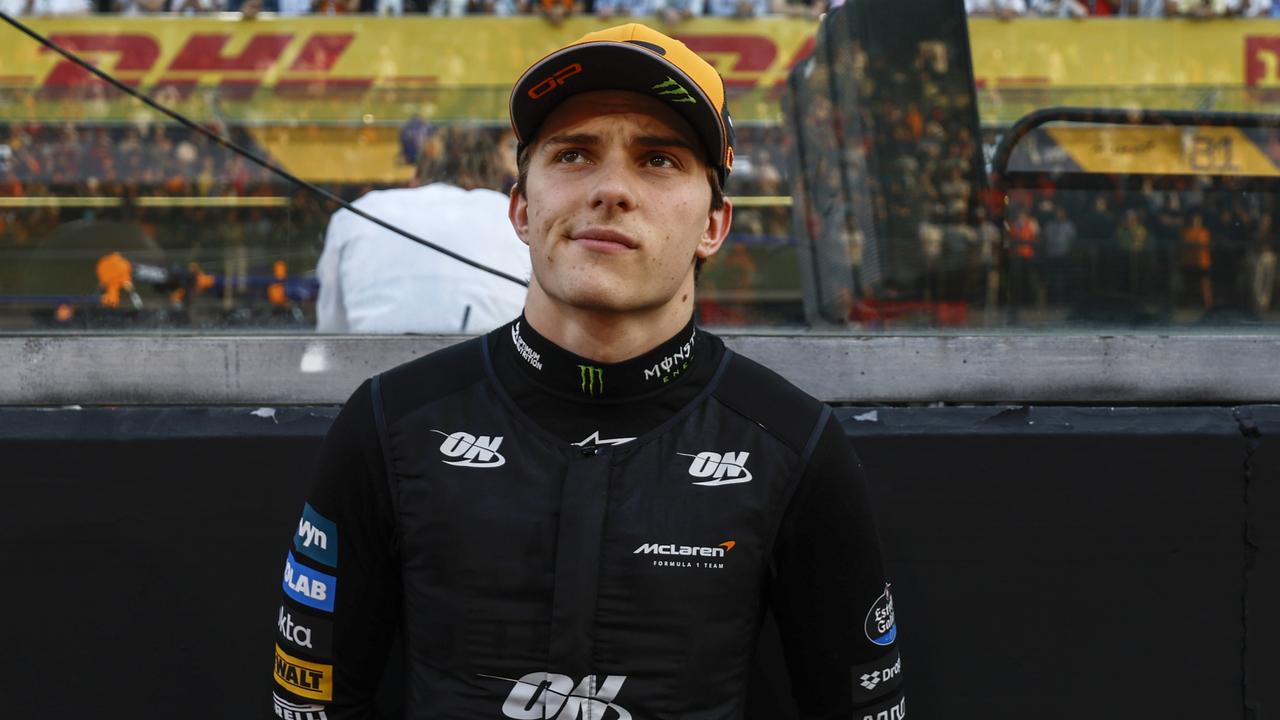
Oscar Piastri has made a career of keeping his emotions to himself, but even the unflappable Australian needed time to process the bitter championship defeat of 2025.
Piastri had topped the Formula 1 title table for 15 rounds, more than any other driver. He’d scored seven of his nine wins and all of his six pole positions. He failed to take home a podium trophy from only six grands prix.
But in an almost inexplicable and brutally brief run of three grands prix in the Americas, what had been at one stage a commanding 34-point slipped dramatically away. Teammate Lando Norris took top spot, then Max Verstappen slid into second place.

Fox Sports, available on Kayo Sports, is the only place to watch every practice, qualifying session and race in the 2026 FIA Formula One World Championship™ LIVE in 4K. New to Kayo? Join now and get your first month for just $1.
Piastri started the Abu Dhabi season finale as a championship outsider, and despite beating Norris to second place in the race, he ended his third Formula 1 season defeated by the Briton by 13 points.
“Obviously the first few days straight after the race were difficult,” he told select media, including Fox Sports.
It took a trip home to Melbourne for the ordinarily rock-solid Aussie to find his way back to equilibrium.
“It just comes with time,” he said, hinting at the emotional toll defeat took after a junior career comprising almost exclusively title victories.
“Once I got home and I was able to spend time with my family and friends, it was just nice to think of all the good moments that happened after as well, not just some of the more painful ones.
“My family, the support team around me — speaking about it with those kinds of people was important.
“You feel it rather than going, ‘Okay, now I’m back in Australia it’s all fine’. As much as I wish that’s how it worked, it wasn’t.
“When it comes up, you deal with it, and you move on.”
And moving on was imperative.
READ MORE
‘THERE WILL BE CHAOS’: Piastri’s Aus GP call as Aussie star makes big McLaren admission
STATE OF PLAY: Where every star stands in most explosive F1 silly season yet as 17-driver chaos looms
EVERY TEAM: Fallen giant impossible to ignore; what will make or break wildcard
With this year’s sweeping rule changes necessitating an unusually early start to the preseason, drivers had just a few weeks away from their teams before diving into the challenge of 2026.
Lamenting his loss would do no good on its own. Piastri had to understand where he’d gone wrong, and fast.
“There’s been a lot of conversations with the team on how we can approach things differently, approach things better,” he explained.
“Some of those conversations are what you need to put things to bed sometimes. That’s how you move on, by talking about things. That was important process to happen.
“This off-season was incredibly short; you very quickly put your mind towards the future instead of the past.”
Now the future has arrived, and Piastri’s preparation is set to be put to the test.
PIT TALK PODCAST: With just days before the opening grand prix of the season, Michael and Matt run the rule over the field to come up with a form guide for Melbourne — including the clear standout and Formula 1’s crisis team of 2026.
REACH FOR THE CEILING
Piastri’s 2025 title run stunned the sport as much as it did even his most hardcore supporters. It was clear the Australian was a title-calibre driver from his glittering junior career and his out-of-the-box speed in Formula 1, but most had expected him to be a four- or five-year project.
But his massive experience deficit to Norris, who started the campaign with almost three times as many race starts, proved no impediment to the young gun leading the way for much of the year.
That trajectory of improvement is at the heart of the narrative of Piastri’s Formula 1 career to date.
But that necessarily must change this year.
Even if he remains among the eight least experienced competitors on the grid, he can no longer be considered fledgeling in his fourth campaign.
In 2026 he’s an established Formula 1 driver, pole getter, race winner and title contender — a known quantity.
The curve has to begin levelling out eventually.
“Definitely I’m getting closer to that ceiling [of potential],” he said. “I certainly felt like that in 2025, and I think the results and a lot of the race weekends showed that.
“At the end of 2024 I felt like I was able to get on top of all the different areas I needed to, just not really all at the same time or on the same weekend,” he said.
“I think probably the biggest positive of 2025 for me was that I was able to put all of those strengths and lessons together so much more often.”
This year will be about more than just raw ability, however.
The massive regulation changes — billed as the biggest in Formula 1 history — have reimagined some elements of what it means to compete at the grand prix level.
The cars are smaller and lighter and have less downforce but these changes are well within the F1 realm, even with the added tricks of moveable bodywork.
The power unit, however, is a totally different beast.
Split between 400 kilowatts from the combustion engine and 350 kilowatts from the electrical motor, balancing power and range is now crucial to the driving challenge.
That’s because there are very few tracks on the calendar at which drivers won’t run out of battery.
The hybrid motor charges the battery mostly under brakes, but it can also recover energy when the driver lifts off the throttle at the end of the straights — lifting and coasting. The car can also automatically redirect power from the internal combustion engine to the battery through high-speed corners as required.
At circuits like Monaco, for example — where braking zones are plentiful — this is unlikely to be a problem.
At tracks like Melbourne, however — where straights dominate and there are few big stops — the battery will be flatter than a phone that’s reached its date of planned obsolescence.
Understanding how the car needs to be driven defined the preseason program of every team.
“I think this year’s cars are so different, and we’re talking about adapting to things that we’ve never even considered as a race car driver before,” Piastri said. “That’s a very new process.
“Two months ago we probably thought we had a pretty good understanding, and then we went testing and realised that there was a whole bunch of stuff that we didn’t necessarily understand. There were a few surprises for us.
“I’m certainly more comfortable now than I was a couple of months ago with how to drive these cars and how to try and get the most out of them, but you don’t know what you don’t know.
“I think we’re as prepared as we can be, and I’ve certainly put in a lot of hard work to try and understand it as well as I can, but I think if you fast-forward time and you come to Melbourne next year and then the year after, we’re probably going to look at this year going, ‘I don’t know why we did some of those things’.
“Without the advantage of hindsight, I think we’re in a good place.”
Kayo & Fox Sports secure new F1 Deal | 03:40
ADAPT OR PERISH
The Australian Grand Prix’s position as the first round of Formula 1’s new era means this weekend’s race begins with so many unanswered questions, many of which will receive only partial responses even by Sunday night.
One thing that appeared to become clear during testing in Bahrain, though is that the new energy management regime will see the cars take a step backwards in high-speed cornering performance.
The so-called ‘super clipping’ protocol effectively turns the combustion engine into a generator, redirecting 250 kilowatts to the battery and leaving only 150 kilowatts to power the wheels.
In Bahrain it manifested as car speed plateauing through the usually rapid turn 12 and also looking distinctly uninspiring through the esses of turns 5, 6 and 7.
This is likely to be the case at fast corners around the world, including, as just one example, the normally fearsome turn 9-10 chicane in Melbourne.
That could present a problem for Piastri. One of his major strengths has been pushing the envelope through high-speed corners — he was reliably better than Norris at circuits where high- and medium-speed bends dominated.
There are concerns ahead of the season that the regulations could neuter that advantage by effectively setting a hard limit on how hard drivers can push through these sorts of corners, with the battery leaching power from the combustion engine.
It adds another question into the mix for Piastri, whose high-profile struggles with low-grip tracks late in the year will inevitably become a talking point as those races begin looming large on the horizon after the midseason break.
“I think some of the learnings just from a driving style point of view, there were still some things that suited me better than others, and that’s just natural in the way you drive — everyone’s going to have their things that they find easier to adapt to and things that they find harder to adapt to,” he said.
“I think for me what was very positive out of last year was that the process of attacking something that was either new or I needed to get on top of worked well, and I think you can apply that to anything.”
That’s not to say there aren’t elements of these rules that could play to Piastri’s strengths.
The Australian isn’t the sort of driver to jump in the car and thrash it. Deeply analytical and reflective, much of his vaunted trajectory of improvement has been down to his willingness to comprehend his own strengths and weaknesses to raise both his floor and his ceiling.
That sort of cerebral approach to his craft could be rewarded in a year muscle memory could count for less.
“I think a lot of my adaptation comes through understanding things,” he said. “I think there are two avenues you can take. One is understanding something and then doing what you think is the best for that. The other one is just experimenting with all kinds of stuff and seeing what works and what doesn’t.
“I think a combination of the two is probably the right balance, but definitely I like to think my brain’s pretty logical, and doing things for a reason is generally an important thing for me.
“The more I understand about these cars, then the quicker you try and learn.
“For me generally, understanding the things I need to do comes pretty quickly, so hopefully that is an advantage.”
Middle East conflict to impact AUS GP | 05:00
EXECUTION IS EVERYTHING
All of this assumes, of course, that McLaren will be in a condition to put Piastri into the championship mix.
The team has won the last two constructors titles in succession — it dominated the count last year — and Norris’s 2025 title victory completed the comeback after a decade in the competitive wilderness.
Had the rules not changed, McLaren would have been in the thick of a championship-winning dynasty, with a technical team operating at the highest level and arguably the best balance driver line-up on the grid.
Instead its accumulated advantage has been cut down by the sweeping rule changes.
Suspicions are that works teams will have an early lead given the importance of understanding the power unit. McLaren is the only non-works team among the presumed top four constructors.
McLaren is also taking a slightly different approach to those other leaders, holding fire on major upgrades until later in the season. It’s the sort of steady approach that worked well in recent seasons but that must be proved for the new rules.
Team principal Andrea Stella said “the first part of the season will see us playing a bit defensively, trying to exploit the counterattack”.
In other words, he isn’t expecting to be victory favourites early in the campaign.
Piastri, though, doesn’t see it quite so simply. Instead he thinks this phase of the season will offer prizes for those who can execute most cleanly on the day rather than those with the greatest performance potential.
“I think building your level of knowledge and understanding at the moment is the most important thing, because this year more than certainly previous years we’re going to see a lot of change through the year,” he said.
“In 2022, for example, when there were new regulations, we saw Ferrari being very quick at the start and Red Bull finding their feet. Even for us through 2023.
“There’s going to be a lot of big gains and areas where if you don’t execute well enough, it can be a big penalty.
“I think just trying to make sure you get things right, be consistent — that’s obviously a very important part.
“Eventually — ideally from the start, but certainly eventually — you want to be fast and consistent as well, but I think execution and not falling into any traps at the start of the season is going to be a very important thing.”
The first trap?
The Australian Grand Prix, the first of 24 potential pitfalls as teams and drivers navigate these new regulations while attempting to fight for the championship.
The 2025 season was bitterly disappointing for Piastri as his first championship defeat as a genuine title contender in any series in almost a decade, but 2026 must be the culmination of three years of tough lessons and the indispensable experience of fighting in motorsport’s brightest spotlight.
The past is behind him. Piastri’s future is here now.