
The wait is officially over.
The Formula One season kicks off this weekend with new teams, fresh regulations and plenty of drama set to unfold on track.
What you might not realise, however, is that F1 technology never really left you.
Beyond the obvious examples of manufacturers dropping race-bred engines into limited-edition hypercars, the influence of Formula 1 runs much deeper.

MORE: The beast F1 stars struggle to tame
From the way your car starts to how it saves fuel, the world’s fastest sport has quietly shaped the vehicles sitting in Australian driveways.
Here are the key technologies born or refined in F1 that now feature in everyday road cars.
Hybrid System
The rapid development of hybrid power units in Formula One over the past 15 years has transformed how energy is captured and reused.
Modern F1 power units are highly sophisticated petrol-electric systems that recover energy under braking and from exhaust heat, storing it in battery packs for an extra burst of acceleration.
A prime example is F1’s Kinetic Energy Recovery System (KERS), which made its competitive debut in 2009.
KERS recovers a moving vehicle’s kinetic energy during braking and stores it as energy that can later be used to boost acceleration. While teams initially struggled with weight, engineers eventually boosted efficiency to around 80 per cent.
While KERS-style tech is a staple for supercars, manufacturers like Volvo have used similar flywheel and regenerative tech in models like the XC90.
Mercedes-Benz has also openly acknowledged the link between its F1 team and its road cars.
The Mercedes-AMG C63 S E Performance is an excellent F1-inspired example, featuring an electric exhaust-gas turbocharger and a 6.1 kWh high-performance battery with direct cell cooling.
MORE: $3/litre: Aus warned as petrol jumps in 48hrs
Paddle Shifters
Paddle shifters are increasingly common in sub-$30k hatchbacks, but they first gained prominence in the cockpit.
In 1989, Ferrari broke tradition with the H-pattern manual shifter by introducing a semiautomatic gearbox operated by paddles behind the steering wheel.
The tech was an instant success, reducing missed shifts and drivetrain damage.
And in the 1990s, Ferrari famously became the first to bring this to the street with the F355 F1 Berlinetta.
Today, they are the standard for automatic and dual-clutch transmissions as carmakers slowly phase out the manual stick.
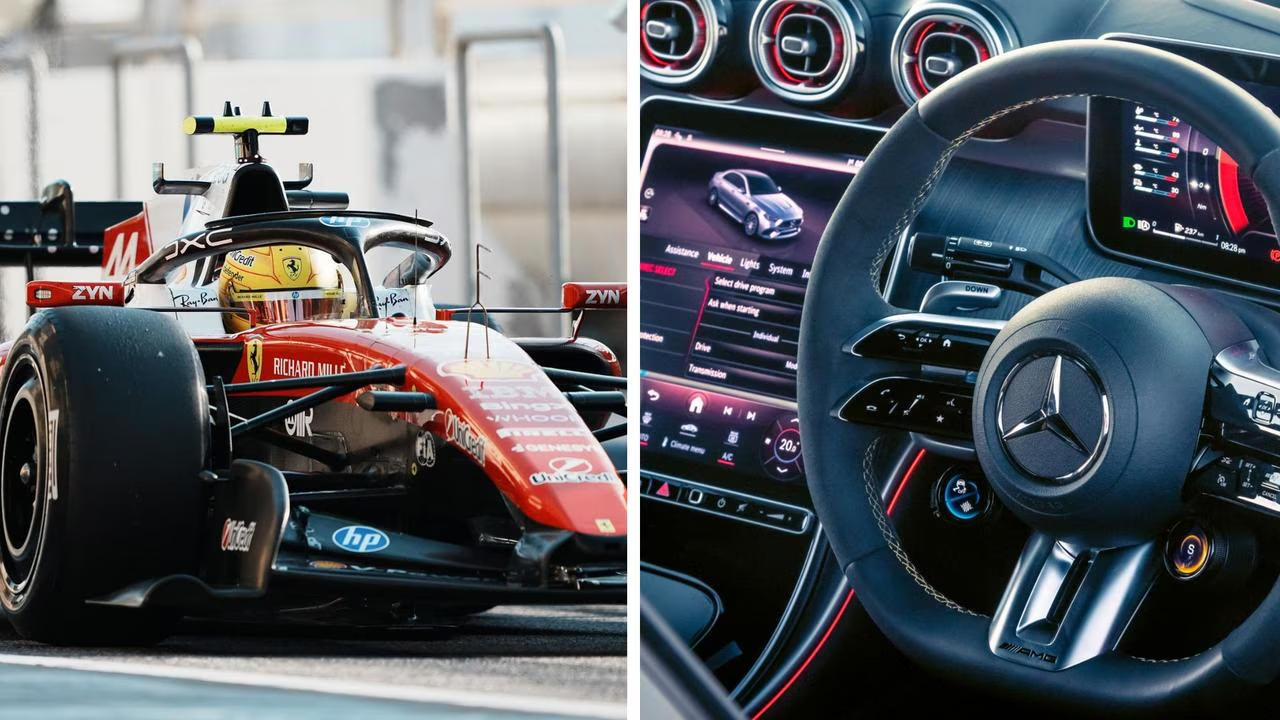
Steering-wheel Buttons
Buttons used to change the volume and set cruise control are all derived from F1.
A modern F1 steering wheel is a $100,000 piece of carbon fibre covered in more than 20 buttons and a digital display.
Because drivers travel at high speeds, they need to adjust car settings without moving their hands too much. That same ergonomic philosophy is why your steering wheel serves as a central hub, letting you change songs while keeping your eyes on the road.
MORE: Huge Tesla rival’s major flaw exposed
Vehicle and Tyre Pressure Monitoring
Formula One cars are covered in sensors and telemetry systems that constantly transmit data back to engineers in the garage.
The widespread use of real-time vehicle telemetry has played a crucial role in teams’ performance and safety over the years.
And some modern cars feature a similar system.
The Hyundai i30 N uses an F1-style Performance Driving Data System that serves as a real-time tracking tool for lap times, acceleration and G-force..
Tyre Pressure Monitoring Systems (TPMS) were also refined in Formula 1 before becoming a popular feature in many car models in Australia.
Cars use a very similar system to warn drivers of slow punctures or incorrect tyre pressure, which ultimately improves safety, reduces tyre wear and can even enhance fuel efficiency.
Adaptive Suspension
Active suspension was pioneered in F1 to maintain optimal ride height and aerodynamic performance, most famously by Williams in the early 90s, before it was banned due to costs and safety concerns.
The argument was that active suspension provides higher cornering speed, and failure at those limits would likely throw the driver off the track, significantly increasing the danger.
While fully active systems remain a rarity in production road cars, adaptive suspension has become a modern standard.
Brands like BYD and Volkswagen use these systems to automatically adjust damping in milliseconds, ensuring your SUV doesn’t roll like a boat through the corners while remaining comfortable over Australia’s mediocre roads.