
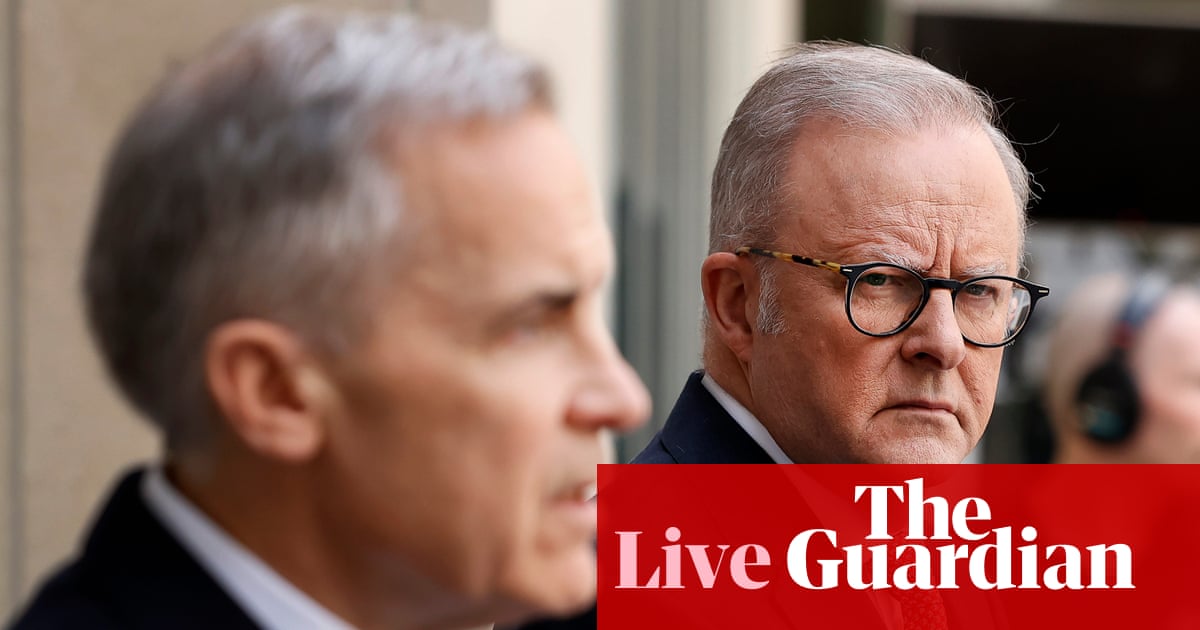
Carney and Albanese questioned on escalation of Iran war
Onto questions, the ABC’s Stephen Dziedzic asks the leaders how concerned they are about the escalation of war, and whether they’re concerned about the actions of the US navy, after Carney called for a deescalation of conflict.
Albanese says the world wants to see a de-escalation, for Iran to stop its attacks over an increasing number of countries.
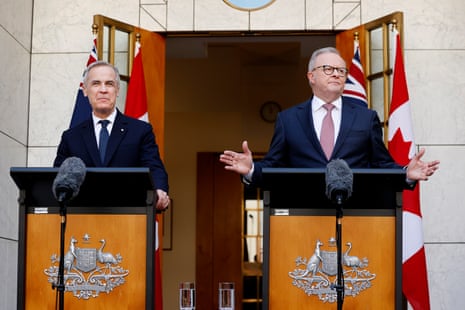 Canadian prime minister Mark Carney and Australian prime minister Anthony Albanese hold a press conference at Australian Parliament House on 5 March, 2026 in Canberra. Photograph: Hilary Wardhaugh/Getty Images
But he says that Australia wants to see the “objectives” of the strikes by the US and Israel achieved.
double quotation markWe’re seeing Gulf states that have not been involved attacked across the board, including the attacks on civilian and tourist areas as well. We also want to see the objectives achieved. I want to see the possibility of Iran getting a nuclear weapon removed once and for all. And I also want to see a removal of the ongoing threat that has been there for such a long period of time of Iran endangering peace and security and stability, not just in its own region but here in Australia.
Carney says he associates himself with Albanese’s remarks, and points to the brutality of the Iranian regime, which has killed “scores of Canadians”.
The Canadian PM says he wants to see de-escalation but also says that has to come after those outcomes are achieved.
double quotation markWe want to see a broader de-escalation of these hostilities with a broader group of countries than just the direct belligerence involved. We recognise, we stress, that cannot be achieved unless we’re in a position that Iran’s ability to acquire a nuclear weapon, develop a nuclear weapon, and to export terrorism is ended. So that process must lead to those outcomes.
Updated at 20.38 EST
Key events
Show key events only
Please turn on JavaScript to use this feature
 Penry Buckley
Pro-Palestine group compares NSW premier to ‘Red Scare’ US senator Joseph McCarthy
The Palestine Action Group has shared a statement with Guardian Australia after the NSW premier, Chris Minns, characterised the group to a budget estimates hearing as “a pack of communists … intent on confrontation with the police”.
The statement, which compares the premier to Cold War-era US senator Joseph McCarthy, who led a campaign against suspected communists in a period known as the “Red Scare”, says:
double quotation markIt seems Chris Minns has completed his transformation into Senator Joe McCarthy, trampling on democratic rights and criminalising dissent with Cold War tactics. He already tries to censor authors and academics, and plans to ban phrases critical of Israel, next he will be blacklisting books and movies which oppose genocide.
Minns is desperate to justify the police violence he unleashed against peaceful protesters who opposed the visit of genocide-inciting president Isaac Herzog … It is the police who attacked protesters and worshippers on 9 February, not the other way around, which is confirmed by the mountain of video and eyewitness evidence. Minns must come clean, apologise and resign for unleashing this shocking police brutality.
The Law Enforce Conduct Commission (Lecc) will investigate reports of alleged police brutality during the protest against the Israeli president, Isaac Herzog, last month after receiving “a significant number of complaints”. Minns and the NSW police commissioner, Mal Lanyon, have defended the police response.
Updated at 21.05 EST
 Patrick Commins
Allegra Spender calls for 50% tax on windfall Iran ‘war profits’
The government should slap a 50% tax on the windfall “war profits” earned by Australia’s major energy exporters, independent MP Allegra Spender says.
Oil and gas prices have jumped since the start of hostilities at the weekend, triggering fears of renewed cost-of-living pressures as they feed through to higher petrol bills and inflation more broadly.
But while households are hurt, a spike in global energy prices translates to booming profits for some businesses. Spender said:
double quotation markThe supernormal profits made by a few companies during this time is not a reward for effort or ingenuity, or a driver of investment, it is the windfall from war.
Woodside’s profit, for example, more than tripled in 2022 following the war in Ukraine.
I’m proposing an immediate tax of at least 50% which would only apply to the extra, supernormal revenue that companies receive because of the war driven price spikes.
The teal MP said the extra one-off tax revenue should be used to pay down debt.
Amid a steep regional sell-off, the Australian sharemarket is down 2.8% over the past five trading days. In contrast, over the same period the share prices of oil and gas firms Santos and Woodside have jumped by 6.1% and 7.2%, respectively.
Updated at 20.54 EST
 Nick Visser
Australia and Canada announce vaccine manufacturing partnership in event of another pandemic
Australia and Canada just announced a new vaccine manufacturing partnership in the event of another pandemic.
The deal will see Australian vaccine maker CSL Seqirus support Canada’s influenza pandemic preparedness through a guaranteed supply of 15 million doses of advanced, cell-based vaccines that will help protect Canadians should the World Health Organisation declare one.
A new Melbourne facility will be the first of its kind in the southern hemisphere and will be able to make more than 150m vaccines in the first wave of manufacturing during a declared pandemic, if needed.
The site, near Melbourne airport, will support a supply chain worth $300m annually to the Australian economy. Marjorie Michel, Canada’s minister of health, said in a statement:
double quotation markThis renewed contract with CSL Seqirus strengthens Canada’s ability to respond quickly to a potential future flu pandemic. By securing access to 15 million doses of flu vaccine if a pandemic is declared by the WHO, we are reinforcing our commitment to protecting health and being prepared and ready to act in the face of emerging public health threats.
CSL Seqirus is a pandemic preparedness partner to more than 30 governments worldwide, and has made vaccines for five pandemics in Australia.
Carney challenged on whether he should have immediately called for de-escalation
The final question goes to a Canadian journalist who asks why Carney did not immediately call for de-escalation when he first responded to the US and Israeli strikes on Iran.
Carney said that even in the early hours after the strikes, it was clear the objectives of the US and Israel to prevent Iran developing nuclear weapons could not be achieved immediately.
The journalist pushes back, asking if Carney spoke too quickly and if he should have given a more considered response.
Carney says no, and that just because other European nations might have immediately called for de-escalation, Canada is a “sovereign nation” that makes its own decisions.
double quotation markNo, it was essential for us to highlight the nature of threat, of the grave threat that emanates from Iran in terms of efforts to prevent nuclear export weapons and export of extremism and terrorism.
Updated at 20.43 EST
Five Eyes alliance continues to function very well, Carney says
Next, the Guardian’s own Tom McIlroy asks Carney whether the Five Eyes alliance needs modernising in the face of his skepticism of the US and old world institutions.
No is the short answer:
double quotation markI would say that many things, there are many challenges, but there are many things that continue to function very well, and the Five Eyes would be top of that list.
Carney is then asked if he still trusts the United States president, Donald Trump, given his decisions to impose tariffs.
Carney says the protocols under the historic free trade agreement between the US and Canada have not been followed.
double quotation markThat agreement effectively has been broken in the short term by US actions. That’s a fact that would be acknowledged, I think, by all sides.
Anthony Albanese and wife Jodie Haydon join Mark Carney and wife Diana Fox Carney and firefighters at Parliament House, Canberra, Thursday, 5 March, 2026. Photograph: Mick Tsikas/AAPShare
Updated at 20.56 EST
Carney won’t rule out participation in military action but makes distinction between offence and defence
Another question from a Canadian journalist, who asks whether Carney will rule out Canada participating in US military action in Iran if the conflict continues to spread.
Carney says it can’t be ruled out and that Canada will stand by its allies, and always defend Canadians.
double quotation markOne can never categorically rule out participation. We will stand by our allies, but it makes sense there’s a distinction between the offensive actions that were taken and are being taken by the United States and Israel, that were taken by them without consultation with Canada, with other allies, and we’re not party to those actions, but we will always defend Canadians. We will always stand by and defend our allies when called.
Albanese does not provide an answer to the question.
Updated at 20.44 EST
Canada ‘aspires’ for a ceasefire in Iran, Carney says, but attacks on civilians must stop first
Will the leaders call for a ceasefire, asks a Canadian journalist? Today’s press conference only allows three questions from Australian journalists and three from Canadian journalists travelling with Carney.
Both leaders say that before a ceasefire can occur, attacks on civilians and on civil infrastructure have to stop.
Carney says that the government “aspires” for a ceasefire but that it’s not yet the time for it.
double quotation markTo see a situation where all the parties in this conflict must recognise the necessity to avoid attacks on civilians and on civil infrastructure, that is not given this stage.
Albanese gives a similar answer and adds that there needs to be a “de-escalation of hostilities. Right now we have a spreading of hostilities.”
Updated at 20.18 EST
Carney and Albanese questioned on escalation of Iran war
Onto questions, the ABC’s Stephen Dziedzic asks the leaders how concerned they are about the escalation of war, and whether they’re concerned about the actions of the US navy, after Carney called for a deescalation of conflict.
Albanese says the world wants to see a de-escalation, for Iran to stop its attacks over an increasing number of countries.
Canadian prime minister Mark Carney and Australian prime minister Anthony Albanese hold a press conference at Australian Parliament House on 5 March, 2026 in Canberra. Photograph: Hilary Wardhaugh/Getty Images
But he says that Australia wants to see the “objectives” of the strikes by the US and Israel achieved.
double quotation markWe’re seeing Gulf states that have not been involved attacked across the board, including the attacks on civilian and tourist areas as well. We also want to see the objectives achieved. I want to see the possibility of Iran getting a nuclear weapon removed once and for all. And I also want to see a removal of the ongoing threat that has been there for such a long period of time of Iran endangering peace and security and stability, not just in its own region but here in Australia.
Carney says he associates himself with Albanese’s remarks, and points to the brutality of the Iranian regime, which has killed “scores of Canadians”.
The Canadian PM says he wants to see de-escalation but also says that has to come after those outcomes are achieved.
double quotation markWe want to see a broader de-escalation of these hostilities with a broader group of countries than just the direct belligerence involved. We recognise, we stress, that cannot be achieved unless we’re in a position that Iran’s ability to acquire a nuclear weapon, develop a nuclear weapon, and to export terrorism is ended. So that process must lead to those outcomes.
Updated at 20.38 EST
Albanese jokes that he looks forward to hosting Carney at The Lodge, and to look out for his dog, Toto, who “will hunt down who the weakest is in your pack to beg for food. I assure you she is not starving.”
Carney responds that he too, after 48 hours in Australia, is also very much not starving, cue some diplomatic chuckles.
More seriously, Carney restates the cooperation and friendship between the two nations.
Updated at 20.04 EST
Albanese and Carney hold joint press conference
Fresh off his address to parliament, Carney joins Anthony Albanese for a press conference.
Albanese says the two countries have agreed to deepen ties on critical minerals, defence and security and AI.
Albanese points to:
double quotation markPursuing common positions on key critical minerals issues, increasing alignment between Australia’s critical mineral strategic reserve and Canada’s defence stockpiling regime, working together to shape emerging markets, as well as Australia joining Canada’s G7 critical minerals production alliance.
He also announces a new annual emergency ministers meeting to boost cooperation on natural disasters.
During his address Carney earlier paid tribute to Australian firefighters who flew to Canada to help with wildfires in Alberta.
Canada’s prime minister Mark Carney, left, and Australian prime minister Anthony Albanese shake hands as they leave parliament, Thursday, 5 March, 2026. Photograph: Adrian Wyld/APShare
Updated at 20.02 EST
 Benita Kolovos
Victorian minister says 140 labour hire companies issued notice to cancel licences
The Victorian transport infrastructure minister, Gabrielle Williams, says 140 labour hire companies have been issued notices to cancel their licences.
Speaking outside parliament this morning, she confirmed Victoria’s Labour Hire Authority had issued a notice to an M Group subsidiary on Wednesday, flagging its intention to cancel the firm’s labour hire licence:
double quotation markThat sets in train a process and if that final determination is upheld, M Group will be walked off any sites that they’re on. I’m advised that they are currently have a presence on the North East Link project. Obviously, the notification that was issued yesterday is a very meaningful step, and with a final determination come in, which may well change the presence of M Group on that site.
M Group was named in a report by corruption fighter Geoffrey Watson, tabled in the Queensland royal commission inquiry into the CFMEU. The report said gangland figure Mick Gatto owned several companies within the M Group and that it received favourable treatment from the construction union:
double quotation markGatto, of course, denies he owns the M Group companies, but that is transparently false. The attempts to conceal Gatto’s involvement are crude.
The report described Gatto as a “malignant influence” on the CFMEU for decades.
Earlier on Wednesday, another M Group company had its Gold Coast-based operation called out by the Queensland royal commission.
Williams denied that the Queensland inquiry influenced the Victorian Labour Hire Authority’s actions:
double quotation markLet’s be clear, the Labour Hire Authority has been squirreling away across a number of investigations, and we’ve seen in recent days and weeks that bear fruit with the cancellation of now, I believe, over 140 licences .. the issuing of that notice yesterday was a part of a broader investigation that’s been taking place over many months.
Updated at 19.47 EST
 Josh Taylor
Privacy commissioner won’t appeal Bunnings facial recognition ruling
Last month, the administrative review tribunal gave Bunnings the green light to use facial recognition technology to detect previously banned people entering its stores, overturning a decision of the privacy commissioner.
The privacy commissioner, Carly Kind, confirmed today that she had not appealed the ruling (before the time to appeal expired), but said it’s not a green light for every other business to rush out the technology.
Photograph: Stephen Coates/Reuters
She said retailers have expressed a desire to deploy this technology, and had sought more certainty on how the Privacy Act operates with this emerging technology.
Kind said the ART decision provides clarity:
double quotation markThe tribunal’s decision shows that Australian privacy law allows for the balancing of competing interests – the individual and public interests in privacy, on the one hand, and the need to protect public safety and address unlawful activity on the other.
Specific updates to existing guidance will be made to reflect the tribunal’s decision and ensure that retailers have up-to-date information about our regulatory application of the law.
She said there will still be a “high bar” for using facial recognition technology in Australia, and companies will need to undertake a detailed risk assessment before deploying it:
double quotation markRetailers should view the decision as a useful case study, rather than a green light for deployment of biometric technologies.
SharePenry Buckley
Minns tells budget estimates hearing pro-Palestine protests ‘organised by a pack of communists’
Returning to NSW budget estimates, the premier, Chris Minns, has lashed out at the organisers of a protest against a visit by the Israeli president, Isaac Herzog, which saw multiple protesters charged, and following which alleged police brutality is being investigated by the Law Enforcement Conduct Commission (Lecc).
Upper house Labor members Sarah Kaine and Stephen Lawrence, among government MPs who attended the protest last month, as well as a pro-Palestine march on the Harbour Bridge last year, are on the estimates committee responsible for the premier’s portfolio but have been absent from today’s hearing. Lawrence has said conflict with police at the Herzog protest was “almost inevitable” following protest laws enacted by the government.
NSW premier Chris Minns. Photograph: Bianca de Marchi/AAP
Asked what advice was given to Labor MPs about attending rallies, Minns said at the committee hearing this morning he does not know whether advice was issued, but said members who attended the protest against Herzog had followed the law.
double quotation markI’ve sort of grappled with this a lot over the last three years or two and a bit years. In my view, a lot of the protests that have taken place – I assume you’re referring to the Palestinian Action Group protests – a lot of those protests have resulted in violent behavior, terrorist symbols, hate speech on Sydney streets.
But I also believe, I genuinely believe, that a lot of people have attended those marches with none of those intentions in place, that they’ve tried to exercise their democratic right to freedom of speech and expression, and they’re concerned about the circumstances relating to civilians in Gaza … They’re not part of the Palestinian Action Group leadership. My dilemma is that those protests are organised by a pack of communists … intent on having a confrontation with police.
The Palestine Action Group has been contacted for comment.
Updated at 19.51 EST
We must build sovereign AI capability, Carney says
Continuing his address, Carney says AI is transforming economies and our lives and it will be crucial to develop sovereign AI and intelligence infrastructure.
He says Australia and Canada can work together on this, as Canada also partners with like-minded nations in Europe, and has a trilateral AI initiative with India.
double quotation markStrategic autonomy will require sovereign intelligence infrastructure, including secure clouds data, LLM models, enterprise applications. Canada can contribute here as well … We know we must work with others who share our values to build sovereign AI capabilities so we are not caught between the hyperscalers and the hegemons.
Updated at 19.15 EST
World can be shaped by middle powers, Carney says
Carney has been heralded for his speech about the rupture in the world order, which he made at Davos in Switzerland earlier this year.
He tells the parliament that middle powers can shape the world when they trust each other and that Australia and Canada are right to build up their defence and strategic capabilities, as well as sovereign AI.
He says Canada is building a “dense web of connections to build our resilience”, and that this is not a retreat from multilateralism but an “evolution of it”.
double quotation markMiddle powers like Australia and Canada hold this rare convening power, because others know we mean what we say, and we will match our values with our actions. This has been earned by those before us, throughout our history, and the question is now what do we do with it.
The world will always be shaped by great powers. But it can also be shaped by middle powers that trust each other enough to act with speed and purpose.
We need coalitions now to address immediate challenges, and as those coalitions work, they will help demonstrate the power of multilateralism and reinvigorate it.
Updated at 19.04 EST
In pictures: Mark Carney addresses the parliament
Canadian prime minister Mark Carney delivers an address to members and senators in the House of Representatives. Photograph: Lukas Coch/AAPAustralia and Canada are ‘strategic cousins’, says Carney. Photograph: Lukas Coch/AAPBoth houses of parliament sit in the House of Representatives for Mark Carney’s address. Photograph: Mick Tsikas/AAPShare
Updated at 19.00 EST
Australia and Canada are ‘strategic cousins’, not competitors, Carney says
Canadian prime minister, Mark Carney, says Australia and Canada will be stronger negotiating with major powers together, acting as “strategic cousins” rather than competitors.
Carney is addressing the parliament, and begins by acknowledging the firefighters in the chamber who battled wildfires in his home state of Alberta in Canada last year, and says it’s one of many testaments to the “profound friendship” of the two countries.
Carney calls for greater cooperation on critical minerals, defence and trade and announces Australia would join the G7 critical minerals alliance.
double quotation markWith that global architecture now breaking down from consecutive crises, I have come to Australia to reaffirm our alliance and to suggest where we can go next. Because it is my fundamental belief – the result of an optimism I may have picked up from this great country – that from this rupture we can build something better, more prosperous, more resilient, more just …
In the old world, and even to a degree today, the temptation has been to see ourselves as competitors. In this new world, we should be strategic collaborators.
Updated at 19.10 EST