
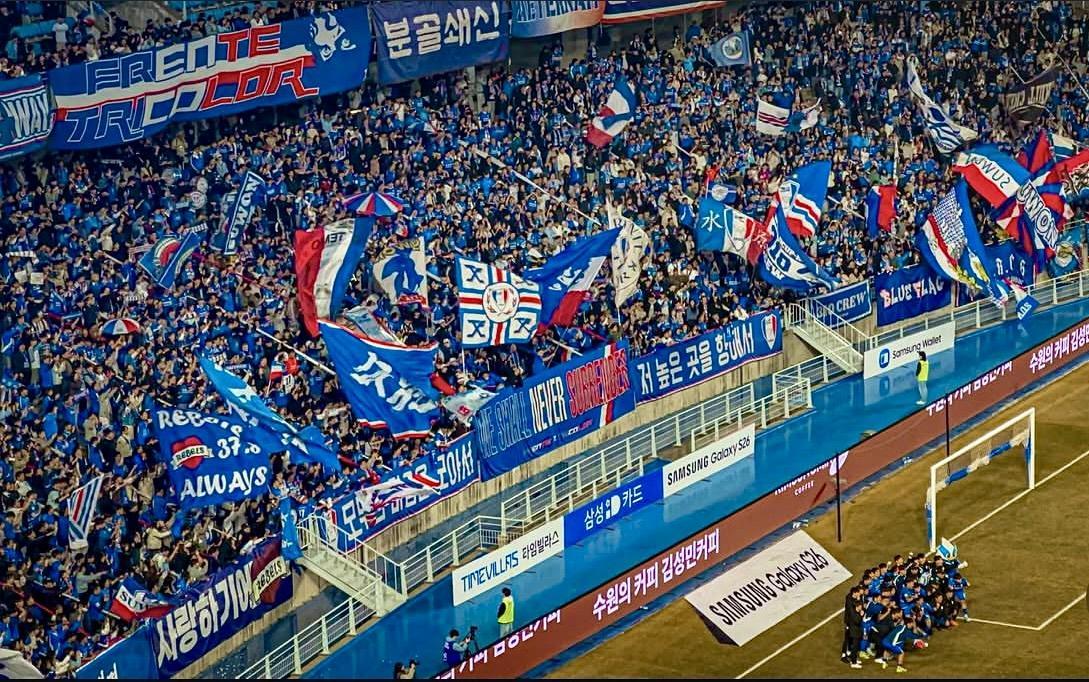
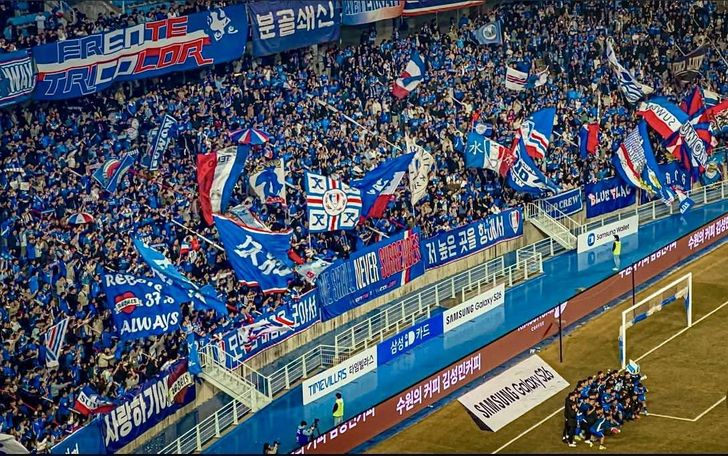
Suwon Samsung Bluewings players pose with fans in the stands after the K League 2 2026 Round 1 opening match against Seoul E-Land at Suwon World Cup Stadium in Suwon, Gyeonggi Province, Feb. 28. Captured from @gnariy_blue’s Instagram
SUWON, Gyeonggi Province — On a mild Saturday in late February, traffic around Suwon World Cup Stadium slowed to a crawl.
Red express buses from Seoul and across Gyeonggi Province arrived brimming with supporters clad in royal blue, their chants rising in waves. Nearly 900 meters from the arena, the sound was already thunderous — audible even through the sealed windows of a city bus inching toward the stadium.
Welcome to the home of Korean football.
The occasion was the 2026 K League 2 season opener, pitting storied powerhouse Suwon Samsung Bluewings against Seoul E-Land FC at the 44,000-seat “Big Bird” stadium ― the wing-roofed colosseum that hosted four matches during the 2002 FIFA World Cup. A banner stretching across the concourse read “Home of Football,” and the 24,071 supporters who filled the stands that afternoon made the slogan feel like an understatement, smashing the K League 2 all-time single-match attendance record.
For nearly 100 minutes, the N section behind the goal — the domain of the Frente Tricolor, Suwon’s organized supporters group — erupted in nonstop song. Twenty-five chants, none repeated, rang out in a relentless wall of sound that left neutral spectators and the growing number of foreign fans in the stadium visibly stunned.
When substitute Kang Hyun-muk slotted the go-ahead goal in the 73rd minute to seal a 2-1 comeback victory, Big Bird shook as if it were June 2002 all over again.
It was also the debut match for head coach Lee Jung-hyo, the most talked-about appointment in Korean football this year. His arrival has been dubbed “Lee Jung-hyo Syndrome” — a phenomenon that has redirected the nation’s footballing gaze away from the approaching FIFA World Cup in North America and onto a second-division club in Gyeonggi Province.
“Forget the World Cup — Lee Jung-hyo’s Suwon is what excites me more,” has become a common refrain among Korean football fans, and the numbers back it up: over 150,000 viewers streamed the match on Coupang Play, setting a K League viewership record across both divisions.
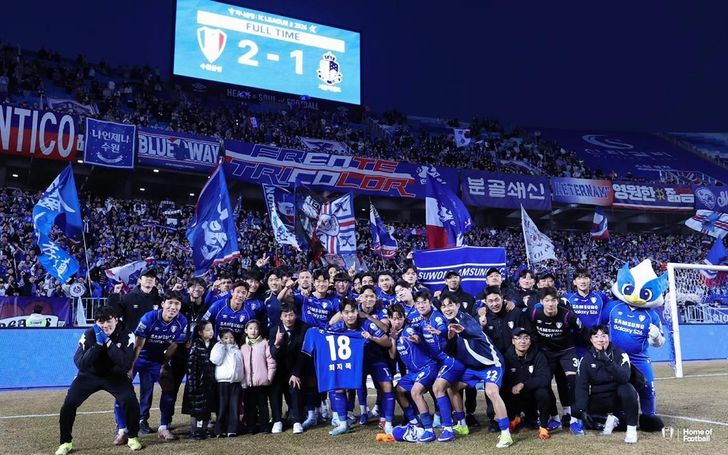
Suwon Samsung Bluewings players and coaches pose after their K League 2 2026 Round 1 season opener against Seoul E-Land at Suwon World Cup Stadium in Suwon, Gyeonggi Province, Feb. 28. Courtesy of Suwon Samsung Bluewings
Suwon Samsung Bluewings are not simply a football club. Founded in 1995 at the urging of then-Korea Football Association President Chung Mong-joon, who personally persuaded Samsung Group Chairman Lee Kun-hee to invest in the sport, the Bluewings became the country’s ninth club and the first team created for a single designated city in K League history — a model that would later become the league standard.
Within three years of their inaugural 1996 season, they were champions. In 1999, they completed a quadruple — league title, Super Cup, League Cup and Adidas Cup in a single season — a feat no Korean club has matched. Back-to-back Asian Club Championship titles in 2001 and 2002 established them as continental royalty.
Several of Korea’s most recognizable football figures have passed through Suwon, from legendary striker and former coach Cha Bum-kun to World Cup stars like Lee Woon-jae and Kim Do-heon, further cementing the club’s status at the heart of the domestic game.
The club’s crest, redesigned in 2008, prominently features Suwon’s Hwaseong Fortress, the UNESCO World Heritage Site that defines the city’s skyline and cultural identity. It is a deliberate fusion of sporting ambition and civic heritage, one that has projected Suwon’s name across Asia on match day broadcasts for three decades.
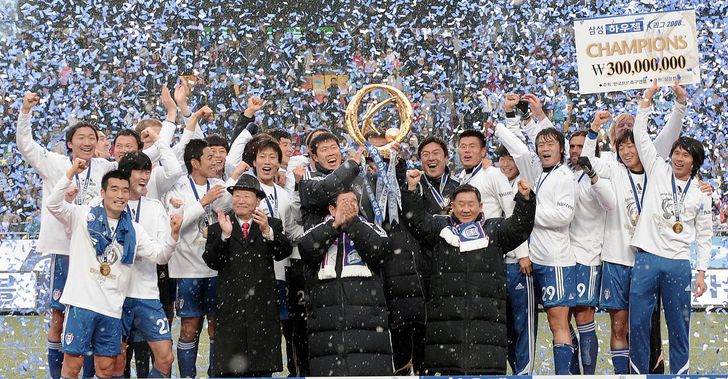
Suwon Samsung Bluewings players and coaches celebrate securing the K League championship at Suwon World Cup Stadium in Suwon, Gyeonggi Province, Dec. 7, 2008. Korea Times photo by Koh Young-kwon
Then came the fall.
A gradual decline through the 2010s culminated in relegation from K League 1 in 2023, and two consecutive failures to return. For most clubs, such a spiral would scatter the fanbase. For Suwon, it did the opposite.
Average home attendance jumped to 12,048 in 2025, the fourth-highest in all of Korean football and the club’s best in over a decade. Of the 16 K League 2 matches that drew more than 10,000 fans that season, 14 involved Suwon. Their traveling support became so conspicuous that social media posts from rival cities frequently went viral: “What’s happening today? There are people in blue everywhere.”
Baek Jong-ha, who runs football YouTube channel Baek Hanryang and has followed the Bluewings for 20 years, traced the paradox back to something deeper than results.
“Even when we were down to 2,000 fans, the culture survived,” Baek said at Samgwang, a supporters’ bar in Suwon’s Ingye-dong neighborhood, hours after the record-breaking opener. “When I first walked into Big Bird in 2006, I came to pick a team — I was going to visit every stadium near me. But the moment I saw the Frente Tricolor, I never made it to the next ground. I fell for the supporters.”
That pull, he said, only intensified when adversity struck. “Relegation actually brought people back. Fans who hadn’t come out in 10 years heard the club was in crisis and returned. And the newcomers who saw those diehards thought, ‘These people are incredible.’ That cycle fed on itself.”
He pointed to the stadium’s atmosphere as Suwon’s strongest tourism asset.
“Whether we’re in the first division or the second, we draw the biggest crowds and create the most electric atmosphere,” Baek said. Armed with blue, white and red umbrellas raised in unison, showers of confetti and chants with lyrics recalling snowfall on championship nights, Suwon’s supporters turn every match day into a spectacle that overwhelms the senses, he explained. Their European-style terrace culture — from call-and-response chants to the original “Su-won Sam-sung” roar — later became the blueprint for the Red Devils, shaping how Korean fans nationwide sing, drum and rally behind the national team. “I tell everyone: If you want to feel the heartbeat of Korean football, come to Suwon.”
After the final whistle, the celebrations migrated south to the neon-lit streets of Ingye-dong and the Ajou University neighborhood, Suwon’s commercial hearts. Restaurants and pubs overflowed with blue-clad revelers ― but one venue stood apart. At Samgwang, a 100-seat sports bar that has become the unofficial living room of the Bluewings faithful, the party was already in full swing.
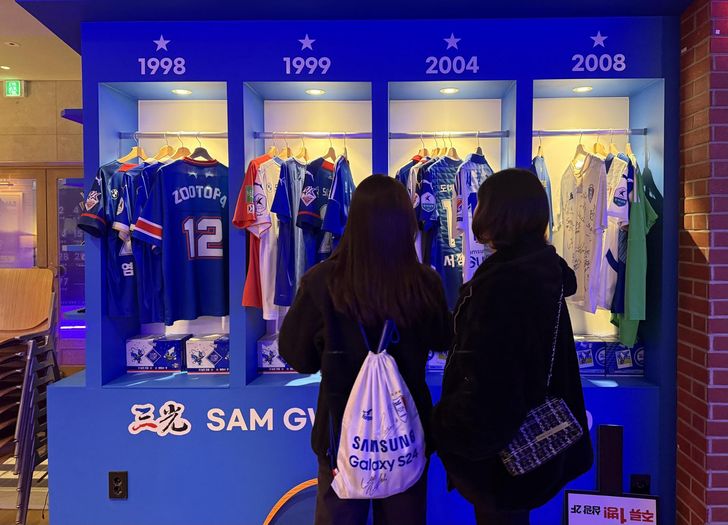
Suwon Samsung Bluewings fans browse through the football club’s uniforms at Samgwang, a supporters’ pub run by a fan of the team in Suwon, Gyeonggi Province, Feb. 28. Korea Times photo by Lee Hae-rin
Under blue-tinted lighting, fans in scarves and jerseys crowded around large television screens replaying match highlights. Someone belted out the opening bars of “Ole Ole O” and the room joined in unison. The owner, grinning behind the bar, hit a button on a fog machine, sending a plume of theatrical smoke across the ceiling. One wall was covered floor-to-ceiling with signed jerseys, cleats and supporter memorabilia ― a shrine that could pass for a club museum’s hall of fame.
The man behind the bar is Kim Kwang-hun, a Bluewings supporter since the club’s first season in 1996. He opened the first incarnation of Samgwang near Big Bird in 2017, initially as a modest bar with a television.
“I didn’t plan any of this,” Kim said between rounds of celebratory drinks. “I just put a TV on the wall and started watching matches. Word got around that a Suwon fan was running the place, and people started showing up. They’d ask about the old days ― the quadruple season, the snow falling during the 2008 championship final ― and I’d tell them everything. It just grew from there.”
It grew enough to force two relocations, each to a larger space. The current venue, his third, sits on a prime corner in Ingye-dong ― a location he chose, he said, out of competitive pride. “I asked where the best spot in Suwon was, and they said next to the Starbucks. So here we are.”
Kim has turned it into far more than a place to watch football. An annual charity auction of player-donated jerseys and footwear has raised increasingly larger sums each year, with players occasionally showing up in disguise. In the offseason, the bar hosts rotation-style social mixers for sports fans, where the dress code is your team’s jersey and cap. “Couples have come out of it. Marriages, even,” Kim said.
Fans from Japan’s J.League, particularly supporters of Yokohama F. Marinos — who share Suwon’s blue-white-red color scheme — have become regular visitors, swapping scarves and stories with their Korean counterparts.
“KT Wiz even came and asked me to open a pub for their baseball fans,” Kim said with a laugh. “I said no. This is Suwon Samsung’s house.”
When asked what Suwon Samsung means to him, Kim paused.
“It used to feel like a friend. Now it’s more like my teenage kid,” he said. “It makes me angry, it breaks my heart, it keeps me up at night. But you never stop looking after your kid. You turn around and say, ‘OK, let’s try again tomorrow.’ That’s what this club is.”
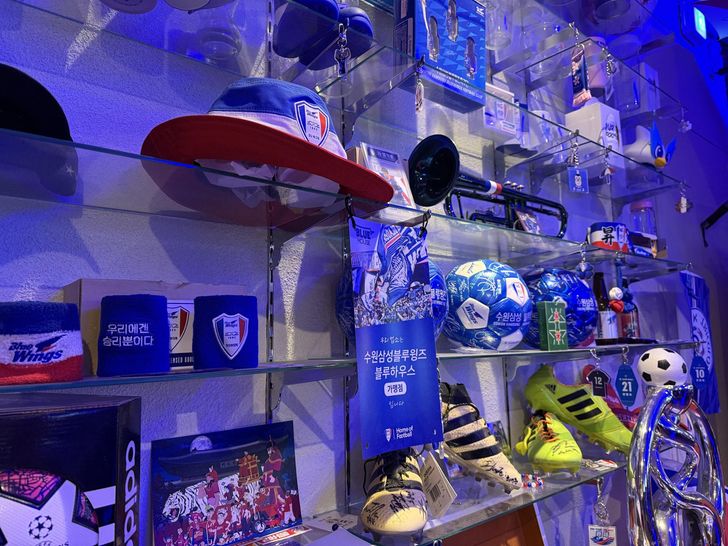
Merchandise from Suwon Samsung Bluewings and signed football boots are displayed at Samgwang, a supporters’ pub in Suwon, Gyeonggi Province, Feb. 28. Korea Times photo by Lee Hae-rin
The economic ripple effects are tangible. A Suwon city government study found that the city’s five professional sports teams generated a combined production inducement effect of 284.79 billion won ($213 million) between 2013 and 2016, with a value-added effect of 118.85 billion won and employment inducement of 3,858 jobs. Suwon accounted for 62.5 percent of Gyeonggi Province’s total professional sports revenue during that period — the highest share among the province’s 10 cities with pro teams.
Each Bluewings home match funnels thousands of visitors into the surrounding Paldal District, filling restaurants, cafes and transit lines. The club’s Blue House affiliate store network, launched in 2006 as the first of its kind in the K League, now links over 150 local businesses to match day commerce.
Trophies will return or they won’t. Promotion may come this year or the next. But on any given match day at Big Bird, 24,000 voices will make the same point that Suwon’s supporters have been making for 30 years: This is where Korean football lives.
As one of the Frente Tricolor’s most popular chants puts it: “No regrets in this love.”