
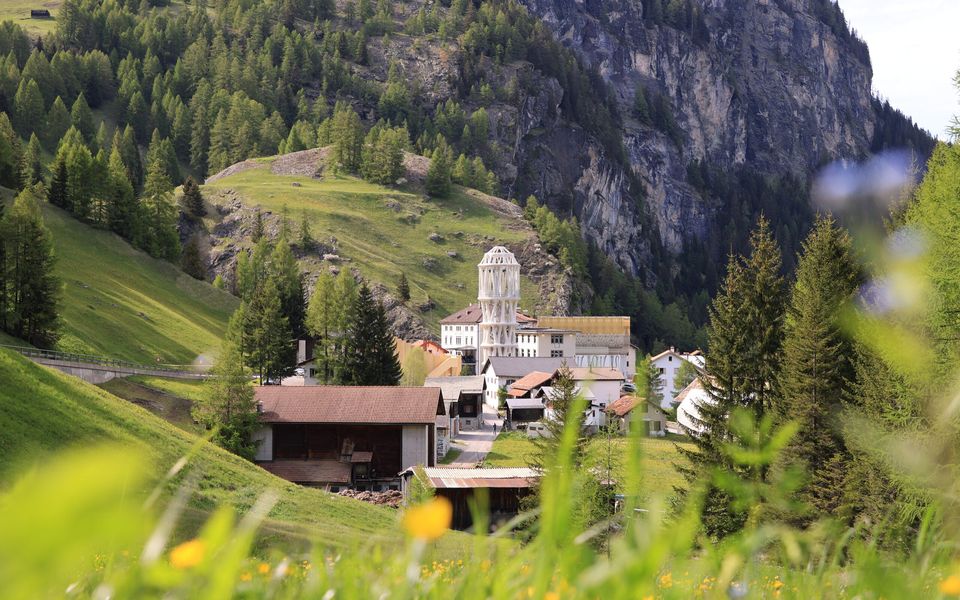
The world’s biggest 3D-printed structure has towered over a tiny village in the Swiss Alps. Tor Alva, or White Tower in Romansh, is more than a global technological milestone; it is also a powerful antidote to the Swiss countryside’s growing depopulation. The driving forces behind this impressive project are a team from ETH Zurich, which built the structure, and a cultural foundation seeking to breathe new life into a historic village.
“The people of Mulegns lived a simple, modest life and for centuries were forced to emigrate just to make a living. Many of them worked as confectioners across Europe. Some became successful and returned, building impressive villas and small chateaus. Their construction activity had a significant impact on the canton Grisons’ tourism industry,” says Giovanni Netzer, the founder and artistic director of the Origen Foundation, which came up with the idea of building the pioneering tower in this village of just 12 residents.
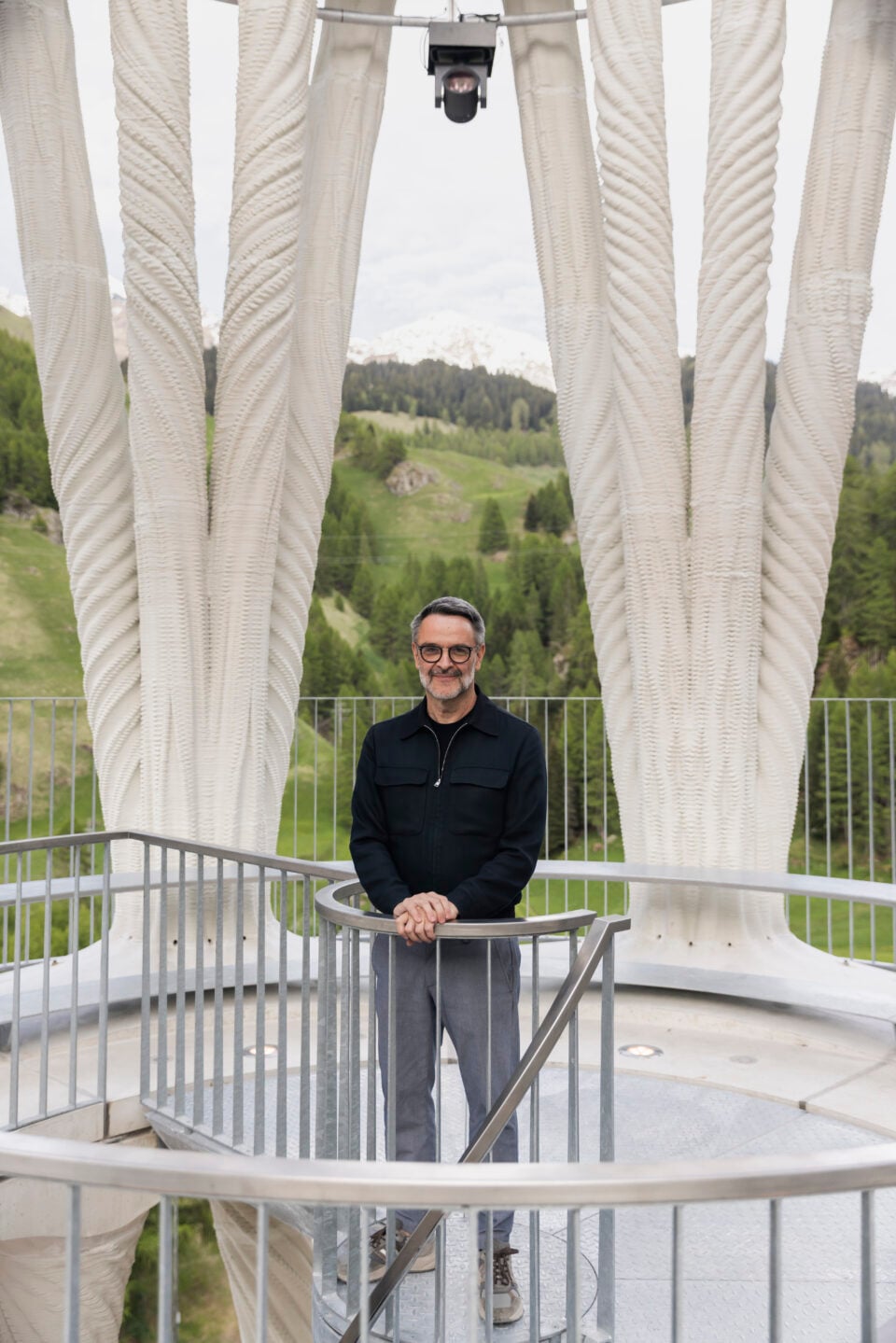 The question that gave rise to the idea for Tor Alva was what a confectioner from Mulegns would build if returning to his village in the 21st century, said Giovanni Netzer, the head of the Swiss cultural foundation, Origen, which manages the tower. [Benjamin Hofer]
“Mulegns lies along one of Europe’s most important alpine road routes and has a history dating back to ancient times. Many prominent figures spent the night at the Post Hotel Lowe after arriving here via the Julier Pass, including an American president, the Russian tsar’s widow, a British heir to the throne, several Nobel laureates and renowned artists,” Netzer told Kathimerini.
For Netzer, the intricate, 30-meter tower stands as a modern symbol of historical memory and the act of returning; for the researchers of ETH Zurich, it is a technological landmark.
“We weren’t just interested in breaking the height record. The real game changer is that we are in a position to produce load-bearing, multistory structures with a distinct architectural identity,” architecture professor Benjamin Dillenburger told Kathimerini. “In conventional construction, producing 32 different columns would be economically prohibitive, and the cost of the molds alone would be extremely high. 3D printing radically changes this equation: complexity no longer costs more.”

The project presented significant technical challenges. The printing of the tower’s 32 unique columns, as the Swiss professor explained, was not a simple process of robotic production but a complex experiment in structural engineering.
“One of the greatest difficulties in 3D concrete printing is the integration of reinforcement. For Tor Alva, we developed a process whereby one robot applies the concrete layer by layer, while a second places steel rings inside the column at intervals of about 20 centimeters, allowing the structure to achieve true load-bearing capacity. The challenge was not only aesthetic but primarily structural. We developed a new testing method that, for the first time, enables the reliable calculation of the load-bearing capacity of a 3D-printed structure. We had to prove that 3D printing can produce multistory structures that meet the same safety standards as conventional reinforced concrete,” he said.
Apart from the technological breakthrough it represents, the project also seeks to address an urgent question of modern times: Can 3D printing contribute to a more sustainable construction model?
“There are tangible advantages from a sustainability standpoint, as eliminating traditional formwork removes a major source of construction waste,” Dillenburger said.
He went on to note that, in line with the principles of cyclical construction, the tower has also been designed to be dismantled, explaining that once it completes its planned five-year stay in Mulegns, it can be taken apart and re-erected at a different location.
 Printing the tower’s 32 columns was not a simple process of robotic fabrication, but a complex experiment in structural engineering. [Benjamin Hofer]
“To put it simply: 3D printing is sustainable and increasingly viable, but perhaps its greatest value today lies in showing the construction industry what becomes possible when digital design, robotic fabrication and materials science converge. Tor Alva is proof that this is not science fiction. It has been built, it stands upright, and people can experience it,” Dillenburger said.
The excellent partnership between ETH Zurich and the Origen Foundation was crucial to the project’s success. As Dillenburger pointed out, the researchers found something rare in the project: a real commission in an actual place, with an actual public and a living cultural context.
 Tor Alva is not just a remarkable technological achievement; it is also being hailed as a compelling answer to the challenge of depopulation in the Swiss countryside and beyond. [Stefan Kaiser]
“From securing structural approval and the transportation of the components to putting up with the weather and the integration of electrical infrastructure, we had to deal with issues that do not arise in a controlled laboratory environment,” he said, adding that the columns were printed over the course of five months at ETH’s Honggerberg campus, assembled in Savognin, and then transported to Mulegns.
A major attraction
The project is the result of interdisciplinary collaboration at ETH, bringing together teams working on digital construction technologies, structural engineering, materials research and industrial partners who helped turn theory into practice.
“Tor Alva demonstrates what can happen when academic research is tested at full architectural scale,” Dillenburger said. “The knowledge we gained will shape the way we approach digital construction in the future.”
Netzer explained that private donors also contributed to the project, including Spyros Niarchos.
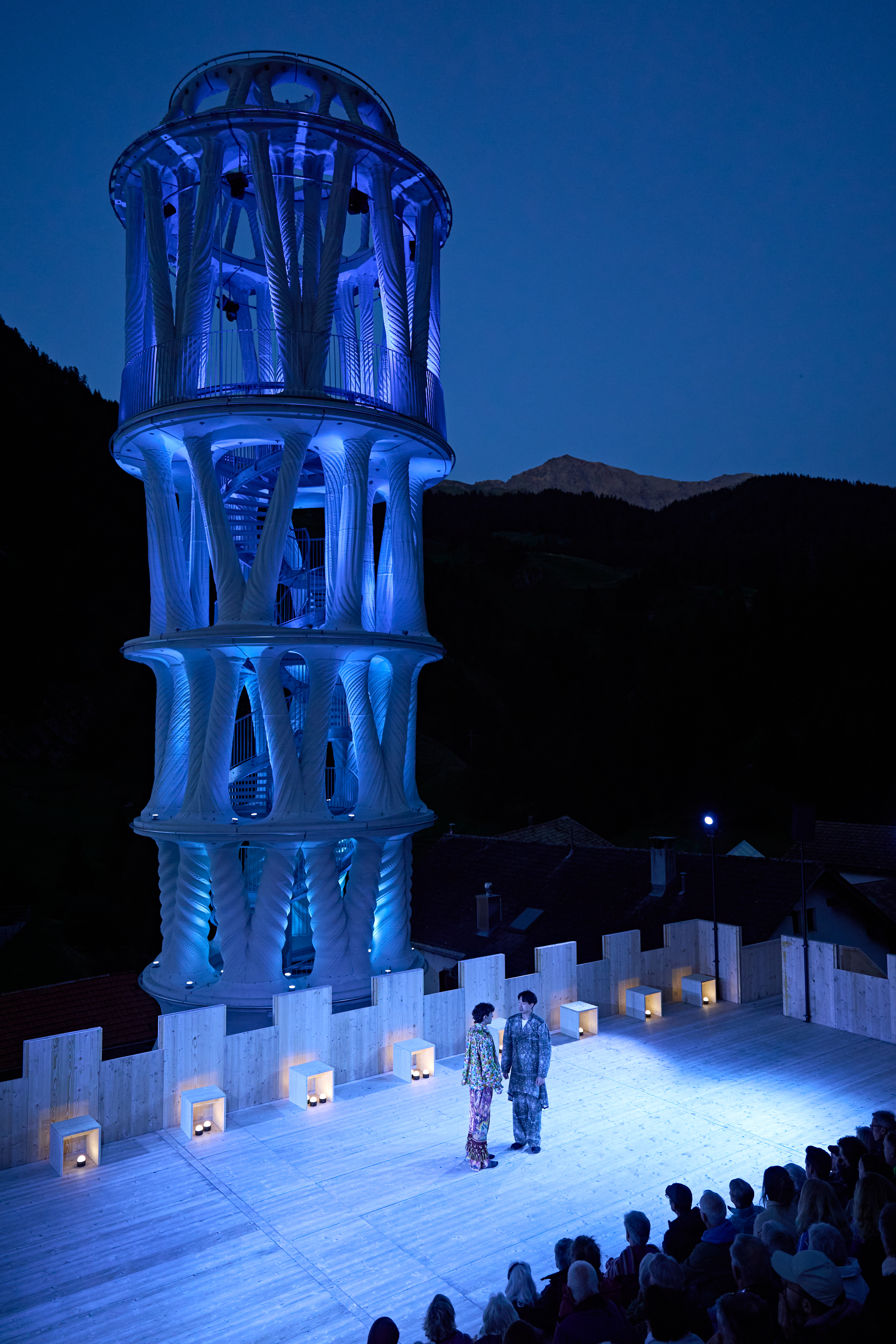 Tor Alva has been used mainly for concerts and tours since going up nine months ago, drawing some 40,000 people to the sleepy Alpine village. [Admill Kuyler]
The effort is already yielding tangible results: Some 40,000 people have visited Mulegns since the tower went up, out of interest for the village’s history, to admire the technological feat or to attend one of the many cultural events the tower has hosted. The Origen Foundation now aspires to develop the village further with theaters, a hotel and a confectionery school and museum.
“Mulegns is an excellent example of a village that is being reborn from its past,” Netzer said. “The White Tower of Mulegns tells the story of those confections, as the idea for its construction emerged from a conceptual question: What would a confectioner build on returning to Mulegns in the 21st century? Would he be as inventive and innovative as his ancestors? The past became the foundation for shaping the future.”
 The ETH Zurich researchers found something rare in the project: a real commission in an actual place, with an actual public and a living cultural context. [Benjamin Hofer]
Netzer and Dillenburger were in Athens on February 26 at the invitation of Swiss Ambassador to Greece Stefan Estermann, and spoke about the project in the context of Romansh Week, one of Switzerland’s four national languages, spoken in Grisons.
“Although it is spoken by less than 1% of the population, we are proud of the Romansh language, as multilingualism lies at the core of our national identity. During Emna Rumantscha, we celebrate what unites us, what makes us stronger and what truly matters in complex times. This year, the focus is on Tor Alva, the tallest building in the world constructed using 3D printing, which has risen in the Alpine village of Mulegns – a unique cultural space that connects contemporary architecture with local history,” Ambassador Estermann told Kathimerini ahead of the event.
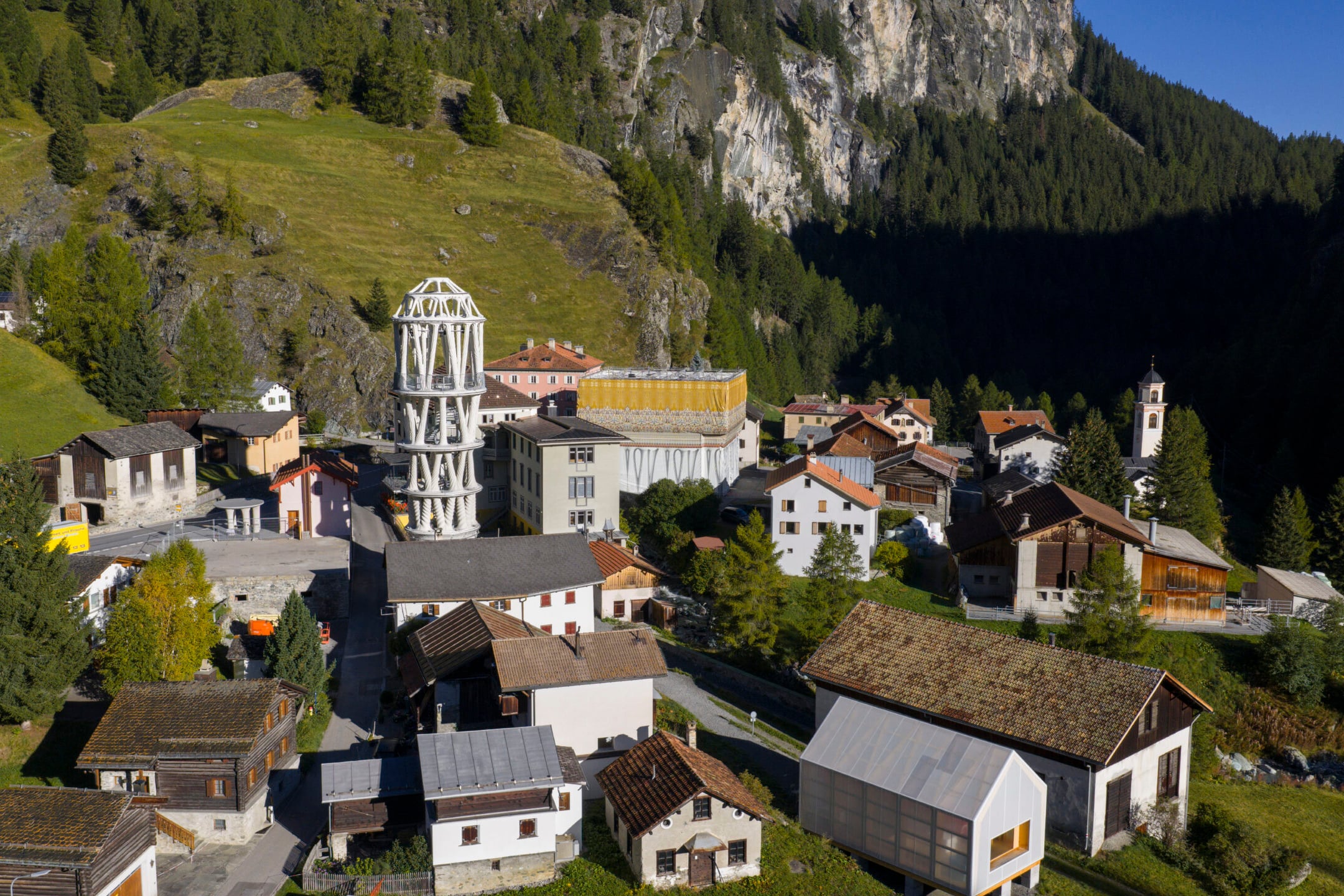 Private donors also contributed to the pioneering tower’s creation. [Benjamin Dillenburger]