
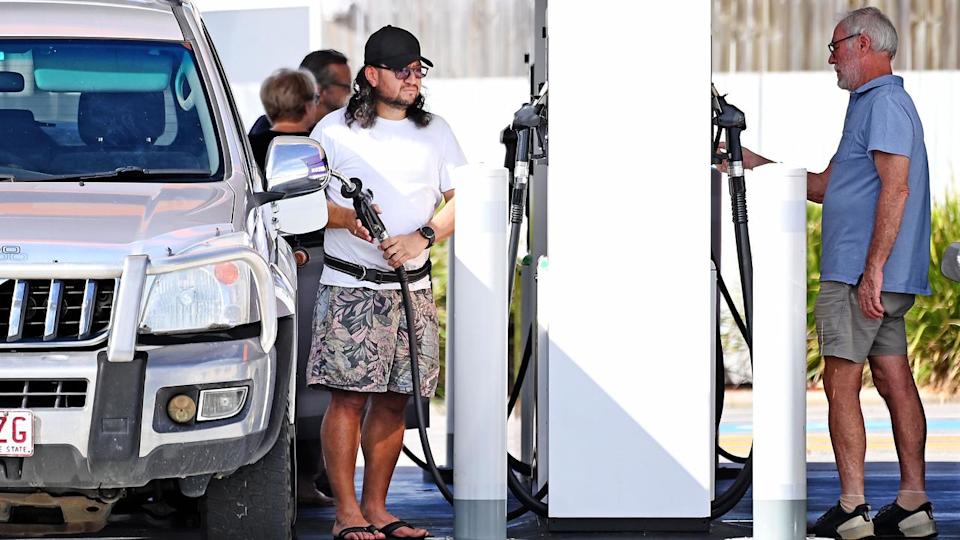
 Fuel companies in Brisbane lifted petrol prices earlier this week in a move the RACQ claims was unjustified. Picture: NewsWire / John Gass
Petrol retailers are crisis profiteering and unjustifiably hiking prices at least five to 10 cents a litre across the country, the NRMA claims.
As the conflict in Iran lifts global wholesale fuel prices about 10c per litre, the national motorists’ group says service stations have hiked prices well above the wholesale increase.
NRMA spokesman Peter Khoury said on Friday fuel retailers were already maximising their margins before the US and Israel began bombing Iran on Saturday.
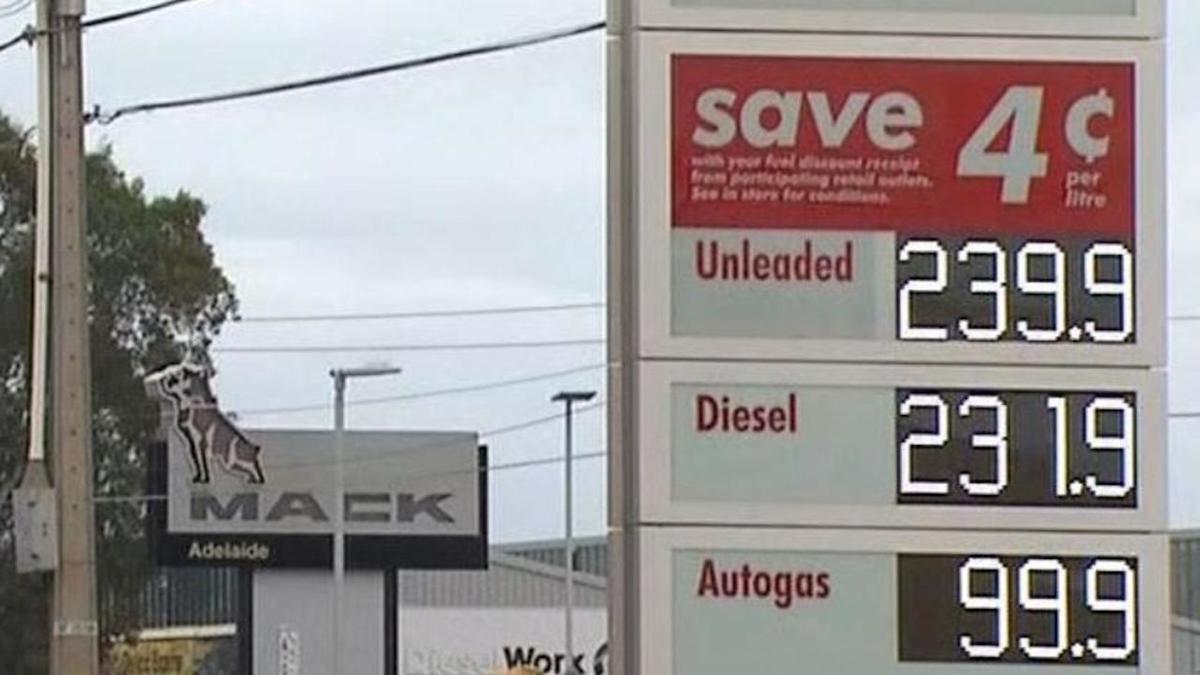
“What we’ve seen in Sydney, Melbourne, Brisbane in particular, we were already at the top of the cycle. They were already charging the peak amount at $2.13 when the wholesale price was $1.53,” he told Sunrise.
“The wholesale price has gone up 10 cents a litre. They’ve put their prices up even further, and they’re refusing to come down. They’re using a crisis to make money, and it’s got to stop.”
 Concerns about impending hikes in petrol prices have already prompted a flurry of buying across Australia. Picture: NewsWire / John Gass
Global oil prices – inflated by the military conflict – typically took seven to 10 days to flush through to Australian petrol prices, Mr Khoury said.
“What we’ve seen is those prices go up when they shouldn’t have, and they went up too quickly,” he said.
“The public are reporting them, and so there is more that they can do. They’ll drop their prices if you put a bit of pressure on them.”
NewsWire has recorded a 58c-per-litre hike from Monday to Thursday at one major retailer in Sydney and approached the company for comment.
The consumer watchdog issued a warning to fuel retailers on Friday.
The Australian Competition and Consumer Commission says it “will not hesitate to take action” against price gouging.
“The international price of refined petrol is a key driver of Australian retail petrol prices,” ACCC commissioner Anna Brakey said.
“While these international costs are largely outside the control of local petrol retailers, we remind retailers that making false or misleading statements to consumers about the reasons of price increases would be in breach of the Australian Consumer Law.”
Treasurer Jim Chalmers says the consumer watchdog has the powers to investigate petrol price changes. Picture: NewsWire /Martin Ollman
The consumer watchdog had written to the fuel retailers telling them not to falsely blame the conflict for price increases, Ms Brakey said.
“The ACCC will not hesitate to take action if representations and market behaviour by a petrol company contravene competition and consumer laws,” she said.
“We have written to major fuel companies to set out our expectations about domestic fuel pricing as these international events unfold.
“At this time, as at any time, we encourage motorists to use fuel price apps and websites to shop around to find the lowest prices.”
On Thursday, federal Treasurer Jim Chalmers said motorists should not be taken for mugs by the fuel companies, as RACQ reports “unwarranted” hikes at the bowser to the consumer watchdog.
Story continues
As the war in Iraq now involves 16 countries, the economic concerns mount for the Australian government, with allegations fuel companies have begun to hike petrol prices seven days into the conflict.
Speaking on Thursday, Mr Chalmers said motorists should not be taken for mugs.
“We don’t want to see people taken for mugs at the bowser,” he told the ABC.
“Service stations should not be doing the wrong thing by their customers, using the conflict in Iran, and the Middle East more broadly, as an excuse to gouge customers.”
Motorists are being taken for mugs, the Treasurer says. Picture: NewsWire / John Gass
As well as Iran and Israel’s closest neighbours, the UK has now been pulled into the conflict after an Iranian drone struck a UK military base in Cyprus, and France has sent antimissile and anti-drone systems to the island.
The widening conflict has moderately pushed up global oil prices and began to spark some pulses of petrol panic buying across Australia.
“The key determinant of the impact on the economy will be the duration of this conflict,” Mr Chalmers said on Thursday.
“This conflict is now bigger and broader. It’s no longer a matter of days, it’s a matter of weeks at least and potentially longer. And so that will have implications for the global economy.
“For our economy, as a consequence, we’re already seeing big movements on oil markets, for example, and European gas markets.”
The Treasurer said some of the domestic petrol price hikes seen this week were part of the usual price cycle, but added the consumer watchdog had the power to monitor the service station companies and fuel retailers.
“We’ve empowered the ACCC to get to the bottom of what’s happening at service stations around the country. Obviously, there are concerning developments on global oil markets but also at local service stations,” he said.
RACQ has reported alleged petrol price gouging in Queensland to the Australian Competition and Consumer Commission.
Royal Automobile Club of Queensland principal economist Ian Jeffreys said hikes in the sunshine state capital were unjustified.
“At the beginning of the week, the highest price we were seeing was $2.13.9 per litre.
“But at the time, that was between 50 to 60 cents above the average wholesale price. And we saw no reason why prices would increase any further,” he told the ABC on Thursday.
“Unfortunately, on Tuesday morning, one of the majors pushed their prices up to $2.19.9-per litre.
“There wasn’t a massive increase in the wholesale price earlier in the week, and this increase was unwarranted in our view.”
In the short term, conflict in the oil-rich region has some overall benefits for the Australian economy. Since the US and Israel began bombing Iran on Saturday, the Australian dollar has risen 1.4 per cent against the Euro.
“AUD/EUR has increased because Australia is a net energy exporter while Europe is a net energy importer,” Commonwealth Bank global analyst Samara Hammoud said.
“Europe, however, is not heavily reliant on oil from the Middle East. Only around 11 per cent of the major European economies’ oil imports are from the region.”
The crucial Strait of Hormuz shipping lane, which about 20 per cent of global oil exports traverse, has been severely limited.
“Energy prices have spiked since the start of the conflict amid concerns over disrupted supply,” Ms Hammoud said.
“Vessel‑tracking data show supertankers diverting toward the Atlantic Basin. The volume of trade through the Strait (of Hormuz) has already dropped sharply from around 5.5 million metric tons to less than 1 million metric tons.
“In addition, LNG flows from the Middle East are effectively offline until both Ras Laffan — the world’s largest export complex — and Hormuz reopen.”